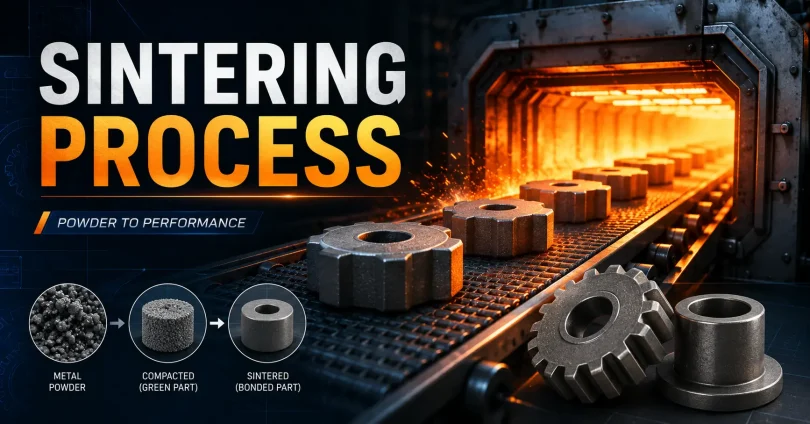

If you have ever wondered how a pile of loose metal dust turns into a solid, precision-machined gear or bushing, the answer is the sintering process. It is the step that gives powder metal parts their strength, and it is arguably the most important stage in the entire powder metallurgy process.
This guide breaks down what sintering is, how the sintering process actually works at a particle level, the stages it goes through, the different types used in industry, and the practical factors that make or break a good sintered part. We will also cover the mistakes and defects that trip up manufacturers, something most articles on this topic skip entirely.
What Is Sintering in Powder Metallurgy?
The sintering process is a heat treatment that fuses compacted metal powder particles together without fully melting them. The compacted powder, known as a “green part,” is heated in a controlled atmosphere to a temperature typically between 70% and 90% of the metal’s melting point.
At this temperature, atoms at the surface of neighboring powder particles start to migrate and diffuse into one another. This forms metallurgical bonds called “necks” between particles. Over time, these necks grow, pores shrink, and the once-fragile compact becomes a dense, strong, dimensionally accurate part.
Think of it like a snowball. Pack loose snow together and it holds a rough shape, but it stays fragile and crumbly. Leave that snowball out in slightly warmer air and the ice crystals bond and fuse at their contact points, forming a harder, more solid mass, all without ever turning fully to liquid. Sintering does the same thing to metal, just with far more precision and control.
Why Sintering in Powder Metallurgy Matters So Much
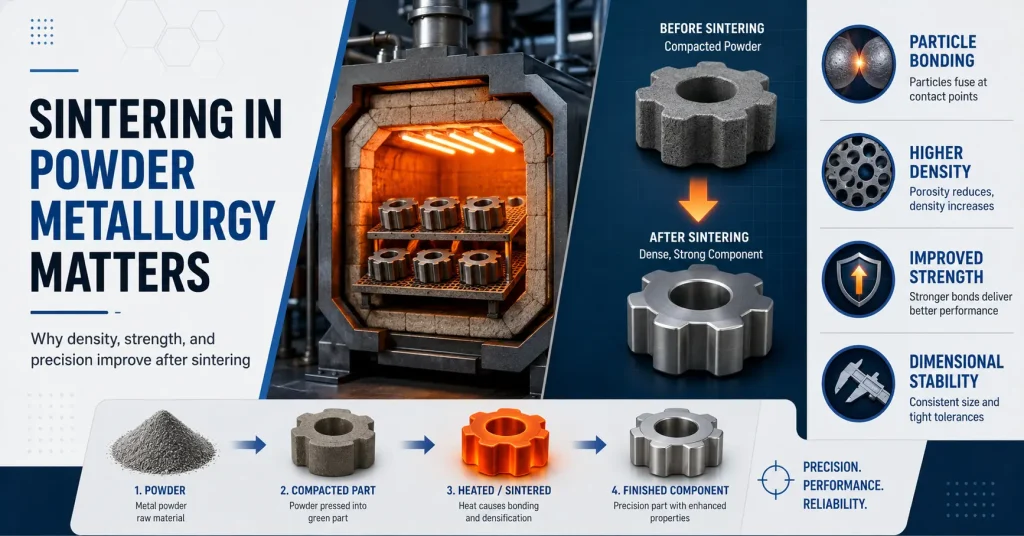
Compaction alone is not enough to make a usable part. A freshly pressed green compact is held together only by mechanical interlocking and light cold welds between particles. It has what engineers call “green strength,” just enough integrity to be handled carefully, but nowhere near enough to survive real-world use.
Sintering is what transforms that fragile compact into a functional component. It:
- Increases tensile strength and hardness
- Reduces porosity and increases density
- Improves fatigue resistance and wear resistance
- Locks in the final microstructure of the material
- Enables tight dimensional tolerances without heavy machining
Without sintering, powder metallurgy parts would simply fall apart under load.
The Three Core Stages of the Sintering Process
Most sintering cycles, regardless of the material, move through three distinct stages inside the furnace.
1. Preheating and Delubrication
Before real bonding can happen, the furnace must remove the lubricants and binders added during compaction. These additives, such as zinc stearate, helped the powder flow and release cleanly from the die, but they will contaminate the bond if left in place.
This stage runs at roughly 300 to 900°C. Heating is gradual and controlled, because burning off lubricant too fast can trap gas inside the part and cause surface blistering or bulging. Manufacturers manage this by adjusting the furnace atmosphere’s flow rate so gases escape cleanly rather than reacting inside the compact.
2. High-Temperature Sintering
This is where the actual bonding happens. The part reaches its peak sintering temperature, generally 70% to 90% of the base metal’s melting point, and holds there for a set period.
Atomic diffusion takes over at this stage. Particles form necks at their contact points, pores begin to close, and the microstructure reorganizes into a denser, more unified mass. For iron-based parts, this typically falls between 1,100°C and 1,300°C, though refractory metals like tungsten and molybdenum need much higher temperatures because their melting points are so extreme.
3. Cooling
The part cannot simply be pulled out of a hot furnace. Controlled cooling locks in the mechanical properties achieved during sintering and prevents distortion, cracking, or unwanted phase changes in the metal.
Cooling rate matters more than most people realize. Cool too fast and you risk residual stress or brittleness. Cool too slowly and you may lose hardness gains, especially in alloys designed for specific heat-treatment responses. Many production lines now use this cooling zone to also perform sinter-hardening, quenching the part fast enough within the furnace itself to skip a separate heat-treat step later.
Types of the Sintering Process: Solid-State vs. Liquid Phase
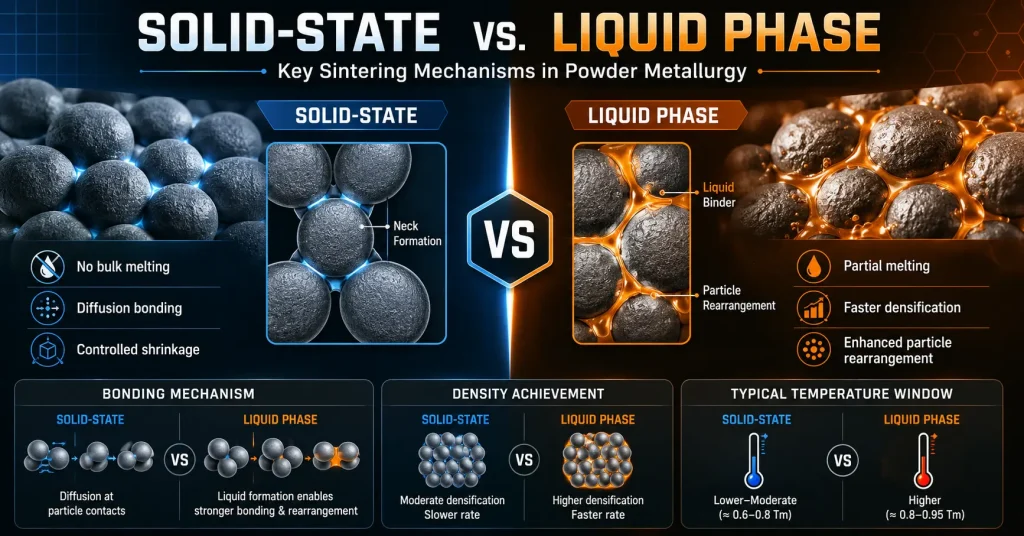
Not all sintering works the same way, and this distinction is one competitors often gloss over.
Solid-state sintering happens entirely below the melting point of every component in the powder mix. Bonding relies purely on atomic diffusion between solid particles. This is common for single-metal systems like pure iron or copper powders.
Liquid-phase sintering introduces a small amount of a lower-melting-point additive, such as copper mixed into iron powder. During the sintering cycle, this additive melts and briefly flows into the pore network, filling gaps and pulling particles closer together through capillary action before the whole system re-solidifies. This produces faster densification and often higher final strength than solid-state sintering alone, which is why it is widely used in structural PM parts like connecting rods and gears.
Sintering Process Atmospheres: Why the Air in the Furnace Matters
One detail many guides skip: the atmosphere inside the sintering furnace is just as important as the temperature.
Exposed to normal air, hot metal powder oxidizes instantly, which ruins the bonding process and weakens the part. To prevent this, manufacturers sinter inside a controlled atmosphere, commonly one of the following:
- Endothermic or exothermic gas (nitrogen, hydrogen, carbon monoxide blends), used for general ferrous PM parts
- Pure hydrogen, used where strong reduction of surface oxides is needed
- Nitrogen-based atmospheres, popular for cost-efficiency and safety in modern furnaces
- Vacuum sintering, used for high-performance alloys, stainless steels, and materials sensitive to any residual gas contamination
The right atmosphere protects the part from oxidation, helps burn off lubricant cleanly, and in some cases actively participates in the metallurgical reaction, such as carbon transfer in carbon-controlled sintering.
Common Sintering Process Defects and How Manufacturers Prevent Them
This is the part most competitor content leaves out entirely, yet it is exactly what engineers and buyers actually want to know.
| Defect | Common Cause | How It’s Prevented |
|---|---|---|
| Surface blistering or bulging | Lubricant burning off too fast, trapping gas | Slower, controlled delubrication ramp |
| Excessive shrinkage or distortion | Uneven heating or incorrect cooling rate | Zoned furnace temperature control |
| Poor bonding or low strength | Insufficient sintering time or temperature | Precise time-temperature profiling |
| Oxidation on the surface | Contaminated or incorrect atmosphere | Verified gas purity and flow monitoring |
| Cracking | Cooling too quickly after sintering | Gradual, staged cooling zones |
Understanding these failure points is useful even if you are not the one running the furnace. If you are sourcing sintered parts from a supplier, asking how they control these variables tells you a lot about their process maturity.
Factors That Influence Sintering Process Results
Several variables interact to determine the final quality of a sintered part:
- Particle size and shape: Finer powders sinter faster because they have more surface area for diffusion, but they can be harder to compact evenly.
- Green density: A denser starting compact generally leads to less shrinkage and better final properties.
- Sintering temperature and time: Higher temperatures and longer hold times increase density, but push costs up and risk grain growth.
- Atmosphere composition: Controls oxidation, lubricant removal, and in some processes, alloying reactions.
- Heating and cooling rates: Affect internal stress, distortion, and final microstructure.
Manufacturers balance all five factors together. Changing one, such as pushing temperature higher to save time, almost always affects at least one other, like grain size or dimensional stability.
The Sintering Process vs. Other Metal-Forming Methods
It helps to see how sintering stacks up against alternatives:
- Sintering vs. casting: Casting melts metal fully and pours it into a mold, while sintering never reaches full melting. Sintering typically offers tighter tolerances and less material waste, but casting can produce larger, more complex shapes in a single pour.
- Sintering vs. machining: Machining removes material from a solid block, often wasting 40 to 50% of the raw stock. Powder metallurgy with sintering typically wastes under 5%, making it far more material-efficient for high-volume parts.
- Sintering vs. forging: Forging shapes metal through mechanical force while it is hot but solid. It generally produces stronger parts for extreme loads, but sintering wins on complex geometries and cost at scale.
Where Sintered Powder Metal Parts Are Used
Sintering is not a niche process. It is behind components you likely interact with daily:
- Automotive gears, bushings, and connecting rods
- Self-lubricating bearings for appliances and motors
- Cutting tools made from tungsten carbide
- Medical implants requiring precise, porous structures
- Electrical contacts and magnetic components
- Firearms components requiring tight tolerances
The reason sintering shows up across so many industries comes down to its combination of low material waste, high dimensional accuracy, and the ability to create shapes that would be difficult or expensive to machine from solid stock.
The Sustainability Angle: An Often-Overlooked Benefit
One point rarely discussed in competitor content is how sintering supports more sustainable manufacturing. Because powder metallurgy starts from a near-net shape, it generates a fraction of the scrap that machining produces. Off-spec powder and trim scrap can often be reclaimed and reused in future batches, something that is far harder to do with cast or forged metal offcuts. For manufacturers under pressure to cut waste and energy use, sintering offers a genuine efficiency advantage, not just a technical one.
Frequently Asked Questions
Is sintering the same as melting?
No. Sintering heats powder below its melting point so particles bond through diffusion rather than liquefying completely.
How long does sintering take?
It varies by material and part size, but most industrial sintering cycles run from 20 minutes to a few hours inside the furnace, including preheating and cooling zones.
Can sintered parts be as strong as forged parts?
For many applications, yes, especially with liquid-phase sintering or sinter-hardening. For extreme load-bearing applications, forged parts still tend to have an edge.
What metals can be sintered?
Iron, steel, copper, bronze, stainless steel, aluminum, tungsten, and molybdenum are among the most commonly sintered metals in industrial powder metallurgy.
Final Thoughts
Sintering is what turns a fragile pressed powder compact into a strong, reliable, ready-to-use metal part. Understanding its stages, the role of atmosphere, and the factors that influence quality is useful whether you are an engineer specifying a component, a buyer evaluating a supplier, or simply curious about how everyday metal parts are made.
The details matter here. Small changes in temperature, atmosphere, or cooling rate can be the difference between a part that performs for years and one that fails early. That is exactly why experienced powder metallurgy suppliers treat sintering not as a single step, but as a carefully engineered process from start to finish.
You May Also Like It:
CNC Machining Tolerances: The Complete Expert Guide
Prototype CNC Machining: The Complete Expert Guide
Steel Grade: The Complete Guide to Understanding Every Type of Steel