
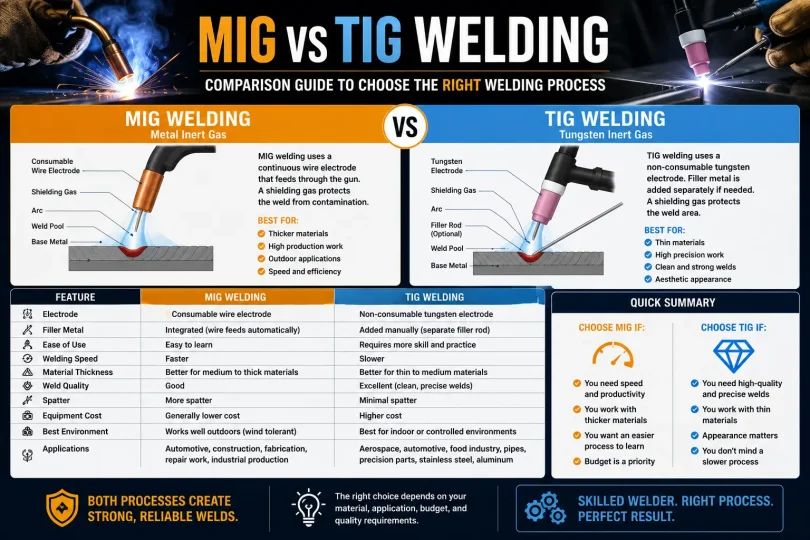

MIG (Metal Inert Gas) welding, formally called GMAW, pushes a consumable wire through the gun at a steady speed, so it welds faster, is easier to learn and handles thick steel and production runs well. TIG (Tungsten Inert Gas) welding, formally GTAW, strikes the arc with a non-consumable tungsten electrode while you feed a filler rod by hand, so it is slower but gives tighter heat control, cleaner welds and better results on thin metal, aluminum and stainless steel. Choose MIG for speed and simplicity, and TIG when precision and finish matter most.
Which Process Fits Your Job?
Start with the work in front of you, not the theory. These are the matches that hold up in real shops.
- Structural steel, trailers and frames: MIG. Long runs on 1/8 inch and thicker steel reward fast wire feed.
- Auto body panels: MIG with short-circuit transfer and stitch-weld patterns to keep heat low and panels flat.
- Exhaust, roll cages and chromoly tube: TIG. Thin-wall tube needs fit-up control and welds you can inspect.
- Aluminum frames, boats and enclosures: TIG for thin sections. Pulsed MIG with a spool gun for thicker aluminum and volume work.
- Stainless food, dairy and pharma pipe: TIG with argon back purge, often automated as orbital TIG.
- Outdoor farm and site repairs: flux-cored or stick, not either gas-shielded process.
- Sculpture and visible furniture: TIG, because the bead is part of the design.
- Production lines and robotic cells: MIG.
If your work mixes both kinds of jobs, buy for the jobs that pay the bills first.
What Actually Changes Between the Two Processes
Skip the textbook list. These are the differences that change results at the bench.
Heat Control and Distortion
With MIG, heat is set by voltage and wire feed speed before you pull the trigger. Once the arc is running you steer with travel speed and gun angle, but you cannot change amperage mid-weld.
With TIG, a foot pedal or torch-mounted control lets you ramp amperage up and down as the puddle reacts. That is why thin or heat-sensitive parts survive TIG. Lower, more focused heat input also means a narrower heat-affected zone and less warping.
For a first guess on either process, use about 1 amp per 0.001 inch of metal thickness. A 1/8 inch (0.125) plate starts near 125 amps. Treat it as a starting point, then adjust on scrap. Both processes can join thin sheet, but TIG leaves more margin before burn-through.
Shielding Gas by Metal
- Mild steel with MIG: 75% argon and 25% CO2 is the all-round choice. Straight CO2 digs deeper but throws more spatter.
- Stainless with MIG: an argon-rich tri-mix, or 98% argon and 2% CO2, with stainless wire.
- Aluminum with MIG: 100% argon.
- Any metal with TIG: 100% argon. Argon-helium blends add heat for thick aluminum and copper.
- Drafts: a light breeze, roughly 5 mph, can scatter gas coverage and cause porosity in either process. TIG runs a lower flow, so it is the more fragile of the two. Screen the work even indoors.
Current Type and Arc Cleaning
MIG runs on DC with the electrode positive. TIG on steel, stainless and titanium runs DC with the electrode negative. On aluminum you switch to AC.
The reason is oxide. Aluminum oxide melts near 3,700°F (2,070°C), while the metal beneath melts near 1,220°F (660°C). The positive half of the AC cycle breaks that skin up. Most AC TIG machines let you shift the balance toward more cleaning or more penetration.
Strength and Defect Risk
Done correctly, both processes produce welds as strong as the base metal. The real difference is defect risk.
MIG in short-circuit mode on thick sections can leave lack of fusion hidden at the root. TIG’s slower travel and visible puddle make that less likely. TIG earns its strength reputation partly because it gets chosen, and inspected, for critical work.
On code work, a qualified welder following a written welding procedure specification (WPS) matters more than the process name.
Spatter and Finishing
MIG throws spatter. Anti-spatter spray, the right gas and a tuned arc cut it down, but expect some grinding before paint. TIG produces almost none.
One catch applies to both on stainless: the blue or straw heat tint beside the weld lowers corrosion resistance. Remove it by pickling or passivation when the part will face moisture, food or chemicals.
MIG vs TIG Welding at a Glance
| Spec | MIG (GMAW) | TIG (GTAW) |
|---|---|---|
| ISO 4063 process number | 131 (inert gas), 135 (active gas) | 141 |
| Electrode | Consumable solid or metal-cored wire | Non-consumable tungsten, lanthanated or ceriated are common |
| Typical steel filler | ER70S-6 wire (AWS A5.18) | ER70S-2 or ER70S-6 rod (AWS A5.18) |
| Typical gas flow | 20 to 35 CFH | 10 to 25 CFH |
| Current | DC electrode positive | DC electrode negative, AC for aluminum |
| Operator controls | One hand on the gun | Two hands plus foot pedal or torch control |
| Thickness window | About 24 gauge (0.6 mm) to heavy plate in multiple passes | Foil-thin with pulse, efficient up to about 1/4 inch (6 mm) |
| Outdoor tolerance | Poor with gas, good with self-shielded flux-cored wire | Poor |
| Automation | Dominant in robotic cells | Orbital TIG for pipe and tube |
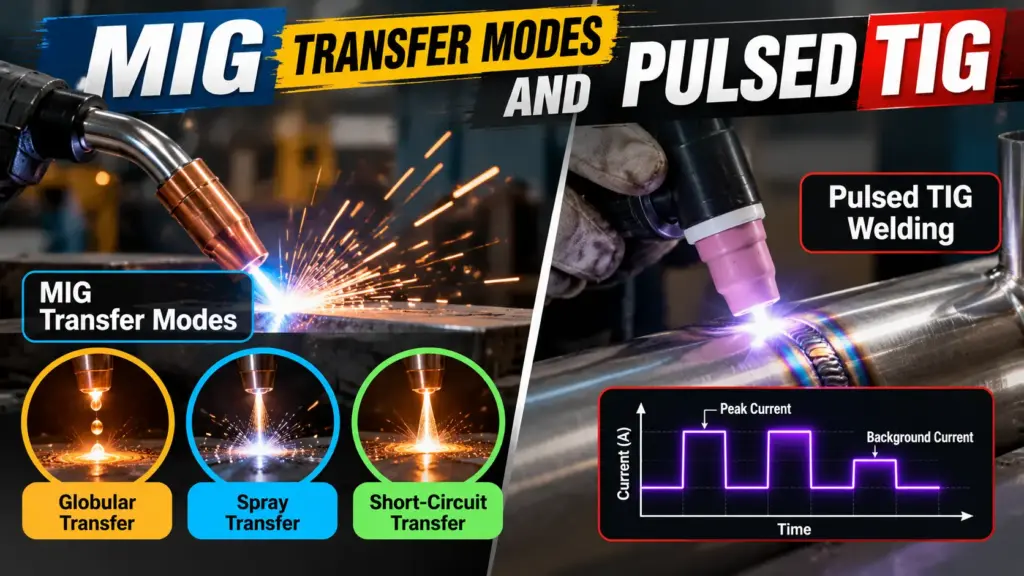
MIG Transfer Modes and Pulsed TIG
These settings explain why two MIG welders can get very different results from the same machine.
- Short-circuit transfer: low heat, the wire touches the puddle many times a second. Good for thin sheet and out-of-position welds.
- Spray transfer: a smooth stream of droplets, high heat and deep penetration. It needs an argon-rich gas and suits flat and horizontal welds on thicker material.
- Pulsed MIG: the machine alternates high and low current. You get spray-like quality with lower average heat, which helps on aluminum and thinner stock.
- Pulsed TIG: the current cycles between peak and background. The puddle freezes slightly between peaks, which controls heat on thin stainless and gives that stacked-dime pattern.
Flux-Cored and Stick: The Third Option
Often the real choice is not MIG versus TIG at all.
- Flux-cored (FCAW): a MIG-style machine with tubular wire. Self-shielded wire needs no gas, so it handles wind, rust and thick steel outdoors. It produces more spatter and slag.
- Stick (SMAW): the cheapest, most forgiving process on dirty or painted metal, and it runs without a gas bottle. It is slower and less refined on thin sheet.
What MIG and TIG Really Cost
These are approximate US prices for new machines in 2026. They vary by brand, region and duty cycle.
| Machine | Typical new price |
|---|---|
| Hobby MIG, 120V | $300 to $900 |
| Shop MIG, 240V | $700 to $1,800 |
| DC-only TIG | $500 to $1,800 |
| AC/DC TIG, aluminum capable | $1,000 to $3,500 |
| Industrial AC/DC TIG, water-cooled | $3,500 to $6,000 and up |
| Multi-process (MIG, TIG, stick) | $600 to $2,500 |
The machine is only part of the bill:
- Gas: cylinder purchase or rental plus refills. TIG runs a lower flow, but the same seam keeps the arc on much longer.
- Consumables: MIG contact tips, nozzles, liners and wire. TIG tungstens, collets, cups and filler rod.
- Add-ons: a spool gun for MIG aluminum, a foot pedal for TIG, and a water cooler for sustained high amperage.
- Protection: helmet, jacket, gloves, and fume extraction or a respirator.
Speed and Labour Cost
Here is an illustrative example. Assume a $75 per hour shop rate and a 100 foot seam.
If MIG averages 1 minute per foot including tacking and cleanup, the job takes about 1.7 hours, roughly $125. If TIG averages 3 minutes per foot, it takes 5 hours, roughly $375. Your own ratios will differ, but the pattern explains why TIG is reserved for jobs where the finish or the metal justifies the time.
Step-by-Step: Running Your First Bead
MIG Setup and Technique
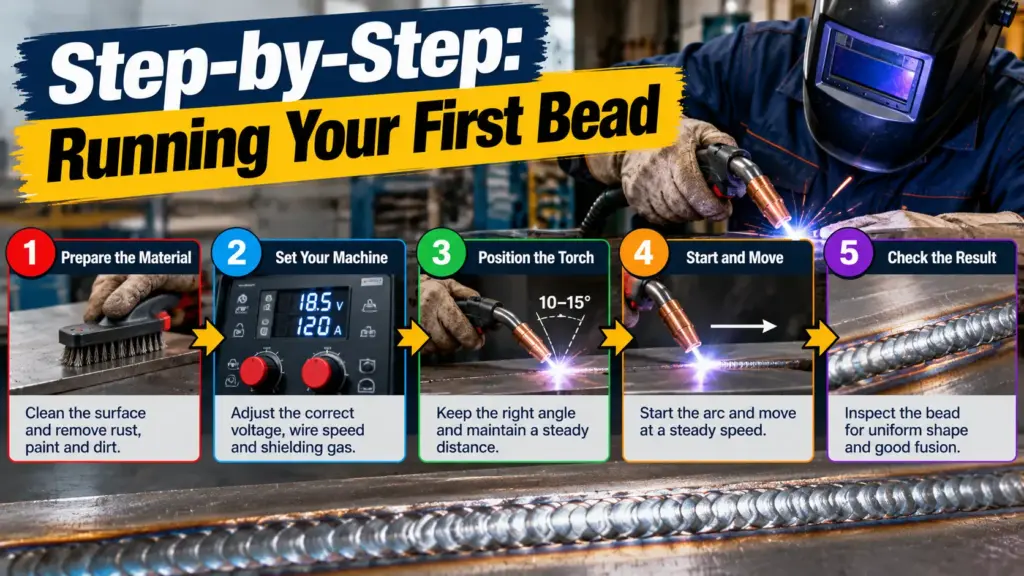
- Clean the joint to bright metal. Remove rust, paint, oil and mill scale.
- Match wire and gas to the metal. For mild steel, 0.030 inch (0.8 mm) ER70S-6 wire with 75/25 gas is a common start.
- Set voltage and wire feed speed from the chart inside the machine door, then fine-tune on scrap.
- Hold about 3/8 inch (10 mm) of wire stick-out with the gun angled 5 to 15 degrees.
- Listen to the arc. A steady crackle like frying bacon means the settings are close. Popping and spitting means they are not.
- Check the weld toes. The bead should wet into the base metal on both sides, not sit on top of it.
TIG Setup and Technique
- Clean to bare, shiny metal. Use a stainless brush kept only for stainless, and wipe with acetone. Dedicate a brush to aluminum.
- Grind the tungsten lengthwise to a point for DC. On modern inverter machines, a truncated or lightly pointed tip also works for AC.
- Set argon to roughly 15 to 20 CFH and amperage from the thickness guide above.
- Start the arc with high frequency or lift start, then hold an arc length close to the tungsten diameter.
- Form the puddle, then dip the filler rod into its leading edge and pull it back out of the arc.
- Taper amperage with the pedal at the end of the weld to avoid a crater.
- Keep the torch over the weld during post-flow so the hot tungsten and puddle cool under argon.
Mistakes That Cause Most Failed Welds
- Cold lap: the bead sits on the plate without fusing, common with short-circuit MIG on thick metal. Raise heat or change the transfer mode.
- Porosity: pin holes from drafts, dirty metal, empty gas or a blocked nozzle. Fix the cause, then reweld.
- Travel speed drift: too fast gives a narrow, ropey bead. Too slow piles up metal and overheats thin sheet.
- Contaminated tungsten: touching the puddle or filler rod forces a regrind. Welding on a dirty tungsten wanders the arc and fouls the weld.
- Sugaring: a rough, crystalline underside on stainless with no back purge. Purge tubing and pipe with argon.
- Wrong gas: using a CO2 mix on TIG or pure argon on mild steel MIG causes poor arc behaviour and weak fusion.
Safety Checklist
- Helmet: auto-darkening, shade 10 to 13 depending on amperage. For low-amp TIG, check the lens minimum amperage rating, since cheap lenses can fail to trigger.
- Skin cover: TIG arcs emit strong UV, so wear long sleeves and cover your neck.
- Fume control: use extraction or ventilation. Welding stainless produces hexavalent chromium, and galvanized steel releases zinc fume.
- Tungsten grinding: use a dedicated wheel with dust extraction. Thoriated tungsten is mildly radioactive, which is why many shops switched to lanthanated or ceriated.
- Cylinders: chain them upright and cap them during transport.
- Fire: clear flammables and keep a fire watch after welding.
For workplace rules in the US, see OSHA 29 CFR 1910 Subpart Q on welding, cutting and brazing.
A Practical Learning Path
I tell beginners to start with MIG. Spend the first few weeks laying flat and horizontal beads on 1/8 inch plate, then move to vertical-up. Once you can read the sound and the puddle, TIG becomes far less frustrating.
TIG usually takes months of regular practice before you produce consistent welds on thin stainless. The foot, both hands and the puddle all have to cooperate.
Professionals also combine processes. On critical pipe, a TIG root pass gives clean, full fusion, and the fill and cap passes use stick, flux-cored or MIG as the WPS allows.
Sources and Further Reading
- American Welding Society (aws.org): filler metal specification A5.18 and structural welding code D1.1.
- OSHA (osha.gov): welding, cutting and brazing safety rules.
- ISO 4063 (iso.org): welding process numbering.
- Related guides: Welding Tools: Essential Tools Every Welder Needs, Welding Training: What It Takes to Become a Welder and Metal Fabrication Welding: A Practical Guide.
FAQ
Why is it called MIG if the gas often contains CO2?
CO2 is an active gas, not an inert one. Strictly, a mix with CO2 is MAG welding, as ISO 4063 number 135 shows. Most people still say MIG, and GMAW covers both.
Can I TIG weld without filler metal?
Yes. Welding without filler is called autogenous welding. It works on thin material with tight, clean fit-up, such as some stainless tube and edge joints.
Do I need a foot pedal for TIG?
Not always. Many machines offer a torch-mounted fingertip control or a slider. A pedal gives the smoothest control on varying heat, but fixed-amperage jobs work fine without one.
Can one machine do both MIG and TIG?
Yes. Multi-process machines handle MIG, TIG and stick. The TIG side is often DC only, so check for AC if you plan to weld aluminum.
How thick can a 120V MIG welder handle?
Most 120V machines weld clean in a single pass up to roughly 3/16 inch (5 mm), depending on the model and duty cycle. Beyond that, use multiple passes or a 240V unit.
Is TIG or MIG better for welding thin stainless steel?
TIG, especially pulsed TIG with argon back purge, controls heat best and limits warping. MIG can work in short-circuit mode on thicker gauges if you accept extra finishing.
Can TIG weld thick metal?
Yes, using multiple passes, often with argon-helium gas for extra heat. It is slow, so shops use TIG on thick pipe mainly for the root pass and switch to a faster process for the fill.
You May Also Like It:
CNC Machining Tolerances: The Complete Expert Guide



[…] MIG vs TIG Welding: Complete Guide to Differences and Procedures […]
[…] machine (MIG, TIG or stick, depending on your […]