
The global oil and gas industry is one of the most powerful and complex sectors in the world economy. It fuels transportation, powers industries, heats homes, and shapes international politics. But without strong oversight, it can also cause environmental disasters, create unfair markets, and harm consumers. That is where an oil and gas regulatory authority comes in.
Whether you are an energy professional, an investor, a student, or simply someone trying to understand how fuel prices are set and who keeps energy companies in check this guide covers everything you need to know about oil and gas regulatory authorities: what they are, what they do, how they are structured in the United States and around the world, and why strong regulation matters for everyone.
What Is an Oil and Gas Regulatory Authority?
An oil and gas regulatory authority is a government body either independent or semi-independent that oversees the exploration, production, transportation, distribution, and sale of oil, natural gas, and related petroleum products. These authorities exist to ensure that energy companies operate safely, compete fairly, follow environmental standards, and do not overcharge consumers.
At their core, oil and gas regulatory authorities serve three main groups: the government, which relies on them to implement energy policy; the industry, which needs clear and consistent rules to operate and invest; and the public, which depends on them for safe, affordable, and reliable energy.
Why Do Oil and Gas Regulatory Authorities Exist?
The oil and gas industry operates massive infrastructure pipelines, refineries, terminals, offshore platforms that affects millions of people and can cause catastrophic harm if poorly managed. Left entirely to market forces, energy companies may exploit monopoly power, cut corners on safety, damage the environment, or manipulate prices.
Regulatory authorities solve these problems by setting rules, issuing licenses, enforcing compliance, determining fair prices, and protecting consumers. Without them, there would be no accountability in one of the world’s most consequential industries.
How Oil and Gas Regulation Is Structured: The Three-Level Model
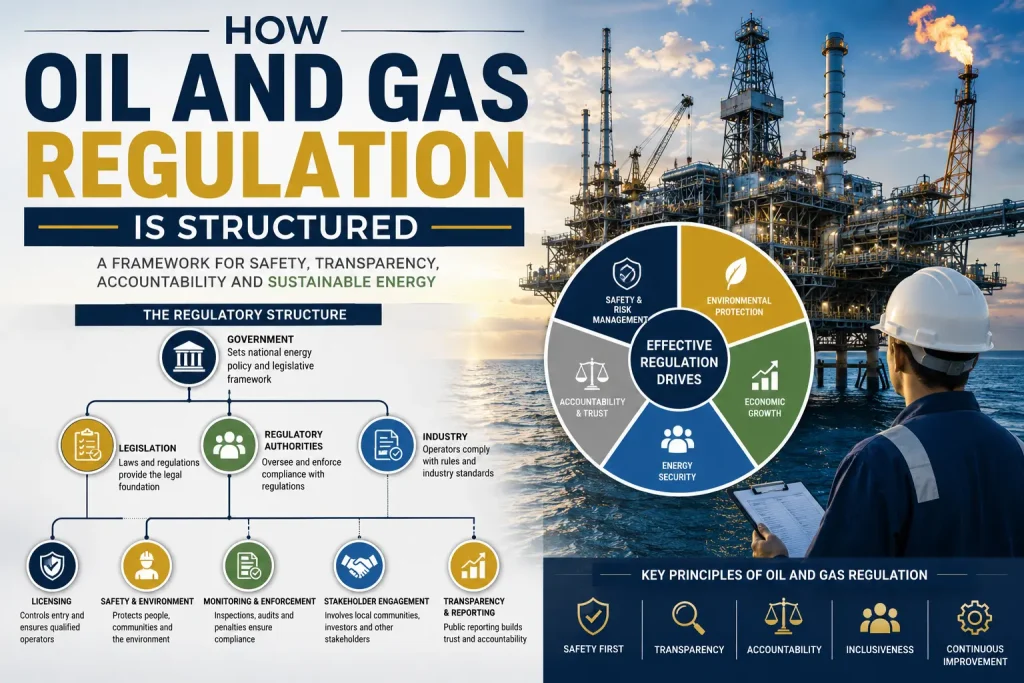
Across the world, oil and gas regulation typically follows a three-level structure: upstream, midstream, and downstream. Understanding this division is essential to understanding what any regulatory authority actually does.
Upstream Regulation
Upstream activities include the exploration, drilling, and production of oil and natural gas. Regulators at this level manage exploration licenses, drilling permits, royalties, and environmental compliance at production sites. This is where questions like “Who can drill, and where?” are answered.
Midstream Regulation
Midstream activities cover the transportation and storage of oil and gas primarily through pipelines. Regulators here set pipeline rates, ensure open access, and approve new pipeline construction. This is where questions like “How is oil transported, and at what cost?” are addressed.
Downstream Regulation
Downstream activities involve the refining, distribution, and retail sale of petroleum products to end consumers. Regulators here focus on fuel quality standards, retail pricing, licensing of distributors, and consumer protection. This is where questions like “Who controls fuel prices at the gas station?” are answered.
Different regulatory agencies may handle one, two, or all three levels, depending on the country and its regulatory framework.
Oil and Gas Regulatory Authorities in the United States
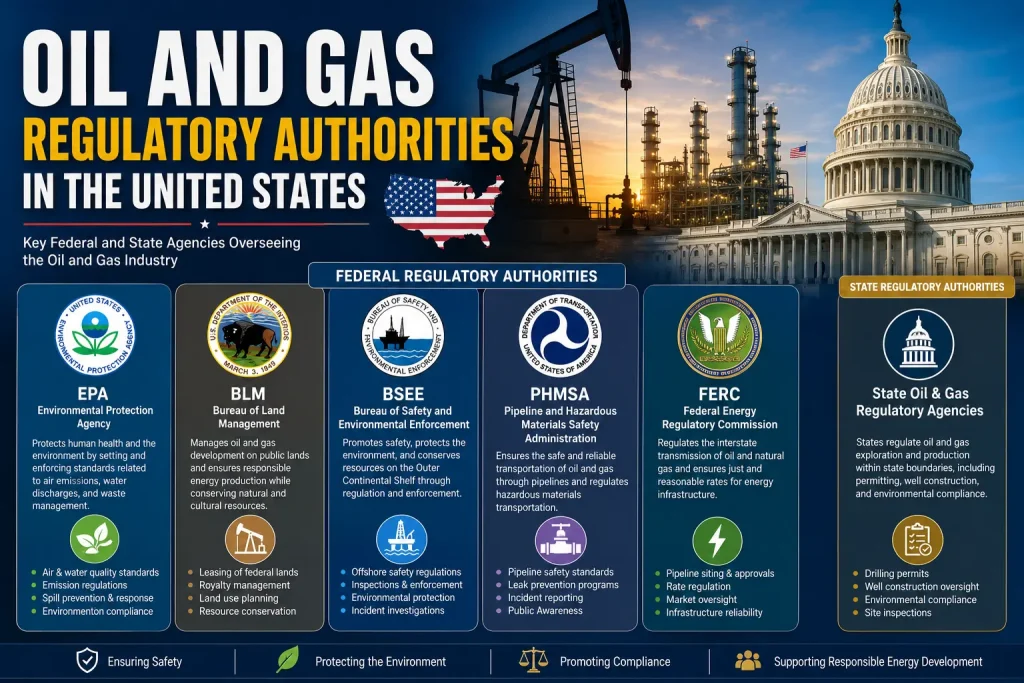
The United States has one of the most complex oil and gas regulatory systems in the world. Rather than a single unified authority, the U.S. uses a multi-agency framework with federal agencies handling national and interstate matters, and state agencies handling in-state operations.
The Federal Regulatory Framework
At the federal level, several major agencies share responsibility for regulating different aspects of the oil and gas industry.
Federal Energy Regulatory Commission (FERC)
FERC is the primary federal body that regulates oil and gas companies at the national level. It is an independent agency housed within the U.S. Department of Energy, though it operates independently from the Secretary of Energy.
FERC’s core responsibilities include regulating the interstate transmission of natural gas, oil, and electricity; reviewing and approving the construction of LNG (liquefied natural gas) terminals and interstate natural gas pipelines; setting rates and terms of service for interstate pipeline companies; regulating the transportation of oil by interstate pipelines under the Interstate Commerce Act; and overseeing environmental matters related to natural gas and hydropower projects.
FERC is composed of five commissioners, each appointed by the President with the advice and consent of the Senate. Commissioners serve staggered five-year terms, and no more than three commissioners can be from the same political party. One commissioner is designated as Chairman and serves as FERC’s administrative head.
FERC is self-funding it raises revenue through annual charges to the natural gas, oil, and electric industries it regulates, reimbursing the U.S. Treasury for its budget appropriations.
Bureau of Land Management (BLM)
The Bureau of Land Management, part of the U.S. Department of the Interior, regulates oil and gas development on federal onshore lands. The federal government owns more than 700,000 acres of mineral-rich land, and BLM leases portions of this acreage to private oil and gas companies for development.
BLM reviews and approves permits for exploration and development, enforces regulatory compliance, and manages royalty payments from production on federal land. The minimum royalty rate on BLM leases is 16.67% of the market value of production.
Bureau of Ocean Energy Management (BOEM)
BOEM manages offshore oil and gas development on the U.S. Outer Continental Shelf (OCS) the seafloor beyond state coastal waters. The OCS covers 1.76 billion acres of seafloor and may hold as much as 90 billion barrels of technically recoverable undiscovered oil and 327 trillion cubic feet of natural gas.
BOEM issues leases, easements, and rights-of-way for offshore energy exploration and development, covering four major regions: the Gulf of Mexico, Alaska, the Atlantic, and the Pacific.
Bureau of Safety and Environmental Enforcement (BSEE)
BSEE is the U.S. government’s lead offshore safety regulator. Established in 2011 following the Deepwater Horizon disaster, BSEE enforces safety and environmental regulations on offshore oil and gas operations. It inspects offshore platforms, enforces the Well Control Rule, and investigates incidents and spills.
BSEE’s mandate is clear: protect workers, protect the environment, and ensure the maximum responsible recovery of America’s offshore energy resources.
Environmental Protection Agency (EPA)
The EPA does not regulate oil and gas business operations directly but plays a critical oversight role through environmental law. The EPA enforces air quality standards, regulates methane and volatile organic compound (VOC) emissions from oil and gas facilities, oversees water quality near drilling operations, and responds to major oil spills under the Oil Pollution Act (OPA).
In recent years, the EPA’s methane regulations have been a major point of political debate. The Biden administration significantly tightened methane emissions rules for the oil and gas sector between 2022 and 2024. Under the Trump administration, several of these rules have been rolled back or delayed as part of a broader push to reduce regulatory burdens on domestic energy production.
Pipeline and Hazardous Materials Safety Administration (PHMSA)
PHMSA, part of the U.S. Department of Transportation, is responsible for the safety of pipelines that transport oil, natural gas, and other hazardous materials. PHMSA sets pipeline safety regulations, conducts inspections, and investigates pipeline incidents. It maintains data on pipeline incidents across the country and researches ways to improve pipeline safety.
Securities and Exchange Commission (SEC)
The SEC plays an important but often overlooked role in oil and gas regulation by ensuring financial and organizational compliance of publicly traded energy companies. Oil and gas companies listed on U.S. stock exchanges must comply with SEC disclosure requirements regarding their reserves, financial performance, and risk factors giving investors the information they need to make informed decisions.
State-Level Oil and Gas Regulatory Authorities
In the United States, states have significant authority to regulate oil and gas development within their borders. State agencies issue drilling permits, regulate well spacing and density, control intrastate pipeline transportation, enforce environmental and safety rules not covered by federal agencies, and collect royalties from production on state-owned lands.
Texas Railroad Commission
Despite its name, the Texas Railroad Commission is the primary oil and gas regulator in Texas the largest oil-producing state in the country. It regulates exploration, production, transportation, and safety for all oil and gas operations within Texas. The Texas Railroad Commission is one of the oldest energy regulatory bodies in the world, dating back to 1891.
California Division of Oil, Gas, and Geothermal Resources (DOGGR)
California’s DOGGR regulates oil, gas, and geothermal drilling and production within the state. California has some of the most stringent environmental standards in the country, often exceeding federal requirements.
Other Key State Agencies
Other major oil-producing states including Alaska, Louisiana, North Dakota, Colorado, and Oklahoma each have their own regulatory agencies. States in colder climates may require special fuel additives during winter months, and each state manages the royalty and taxation framework for state-owned mineral lands.
Oil and Gas Regulatory Authorities Around the World
While the U.S. system is multi-agency and decentralized, many other countries operate through single national regulatory authorities. Understanding global regulatory models is increasingly important for international investors, energy companies, and policy professionals.
United Kingdom: North Sea Transition Authority (NSTA)
Formerly known as the Oil and Gas Authority (OGA), the North Sea Transition Authority regulates oil and gas exploration and production in the UK. Its mandate has expanded to include overseeing the energy sector’s transition to net zero, making it one of the few regulatory authorities with a formal climate transition mandate built into its mission.
Canada: Canada Energy Regulator (CER)
The Canada Energy Regulator regulates interprovincial and international pipelines, power lines, and energy trade in Canada. Individual provinces regulate upstream oil and gas production. Alberta, home to Canada’s oil sands, operates the Alberta Energy Regulator (AER), which handles upstream regulation within the province.
Norway: Norwegian Petroleum Directorate (NPD) and Petroleum Safety Authority (PSA)
Norway separates resource management from safety regulation. The Norwegian Petroleum Directorate manages petroleum resources and data, while the Petroleum Safety Authority Norway regulates health, safety, and the environment on the Norwegian continental shelf. Norway is widely regarded as a global model for transparent and effective petroleum governance.
Saudi Arabia: Ministry of Energy and Saudi Aramco Oversight
In Saudi Arabia, the Ministry of Energy sets national petroleum policy and oversees Saudi Aramco the world’s largest oil company. Saudi Arabia does not have an independent regulatory authority in the Western sense; regulation is closely integrated with national energy strategy and the government’s majority ownership of Saudi Aramco.
Australia: National Offshore Petroleum Safety and Environmental Management Authority (NOPSEMA)
NOPSEMA regulates the safety, well integrity, and environmental management of offshore oil and gas operations in Australian waters. Australia also has state-level authorities for onshore regulation, creating a federal-state split similar in structure (though not in detail) to the U.S. system.
India: Petroleum and Natural Gas Regulatory Board (PNGRB)
India’s PNGRB regulates the midstream and downstream natural gas pipeline infrastructure and LNG terminals. The Directorate General of Hydrocarbons (DGH) oversees upstream exploration and production policy. India’s regulatory system is evolving rapidly as the country seeks to expand its natural gas infrastructure and reduce dependence on oil imports.
Core Functions of an Oil and Gas Regulatory Authority
Regardless of which country or which specific agency, oil and gas regulatory authorities typically perform a common set of core functions.
Licensing and Permitting
Regulatory authorities issue licenses and permits that legally authorize companies to explore, drill, produce, transport, store, or sell oil and gas. Without a valid license, no company can legally operate in the regulated sector. Licensing ensures that only qualified, financially sound, and safety-compliant operators enter the market.
Tariff and Price Regulation
In sectors where competition is limited such as natural gas pipelines, which are natural monopolies regulators set the rates that companies can charge. FERC, for example, sets the rates that interstate pipeline companies can charge for transporting natural gas. Without this oversight, pipeline owners could extract excessive fees from captive customers.
Safety Standards and Enforcement
Regulatory authorities develop technical safety standards and have the power to inspect operations, identify violations, and impose penalties. In the offshore sector, BSEE’s enforcement activities directly prevent blowouts, spills, and worker fatalities. Safety regulation is where the stakes of poor oversight are most visibly catastrophic as the Deepwater Horizon disaster of 2010 demonstrated.
Environmental Compliance
Modern regulatory authorities are deeply involved in environmental oversight. This includes regulating emissions of methane and other greenhouse gases, monitoring water quality near drilling and pipeline operations, requiring environmental impact assessments for new projects, and enforcing cleanup obligations after spills or leaks.
Market Competition and Anti-Monopoly Oversight
Regulators ensure that dominant players in the oil and gas sector particularly pipeline operators do not abuse their market position. FERC, for example, requires interstate pipeline companies to provide open, non-discriminatory access to all shippers, preventing pipeline owners from favoring their own affiliated companies.
Dispute Resolution
When disputes arise between energy companies, between a company and consumers, or between pipeline operators and shippers, regulatory authorities provide an official forum for resolution faster and often cheaper than traditional court proceedings.
Data Collection and Transparency
Regulatory agencies collect and publish critical industry data production volumes, reserve estimates, pipeline capacity, price information, and emissions data. This transparency supports market efficiency, public accountability, and informed policymaking.
Why Strong Oil and Gas Regulation Matters
Protecting Consumers
Without regulatory oversight, energy companies with monopoly or near-monopoly power could charge whatever they want. Regulators set fair rates, ensure competitive market structures, and create mechanisms for consumers to file complaints and seek redress.
Protecting the Environment
Oil and gas extraction, transportation, and combustion all carry environmental risks from methane leaks to pipeline spills to offshore blowouts. Regulatory authorities set the environmental standards that minimize these risks and hold companies accountable when they cause harm.
Ensuring Energy Security
Regulatory authorities play a role in ensuring that energy supply chains are reliable. They approve new infrastructure, monitor supply positions, require companies to maintain minimum inventory levels, and oversee emergency response plans. Energy security having enough fuel when and where it is needed depends significantly on effective regulation.
Attracting Investment
Paradoxically, strong and predictable regulation actually attracts investment to the energy sector. Investors and developers need certainty. Clear licensing rules, consistent enforcement, and transparent pricing frameworks make it easier and safer to commit long-term capital to oil and gas projects. Countries with weak or unpredictable regulation often struggle to attract the investment needed to develop their energy resources.
Supporting the Energy Transition
Modern oil and gas regulatory authorities are increasingly grappling with the energy transition. As the world moves toward lower-carbon energy sources, regulators must manage the declining but still essential role of fossil fuels while creating space for new technologies. The UK’s NSTA formerly the Oil and Gas Authority is a leading example of a regulator explicitly incorporating the energy transition into its mandate.
Key Challenges Facing Oil and Gas Regulatory Authorities Today
Balancing Energy Security and Climate Goals
Regulatory authorities worldwide are under pressure from two directions simultaneously. Governments need oil and gas to maintain energy security and economic stability. At the same time, climate commitments demand reducing fossil fuel use and emissions. Navigating this tension is the defining challenge of energy regulation in the 2020s.
Methane Emissions Regulation
Methane is a powerful greenhouse gas, and the oil and gas sector is one of the largest sources of methane emissions globally. Regulatory authorities are under increasing pressure from scientists, environmental groups, and international agreements to tighten methane rules. In the U.S., this has become a politically contested issue, with different administrations taking very different approaches.
Cybersecurity and Infrastructure Protection
The 2021 Colonial Pipeline ransomware attack demonstrated how vulnerable oil and gas infrastructure is to cyberattacks. Regulatory authorities are expanding their cybersecurity oversight responsibilities, requiring companies to implement stronger protections for critical pipeline and refinery systems.
Offshore Safety Post-Deepwater Horizon
The Deepwater Horizon blowout in 2010 killed 11 workers and released approximately 4.9 million barrels of oil into the Gulf of Mexico the largest marine oil spill in U.S. history. It prompted a complete overhaul of U.S. offshore regulatory oversight, including the creation of BSEE. Maintaining and strengthening those safety frameworks remains an ongoing priority.
Digital Transformation and Data Integration
Modern regulatory authorities are investing heavily in digital systems electronic licensing platforms, real-time monitoring of pipeline operations, automated compliance tracking, and data integration across supply chains. These investments improve transparency and efficiency but require significant resources and technical capacity.
How to Work with Oil and Gas Regulatory Authorities
For businesses, investors, and professionals operating in the oil and gas sector, understanding how to engage effectively with regulatory authorities is essential.
For Companies Seeking Licenses
Begin the licensing process early. Regulatory approvals especially for major infrastructure like pipelines or LNG terminals can take years. Engaging proactively with regulatory staff, understanding the application requirements, and building relationships with the relevant agency before submitting formal applications significantly improves outcomes.
For Investors Conducting Due Diligence
Review the regulatory status of any asset or company before investing. Confirm that licenses are current and in good standing, that no enforcement actions are pending, and that the company is compliant with environmental and safety regulations. Regulatory violations can create significant financial liability and reputational risk.
For Consumers Filing Complaints
If you believe an energy company has overcharged you, provided substandard fuel, or violated your rights as a consumer, you can file a complaint with the relevant regulatory authority. In the U.S., state utility commissions and the relevant state energy regulator handle most consumer complaints related to natural gas and retail fuel.
For Researchers and Policy Professionals
Most regulatory authorities publish extensive data licensing databases, tariff filings, environmental impact assessments, enforcement records, and annual reports. These are invaluable resources for anyone studying energy markets, environmental policy, or regulatory effectiveness.
Frequently Asked Questions About Oil and Gas Regulatory Authorities
What is the main oil and gas regulatory authority in the United States?
There is no single authority. At the federal level, FERC is the primary regulator for interstate pipelines and wholesale energy markets. BLM regulates federal onshore lands. BSEE and BOEM regulate offshore operations. The EPA enforces environmental standards. State agencies regulate intrastate activities within their borders.
Who sets gasoline prices in the United States?
Gasoline prices in the U.S. are primarily set by market forces driven by international crude oil prices, refining costs, distribution costs, and taxes. FERC regulates wholesale pipeline transportation rates, but retail gasoline prices at the pump are not directly set by any regulatory authority. This distinguishes the U.S. system from countries like Pakistan, where a national authority directly sets and publishes retail fuel prices.
What happens when an oil or gas company violates regulations?
Regulatory authorities can issue fines, suspend or revoke licenses, require remediation of environmental damage, and refer criminal violations to law enforcement. FERC, for example, has the authority to impose civil penalties of up to $1.5 million per day per violation.
Is oil and gas regulation the same in every U.S. state?
No. Each state has its own regulatory framework for intrastate oil and gas activities. States vary significantly in their environmental standards, permitting requirements, royalty rates, and enforcement approaches. California, for instance, has much stricter standards than most other states.
How is offshore oil and gas regulation different from onshore?
Offshore regulation is more complex and involves multiple federal agencies primarily BOEM for leasing and BSEE for safety enforcement. Offshore operations carry higher environmental and safety risks due to the remote and technically challenging nature of deepwater drilling. The regulatory framework for offshore operations is more stringent and involves more federal oversight than most onshore regulation.
Conclusion
Oil and gas regulatory authorities are among the most important institutions in the modern economy. They stand at the intersection of energy security, environmental protection, market fairness, and public safety. Whether it is FERC ensuring fair pipeline access in the United States, BSEE enforcing offshore safety standards in the Gulf of Mexico, the NSTA managing the energy transition in the North Sea, or any of dozens of other national and sub-national authorities around the world these bodies shape how energy is produced, transported, priced, and consumed.
For anyone who uses energy which means everyone understanding oil and gas regulatory authorities means understanding one of the fundamental systems that keeps modern life running. And for anyone working in energy, finance, law, or policy, a command of how these authorities function is not optional. It is essential.
You May Also Like It:
CNC Machining Tolerances: The Complete Expert Guide
Prototype CNC Machining: The Complete Expert Guide
Steel Grade: The Complete Guide to Understanding Every Type of Steel