

Choosing the right solar installer can make the difference between decades of reliable savings and years of costly headaches, and Green Power Energy has built its reputation around exactly that reliability. Founded in 2009 and based in Annandale, New Jersey, the company has been recognized as “Installer of the Year” for the East Coast region, serving residential and commercial clients across New Jersey, Connecticut, Pennsylvania, and Texas with solar panel installation, EV charging, and solar-plus-storage solutions. With over 146,000 solar panels installed and 15+ years of industry experience, Green Power Energy handles the entire process in-house from initial consultation and system design to installation and long-term service making it one of the more established names in Northeast solar. This guide breaks down everything you need to know: their services, pricing, reputation, warranty coverage, and whether they’re the right fit for your home or business.
What Is Green Power Energy?
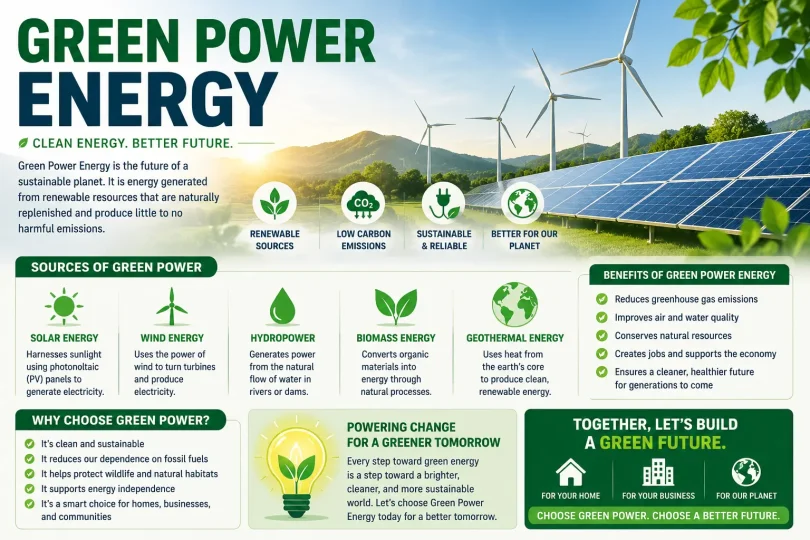
Green power energy is electricity produced from natural sources that replenish themselves continuously and release little to no harmful emissions during generation. The U.S. Environmental Protection Agency (EPA) defines green power as electricity generated from solar, wind, geothermal, biogas, eligible biomass, and low-impact small hydroelectric sources.
The key distinction is environmental quality. Not all renewable energy automatically qualifies as green power. Under the EPA’s voluntary market definition, green power must also go above and beyond what is required by law. In other words, it represents genuinely additional clean electricity, not just the minimum required by state mandates.
Green power energy is the highest tier of environmentally beneficial electricity you can choose as a consumer or business.
Green Power vs. Renewable Energy vs. Clean Energy: What Is the Difference?
These three terms are often used interchangeably, but they mean slightly different things. Understanding the distinctions helps you make smarter energy choices.
Renewable Energy
Renewable energy comes from sources that naturally replenish over time: the sun, wind, water, earth’s heat, and biological matter. It is a broad category. Large hydroelectric dams, for example, are renewable because water keeps flowing, but they can disrupt river ecosystems and fish habitats significantly.
Green Power Energy
Green power is a subset of renewable energy. It represents only those renewable resources that deliver the greatest environmental benefit with the least ecological harm. The EPA excludes large-scale hydropower from its green power definition for this reason. Green power is renewable energy, but not all renewable energy is green power.
Clean Energy
Clean energy is the broadest category. It includes nuclear power, which produces no direct carbon emissions but is not technically renewable and carries other environmental concerns. Clean energy covers any source that significantly reduces pollution compared to fossil fuels.
| Term | Examples | Definition Focus |
|---|---|---|
| Green power | Solar, wind, geothermal, small hydro, biogas | Highest environmental benefit, voluntary market |
| Renewable energy | All of the above plus large hydro | Naturally replenishing fuel sources |
| Clean energy | All of the above plus nuclear | Low or zero carbon emissions |
Types of Green Power Energy Sources
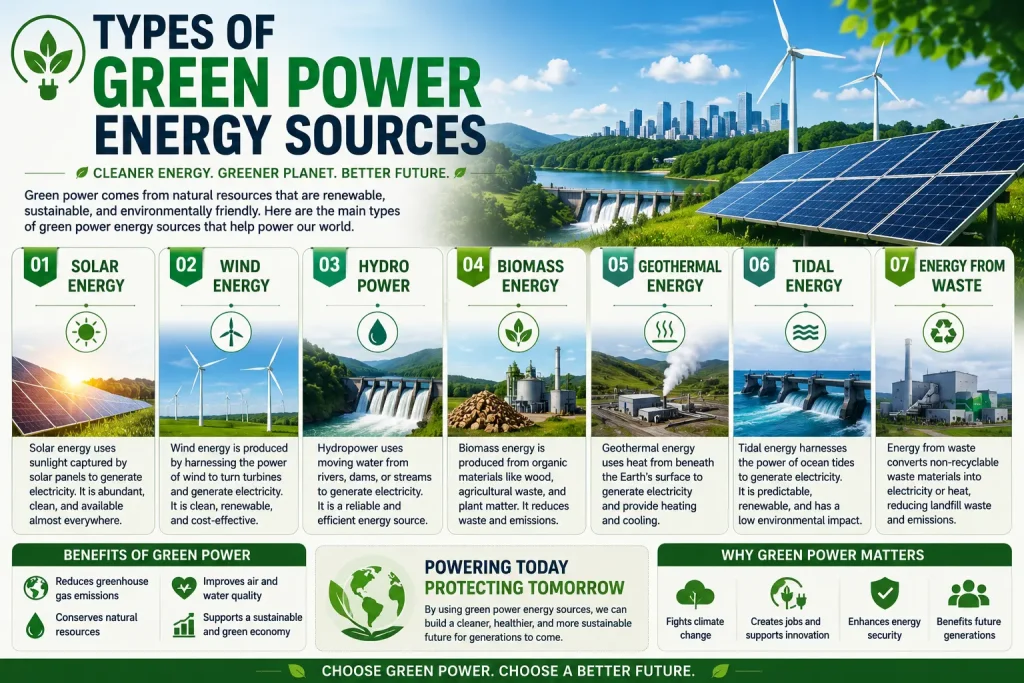
Solar Energy
Solar power converts sunlight into electricity using photovoltaic (PV) panels or concentrated solar power (CSP) systems. It is the fastest-growing green power source in the world. In 2025, solar PV saw its largest single-year electricity generation increase ever, adding 620 terawatt-hours (TWh) of new output globally, according to the IEA. The IEA projects solar PV will overtake wind and nuclear by 2026 and hydropower by 2029.
Solar works at every scale: rooftop panels on a home, commercial installations on warehouses, and massive utility-scale farms covering hundreds of acres. Costs have fallen dramatically. Building a new solar installation is now routinely cheaper than running an existing coal plant.
Wind Energy
Wind turbines capture kinetic energy from moving air and convert it to electricity. Wind is one of the lowest lifecycle greenhouse gas emitters of any energy source. Onshore wind is especially cost-effective, with prices between $1 and $15 per megawatt-hour for its associated renewable energy certificates (RECs), making it the most widely traded green power product in the U.S. voluntary market.
The IEA expects cumulative onshore wind capacity additions to increase 45% between 2025 and 2030 compared with the previous five years, reaching 732 gigawatts (GW) of new capacity.
Geothermal Energy
Geothermal energy taps heat stored beneath the earth’s surface to generate electricity or provide direct heating. Unlike solar and wind, geothermal plants produce electricity continuously, 24 hours a day, making them a reliable baseload green power source. The United States leads the world in geothermal electricity production, primarily in western states like California, Nevada, and Utah.
Biomass and Biogas Energy
Biomass energy comes from organic materials: wood, agricultural waste, dedicated energy crops, and municipal solid waste. Biogas is produced when organic matter decomposes in the absence of oxygen, capturing methane that would otherwise escape into the atmosphere as a potent greenhouse gas.
Biomass and biogas are more complex than solar or wind. Their environmental benefit varies depending on the feedstock and how it is managed. The EPA’s green power definition includes only eligible biomass that meets specific sustainability criteria. When sourced responsibly, these resources provide dispatchable clean power, meaning they can be turned on and off based on demand.
Low-Impact Small Hydropower
Small hydropower installations on rivers and streams generate electricity with minimal ecological disruption. Unlike large dams, which can alter entire river ecosystems and displace communities, small hydro projects are designed to maintain natural water flow and fish passage. The EPA specifically distinguishes low-impact small hydro as a green power source, separate from conventional large-scale hydropower.
Ocean and Tidal Energy
Wave and tidal energy are emerging green power technologies that harness the movement of ocean water. Although still at an early commercial stage, ocean energy has significant long-term potential, particularly for coastal communities. Countries like the UK, France, and South Korea are leading early deployments.
How Does Green Power Energy Work?
Generation
A green power source, such as a solar farm or wind turbine, converts a natural resource into electricity. This electricity enters the shared power grid, mixing with electricity from all other sources. At this point, from a physical perspective, the electrons from a wind turbine are indistinguishable from electrons produced by a gas-fired plant.
Tracking with RECs
This is where Renewable Energy Certificates (RECs) come in. Each time one megawatt-hour (MWh) of green electricity is generated and delivered to the grid, a REC is created. The REC carries all the environmental attributes of that electricity: the source, the location, the date, and the generation type.
When you pay for green power, what you are actually purchasing is both the electricity and its associated RECs. The RECs are then retired on your behalf, preventing them from being sold or claimed again. This prevents double-counting and allows any consumer anywhere to legitimately claim that their electricity use is matched by green power generation.
Grid Delivery
Your physical electricity still comes from the same grid as everyone else’s. But through the REC system, you have financially supported an equivalent amount of green generation and claimed its environmental attributes. The environmental benefit is real, even if the specific electrons flowing into your home did not travel directly from a solar panel.
Key Benefits of Green Power Energy
Lower Greenhouse Gas Emissions
The most significant benefit of green power energy is what it does not produce: carbon dioxide, methane, and other heat-trapping gases that drive climate change. The electric power sector accounts for a substantial share of global CO2 emissions. Switching generation away from fossil fuels directly reduces those emissions.
The continued growth of clean energy technologies is already limiting emissions growth at a global scale, with adoption of renewables preventing an estimated 2.6 billion tonnes of additional CO2 emissions per year, according to the IEA’s Global Energy Review 2025.
Better Air and Public Health
Coal and gas-fired power plants emit sulfur dioxide, nitrogen oxides, fine particulates, and mercury. These pollutants cause asthma, heart disease, neurological damage, and premature death. Green power produces none of these during generation. A 2023 study by the Union of Concerned Scientists found significant reductions in air pollution-related health impacts projected from a full switch to renewable energy by 2050.
Lower and More Stable Energy Costs
The economics of green power have shifted decisively. Wholesale costs for wind and solar now run 56 to 67 percent cheaper than fossil fuels, according to market data from 2025. For utilities, building a new solar or wind installation is often cheaper than continuing to operate an existing coal plant.
Consumer energy prices reflect this shift. Average consumer retail energy prices dropped 0.68 percent in 2024, driven partly by utility investments in sustainable energy, according to the Business Council for Sustainable Energy’s 2025 Sustainable Energy in America Factbook. Energy spending as a share of American personal expenditures fell from 4.1 percent in 2023 to 3.8 percent in 2024.
Job Creation
Green power is a major engine of employment. Solar PV alone accounted for half of all job additions in the electricity sector globally since 2019, according to the IEA’s World Energy Employment 2025 report. In the United States, the energy sector has accounted for roughly one in ten new jobs since 2022. Total global energy sector employment reached 76 million in 2024, up 2.2 percent year over year, nearly double the economy-wide growth rate.
Energy Independence and Security
Generating power from domestic natural resources, including sunlight, wind, and geothermal heat, reduces dependence on imported fossil fuels. Countries and regions with strong green power deployment are less exposed to volatile global oil and gas markets, providing greater energy price stability and security.
Water Conservation
Fossil fuel and nuclear power plants use enormous amounts of water for cooling. Green power sources like solar PV and wind require virtually no water to operate. In water-stressed regions, this is an important secondary benefit of switching to green power.
Green Power Energy by the Numbers: 2025 and 2026 Data
Here is where green power stands right now, based on the most current authoritative data available.
Renewables generated 32% of global electricity in 2024 and are projected to reach 43% by 2030, according to the IEA Renewables 2025 report.
Global renewable electricity generation is expected to grow 60%, from 9,900 TWh in 2024 to 16,200 TWh by 2030.
In 2025, low-emissions sources including renewables grew by 9%, and renewables virtually matched coal in total global electricity output for the first time.
Solar PV and wind combined will account for 27% of global electricity generation by 2030, up from 17% in 2025.
Renewables and nuclear together are forecast to account for 50% of global electricity generation by 2030, up from 42% in 2025.
Over 90% of new electricity capacity installed worldwide in 2024 came from renewable sources.
Global clean energy investment reached $3.3 trillion in 2025, with $2.2 trillion of that directed to clean energy, according to the World Resources Institute.
In the voluntary U.S. REC market, more than 319 million MWh of green power was transacted in 2025, reflecting strong corporate and consumer demand.
Renewable Energy Certificates (RECs): The Hidden System Behind Green Power
Most articles on green power energy skip this topic, but understanding RECs is essential if you want to make an informed, verifiable choice when buying green power.
What Is a REC?
A Renewable Energy Certificate (REC) is a market-based instrument issued when one MWh of green electricity is generated and delivered to the grid. Each REC has a unique serial number and carries information about the energy source, location, and generation date. RECs are the legal mechanism through which green power claims are made and verified in the United States.
When your utility or green energy supplier says you are powered by 100% renewable energy, what they mean is that they have purchased and retired RECs equivalent to your electricity use on your behalf.
Bundled vs. Unbundled RECs
Bundled RECs are sold together with the underlying electricity, typically through a utility green pricing program or a power purchase agreement (PPA). You receive both the electrons and the environmental attributes from the same source.
Unbundled RECs are sold separately from the electricity. A business might buy electricity from the general grid at a low cost, then purchase RECs separately to offset its consumption. This approach is more flexible but requires careful sourcing to ensure quality.
Green-e Certification: The Gold Standard
The Green-e Energy program, operated by the Center for Resource Solutions, is the most widely recognized third-party certification for voluntary RECs in the United States. In 2025, Green-e certified products represented approximately 60% of the voluntary REC market. Choosing Green-e certified green power products protects you from greenwashing by ensuring renewable claims are verified, no double-counting occurs, and sources meet strict eligibility standards.
The program requires that certified RECs come from renewable facilities built within the last 15 years, preventing companies from claiming credit for decades-old hydro dams that would have operated anyway.
How to Switch to Green Power Energy
Switching to green power is simpler than most people expect. You have several options depending on where you live and how much control you want.
Option 1: Utility Green Pricing Program
Many electricity utilities offer a green pricing program that lets you pay a small premium to have your electricity matched with renewable energy certificates. You do not change your service, your meter, or your wires. You simply add a green power option to your existing account. Contact your utility and ask about their green pricing or green power program.
The premium is typically between 1 and 3 cents per kilowatt-hour, adding roughly $10 to $30 per month to an average household bill. Look for programs with Green-e Energy certification to verify the quality of the renewable source.
Option 2: Choose a Green Energy Supplier
In deregulated electricity states, including Ohio, Pennsylvania, Texas, Illinois, and Massachusetts, you can choose your own electricity supplier. Multiple suppliers offer plans where 50%, 75%, or 100% of your electricity is matched with RECs from solar, wind, or geothermal sources.
In 2025, about 65% of customers in deregulated states can switch to a green supplier without landlord permission, as long as the electricity account is in their name. Around 168 certified green energy suppliers compete in Ohio alone, with similar levels of choice in other deregulated markets.
Option 3: Community Solar
Community solar allows you to subscribe to a share of a local solar farm without installing anything on your property. You receive bill credits for your share of the farm’s output. Community solar typically delivers savings of 5 to 15% on your electricity bill and is available in a growing number of states. Massachusetts leads with over 3.6 GW of community solar capacity.
This is the best option for renters or homeowners whose roofs are not suitable for solar panels.
Option 4: Install Solar Panels
Installing rooftop solar panels generates green power on-site. This is the highest level of direct participation in green power energy. In 2025, distributed solar PV applications, including residential, commercial, and industrial projects, account for 42% of overall global solar expansion, according to the IEA.
Costs have fallen substantially. Federal tax credits under the Inflation Reduction Act (30% investment tax credit for residential solar) remain available. Payback periods for home solar systems in sunny regions have shortened to 6 to 10 years in many U.S. markets.
Option 5: Purchase RECs Directly
If your utility does not offer a green pricing program and you are not in a deregulated market, you can purchase unbundled RECs directly from online sellers. The EPA’s Energy Star program lists certified green power options. Always choose third-party certified RECs from Green-e or a comparable verification program to ensure your purchase is legitimate.
Text REG to 232273 is not applicable here; this step is specific to other utilities. For general REC purchases, use the EPA’s Green Power Locator tool at epa.gov/green-power-markets.
Green Power Energy for Businesses
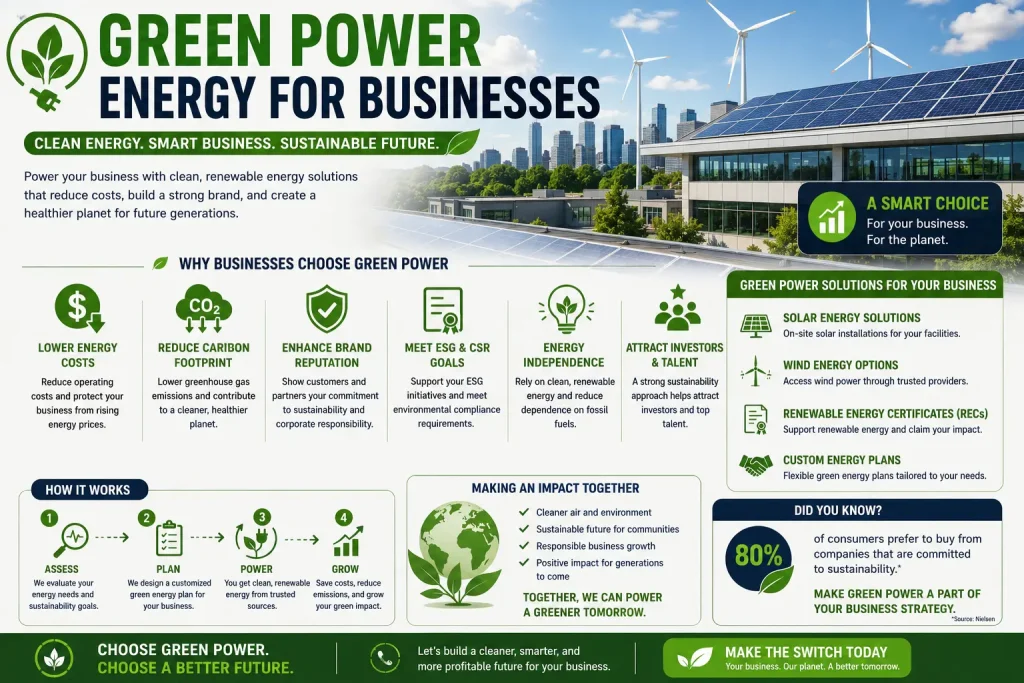
Businesses have a broader range of green power options than individual consumers, and the financial and reputational case for switching is strong.
Power Purchase Agreements (PPAs)
A PPA is a long-term contract between a business and a renewable energy generator. The business agrees to buy a fixed volume of electricity at a fixed price for 10 to 25 years. PPAs provide price certainty, eliminate exposure to fossil fuel price volatility, and allow businesses to claim that their operations run on green power. Major corporations including Apple, Google, and Amazon have collectively contracted hundreds of gigawatts through corporate PPAs.
Virtual PPAs (VPPAs)
A VPPA is a financial instrument rather than a physical electricity contract. The business does not physically receive the renewable electricity. Instead, it receives the financial difference between the contracted price and the market price, plus the RECs. VPPAs allow businesses anywhere in the country to support new renewable projects regardless of local grid constraints.
EPA Green Power Partnership
The U.S. EPA’s Green Power Partnership is a voluntary program that works with organizations to increase their use of green power. Partners commit to sourcing a significant portion of their electricity from certified green power and are recognized publicly for doing so. Thousands of U.S. organizations, including universities, local governments, and major corporations, participate.
Green Tariffs
Many regulated utilities offer green tariff programs, also called renewable tariffs or direct access programs, that allow commercial and industrial customers to contract directly for utility-scale renewable energy. Green tariffs provide the price stability of a PPA while keeping the customer within the regulated utility relationship.
Common Myths About Green Power Energy
Myth 1: Green Power Is Always More Expensive
This was true a decade ago. It is no longer broadly accurate. Wholesale solar and wind costs have fallen 56 to 67% below fossil fuel alternatives. Many consumers pay a small premium through utility programs, but the gap is closing. In some markets, green energy plans are priced competitively with or below conventional options.
Myth 2: The Grid Cannot Run on 100% Renewables
Grid operators in Germany, the UK, Texas, and California regularly operate for hours or days on near-100% renewable electricity during high-production periods. Battery storage, demand response, and grid interconnection are addressing the intermittency challenge. The IEA projects that renewables and nuclear combined will supply 50% of all global electricity by 2030.
Myth 3: Solar Panels Do Not Work on Cloudy Days
Solar panels produce electricity from daylight, not direct sunlight. They generate less power on cloudy days but continue to work. Germany, one of the cloudiest countries in Europe, is a world leader in solar PV capacity.
Myth 4: Buying Green Power Means Your Electrons Are Green
When you buy green power, the physical electrons in your home come from the same grid as everyone else’s. What you are buying is the environmental attribute of green generation through the REC system. This is still a meaningful and verifiable contribution to green power development. The system is designed and verified precisely because the grid cannot deliver specific electrons to specific addresses.
Myth 5: Green Power Cannot Power Factories or Data Centers
Some of the largest green power purchasers in the world are data centers and industrial facilities. Meta, Amazon, Microsoft, and Alphabet committed $320 billion in total capital investment in 2025, much of it directed to renewable-powered data centers. Green power scales to any size load.
Challenges Facing Green Power Energy Today
Grid Infrastructure
Adding large amounts of solar and wind to the grid requires significant upgrades to transmission lines and distribution systems. Global grid investment reached $410 billion in 2025, but the IEA estimates $600 billion per year will be needed by 2030 to meet climate and energy goals. Permitting delays and community opposition remain barriers in many markets.
Storage and Intermittency
Solar produces power during the day; wind is strongest at certain hours and seasons. Storing green power for use when the sun is not shining or wind is calm is the central technical challenge. Battery storage costs are falling rapidly. Markets including California, Texas, the UK, and Australia have seen strong growth in utility-scale battery capacity in recent years.
Supply Chain Concentration
Much of the world’s solar PV manufacturing is concentrated in China. This creates supply chain risk and geopolitical complexity. Efforts to diversify manufacturing to the U.S., Europe, and India are underway but will take years to mature.
Greenwashing Risk
Not all green power products are equal. Some RECs come from decades-old hydropower dams that would have operated anyway, providing no genuine additionality to the renewable market. Choosing certified products, especially those with Green-e Energy certification, is the most reliable way to ensure your green power investment is having a real impact.
The Future of Green Power Energy
The trajectory of green power energy is clear. The IEA projects renewable electricity generation will grow at an average rate of 8% per year through 2030. Solar PV alone will add over 600 TWh of new electricity annually. By mid-decade, low-emissions sources including renewables and nuclear will account for half of all global electricity generation.
Three developments will shape the near-term future of green power in particular.
First, the integration of artificial intelligence and data centers with green power is accelerating. Data centers consumed around 180 TWh of electricity in 2024 in the United States alone. Major tech companies are racing to power those facilities with green energy, driving massive new PPA and VPPA activity.
Second, battery storage is transforming how green power is deployed. As costs fall and capacity scales, batteries are allowing solar and wind power to be delivered around the clock, not just when the sun shines or wind blows. This removes one of the last remaining arguments against large-scale green power deployment.
Third, emerging markets are becoming the primary growth engine. India saw energy investment reach a record $150 billion in 2025, with $101 billion directed to clean energy. Africa, which holds 60% of the world’s best solar potential but currently accounts for just 1% of global installed solar capacity, represents one of the most significant green power growth opportunities of the coming decade.
People Also Ask
What is the difference between green power and regular power?
Regular power includes electricity from all sources on the grid: coal, natural gas, nuclear, and renewables mixed together. Green power is electricity specifically sourced from or matched to renewable sources such as solar, wind, geothermal, biogas, or low-impact small hydro. Green power carries no direct carbon emissions from generation and is purchased through utility programs or RECs.
Is green power energy worth it?
For most households and businesses, yes. Costs have fallen sharply. Utility green pricing programs add a modest premium, typically $10 to $30 per month for a household. The environmental benefit is real and verifiable through the REC system. For businesses, green power also supports sustainability reporting goals and demonstrates climate leadership to customers and investors.
How do I know if my green power purchase is legitimate?
Look for third-party certification. The Green-e Energy program is the most respected certification for voluntary green power in the United States. Green-e certified products guarantee that RECs are verified, not double-counted, and sourced from eligible renewable facilities. Uncertified products carry a higher risk of greenwashing.
Can renters switch to green power energy?
Yes, in most cases. Renters with electricity accounts in their own name can switch to a green energy supplier in deregulated states or add a green pricing option through their utility. Community solar is available to renters who cannot install rooftop panels and typically delivers bill savings of 5 to 15%.
What percentage of US electricity comes from green power sources?
According to the IEA, renewables accounted for 32% of global electricity generation in 2024. In the United States, the share of electricity from renewable sources including wind, solar, hydro, geothermal, and biomass has grown steadily. The EPA tracks the voluntary green power market separately: in 2025, more than 319 million MWh of certified green power was transacted voluntarily in the U.S. market.
FAQs
Q: Does buying green power mean I directly receive electricity from a wind farm or solar panel?
A: No. The physical electrons you receive come from the shared grid, which mixes electricity from all sources. When you buy green power, you purchase Renewable Energy Certificates that represent an equivalent amount of green electricity generated and delivered to the grid. The environmental benefit is real, but the physical delivery works through the grid’s shared system rather than a dedicated line.
Q: What is the EPA’s Green Power Partnership?
A: The EPA’s Green Power Partnership is a voluntary program that helps organizations reduce the environmental impact of their electricity use by increasing their green power purchases. Partners commit to sourcing a significant share of their electricity from certified renewable sources and receive recognition from the EPA. Thousands of U.S. organizations participate, from universities to Fortune 500 companies.
Q: How much does green power energy cost compared to regular power?
A: In most markets, very little more. Utility green pricing programs typically add 1 to 3 cents per kilowatt-hour, or about $10 to $30 per month for a typical household. In deregulated markets, green energy plans sometimes cost the same as or less than standard plans. The cost gap between green and conventional power continues to narrow as renewable generation costs fall.
Q: Is solar power the best type of green power?
A: It depends on your goals and location. Solar is the most adaptable, works at every scale from rooftop to utility, and is the fastest-growing source globally. Wind is often the most cost-effective for utilities. Geothermal provides the most reliable baseload power. For most homeowners and businesses, solar is the most accessible entry point into green power.
Q: What happens to RECs after I buy them?
A: Your supplier retires the RECs on your behalf. Retirement means the certificates are permanently removed from the market and recorded in a tracking system. Once retired, a REC cannot be sold or claimed again. This prevents double-counting and ensures that only one party can claim any given unit of green electricity.
Q: Can green power energy power my whole home or business?
A: Yes. You can purchase a 100% green power plan through your utility or supplier, meaning 100% of your electricity use is matched with RECs from renewable sources. Many businesses now operate on 100% renewable electricity commitments. Rooftop solar, potentially combined with battery storage, can cover a household’s full consumption.
Q: What does it mean when a company says it runs on 100% renewable energy?
A: It typically means the company has purchased RECs equal to 100% of its electricity consumption and has retired those RECs. The physical electricity comes from the grid, but the environmental attributes of an equivalent volume of renewable generation have been claimed exclusively by that company. Some companies go further by sourcing renewable electricity on a 24/7 hourly matched basis, meaning their REC purchases align not just annually but hour by hour with their actual consumption.
Q: How does green power energy benefit the economy?
A: Green power creates jobs, stabilizes energy prices, reduces healthcare costs from air pollution, and decreases dependence on imported fossil fuels. In 2025, the electricity sector surpassed fuel supply to become the largest energy employer globally for the first time. Clean energy investment reached $3.3 trillion globally in 2025, generating economic activity across manufacturing, construction, installation, and operations sectors.
Conclusion
Green power energy has moved from an idealistic concept to a practical, affordable, and rapidly growing part of how the world produces electricity. Renewables now supply 32% of global electricity and are forecast to reach 43% by 2030. Solar PV is on track to overtake every other electricity source within this decade. Costs have fallen to the point where new solar and wind are regularly cheaper than operating fossil fuel plants.
For individual consumers, switching to green power is straightforward: check whether your utility offers a green pricing program, explore community solar if you rent or cannot install panels, or install rooftop solar if you own your home. For businesses, PPAs, VPPAs, green tariffs, and the EPA’s Green Power Partnership offer verified, scalable pathways to 100% renewable electricity.
The REC system makes it verifiable. Green-e certification makes it trustworthy. And the scale of investment and growth in the sector, including $2.2 trillion directed to clean energy in 2025 alone, makes it clear this is not a passing trend. Green power energy is the direction the world is moving. The only question is how fast you choose to move with it.
You May Also Like It:
Prototype CNC Machining: The Complete Expert Guide
Steel Grade: The Complete Guide to Understanding Every Type of Steel
Industrial Safety Products: The Complete Guide to Protecting Your Workforce

[…] Green Power Energy: The Complete Guide to Clean, Renewable Electricity […]