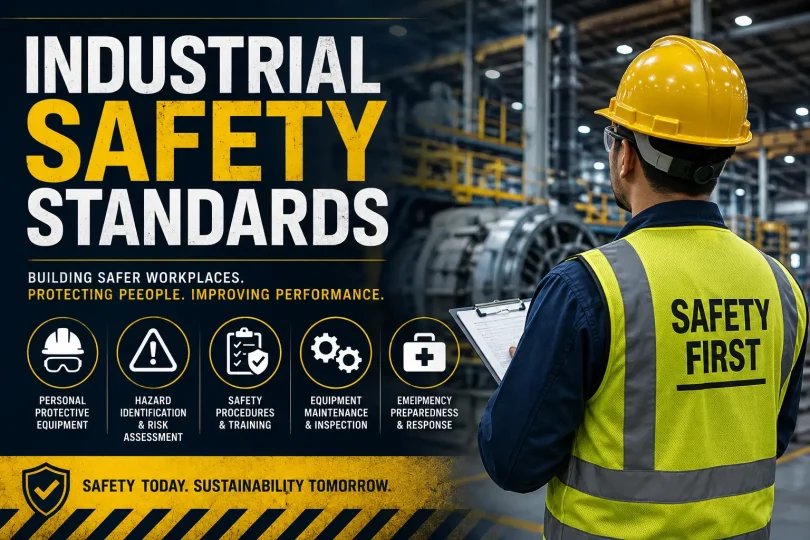

Industrial safety standards are the formal rules, specifications, and management requirements, issued by governments, standards bodies, or industry organizations, that define how a workplace must identify hazards, control risk, and protect workers, property, and the environment. Some are legally binding, such as OSHA regulations, the EU Framework Directive, or India’s OSH Code. Others are voluntary technical benchmarks, such as ISO, ANSI, or ASTM standards, that become effectively mandatory once a client, insurer, or regulator requires them. Together, they convert a vague goal like “work safely” into something that can be written down, audited, certified, and enforced.
That one-paragraph answer covers the basics. The rest of this guide covers what most explanations leave out: the four categories these standards fall into, their three core objectives, who actually enforces each one, what non-compliance costs in real numbers, and the sequence that turns “we have a policy” into a program that survives an audit.
Key Types and Categories
Treating “industrial safety standards” as one undifferentiated category is the most common mistake in this space. The types below behave differently, are owned by different people inside an organization, and carry different consequences when ignored.
| Type | Nature | Examples | Who Owns It |
|---|---|---|---|
| Mandatory regulations | Legal, government-issued | OSHA 29 CFR 1910/1926 (US), EU Framework Directive 89/391/EEC, India’s OSH Code 2020 | Legal / compliance team |
| Technical & voluntary standards | Consensus benchmarks, optional until a contract or insurer requires them | ISO 45001, ANSI Z10, ASTM F2413 | Procurement / EHS |
| Equipment & operational rules | Specifications for machinery, electrical, and fire safety | IEC electrical safety codes, NFPA fire prevention standards, lockout/tagout procedures | Supplier QA / operations |
- Mandatory regulations carry the force of law. Ignoring them risks fines, shutdown orders, or criminal liability, not just a bad audit score.
- Technical and voluntary standards are written by industry committees and stay optional right up until a client contract or insurance policy references them by name, at which point they function like law even though no government wrote them. ISO 45001 falls here as the leading framework for occupational health and safety management, alongside product and testing bodies like ASTM International and ANSI.
- Equipment and operational rules govern machinery guarding, electrical safety under codes like IEC, fire prevention under NFPA, and procedures such as lockout/tagout. These specify exactly how equipment must be built, tested, or operated to avoid a specific hazard, rather than how the organization manages safety overall.
Knowing which bucket a given requirement falls into matters practically: a mandatory regulation needs legal review, a voluntary management standard needs a process owner, and confusing the two leads companies to over-lawyer process work or under-resource actual legal exposure.
Core Objectives of Industrial Safety Standards
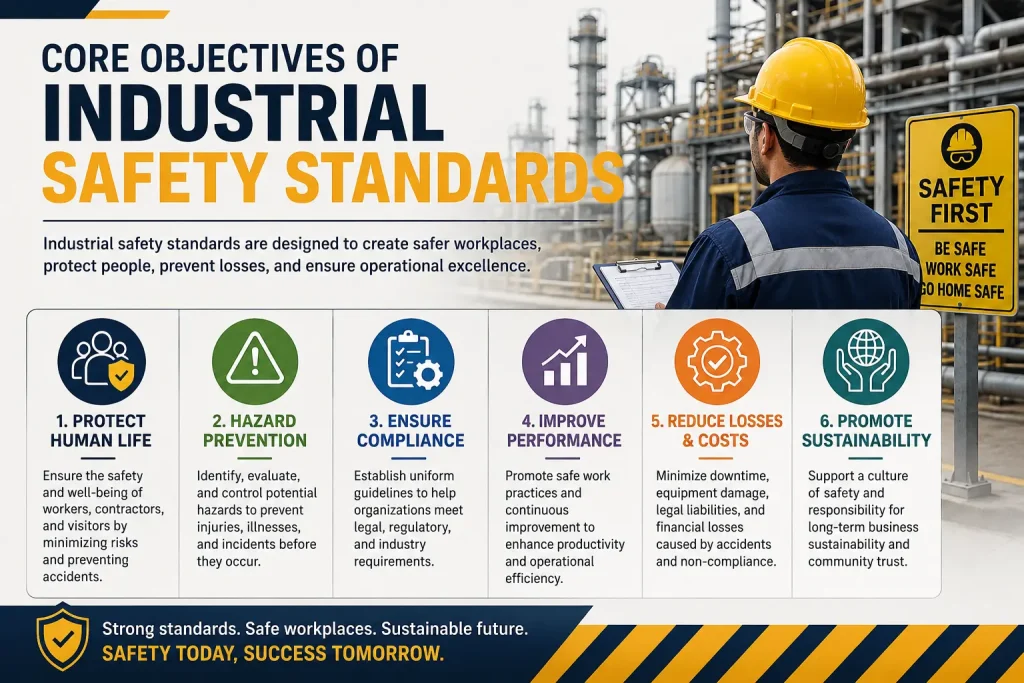
Underneath the different types, every industrial safety standard is trying to achieve one of three things.
- Hazard control. Finding and assessing physical, chemical, or biological risks before they cause harm. This includes risk assessments, exposure monitoring, and machine guarding, and it’s the objective every other part of a standard is built to support.
- Worker protection. Mandating personal protective equipment such as hard hats, safety vests, and eye protection, along with the training required to use it correctly. A PPE policy that exists on paper but isn’t enforced on the floor does not meet this objective.
- Continuous improvement. Training employees on an ongoing basis, auditing the safety culture rather than just the paperwork, and using incident and near-miss data to lower operational accidents and costs over time. This is the objective most one-time compliance efforts skip entirely.
A standard that only addresses hazard control without worker protection or continuous improvement tends to look compliant on paper while leaving real gaps on the floor.
Who Issues and Enforces Industrial Safety Standards
Enforcement is not one system, it’s three that run in parallel, each checking something different.
- Government regulators enforce mandatory regulations. In the US, that’s OSHA; in the UK, the HSE; in the EU, national authorities implementing the Framework Directive; in India, state factory inspectorates under the OSH Code. Inspections can follow a complaint, a referral, a fatality report, or a targeted industry sweep, and inspectors check logbooks, guarding, and recordable-injury data, not your ISO certificate.
- Third-party certification bodies audit against voluntary management-system standards like ISO 45001. These audits are scheduled and paid for, so the value isn’t surprise, it’s a structured, external gap analysis on a fixed cycle: initial certification, then surveillance audits roughly annually, with recertification typically every three years.
- Clients and insurers audit against whatever their own contract or policy specifies, which is frequently stricter than the law and is the audit most companies overlook until it costs them a bid.
A single compliance checklist built to satisfy all three at once usually satisfies none of them well, since they’re different audiences checking different things on different schedules.
What Non-Compliance Actually Costs
Vague warnings about “fines and reputational damage” understate the real exposure. As of 2026, US federal penalty maximums are:
- Serious or other-than-serious violation: up to $16,550 per violation
- Willful or repeated violation: up to $165,514 per violation
- Failure to abate: up to $16,550 per day past the correction deadline, on top of the original penalty
These are per-violation, not per-inspection. A single inspection turning up ten serious findings can exceed $165,000 before any multiplier for willfulness or repetition is applied. Some states run their own OSHA-approved plans with different, sometimes higher, ceilings; California’s Cal/OSHA, for example, can assess serious-violation penalties beyond the federal maximum.
The fine is usually the smallest line item in the total cost:
- Indirect costs, such as lost production during an investigation, replacement-worker training, legal fees, and next-cycle insurance repricing, routinely run several times the direct fine.
- Contract loss is the cost most often missed. Large manufacturers and construction firms increasingly require proof of ISO 45001 or an equivalent certification before they’ll accept a bid at all, independent of how the facility actually performs.
- Insurance impact is delayed, not immediate. A serious incident rarely spikes premiums the same year, but it shows up at renewal and stays on the loss history for several years afterward.
Building a Compliance Program: A 7-Step Sequence
This is the order that holds up in practice, not the order that looks clean in a slide deck.
- Map every obligation before touching controls. List legal requirements by jurisdiction, every client contract term, and every voluntary standard being pursued. Programs fail here most often by jumping to controls before knowing the full list of what they’re accountable for.
- Run a gap assessment against reality, not against the written policy. Compare the safety manual to what’s actually happening on the floor at a random point in a shift. The gap is usually larger than management expects.
- Fix death-and-serious-injury controls first. Machine guarding, lockout-tagout, fall protection, and confined-space entry take priority over paperwork gaps every time. A missing training signature is a finding; a bypassed machine guard is an emergency.
- Build the management system around fixes already made, not the reverse. ISO 45001 works best documenting a system that’s already running, not inventing one on paper.
- Train for judgment, not just procedure. Workers should be trained to recognize when a situation has drifted outside the written procedure and to stop and ask, not improvise.
- Audit on a risk-based cycle, not a calendar convenience. High-hazard processes need more frequent checks than low-risk administrative areas.
- Close the loop on every incident, near miss, and audit finding. An unresolved finding without documented corrective action is just paperwork, and is the single most common gap in programs that technically “have” a management system but don’t run one.
Standards by Industry
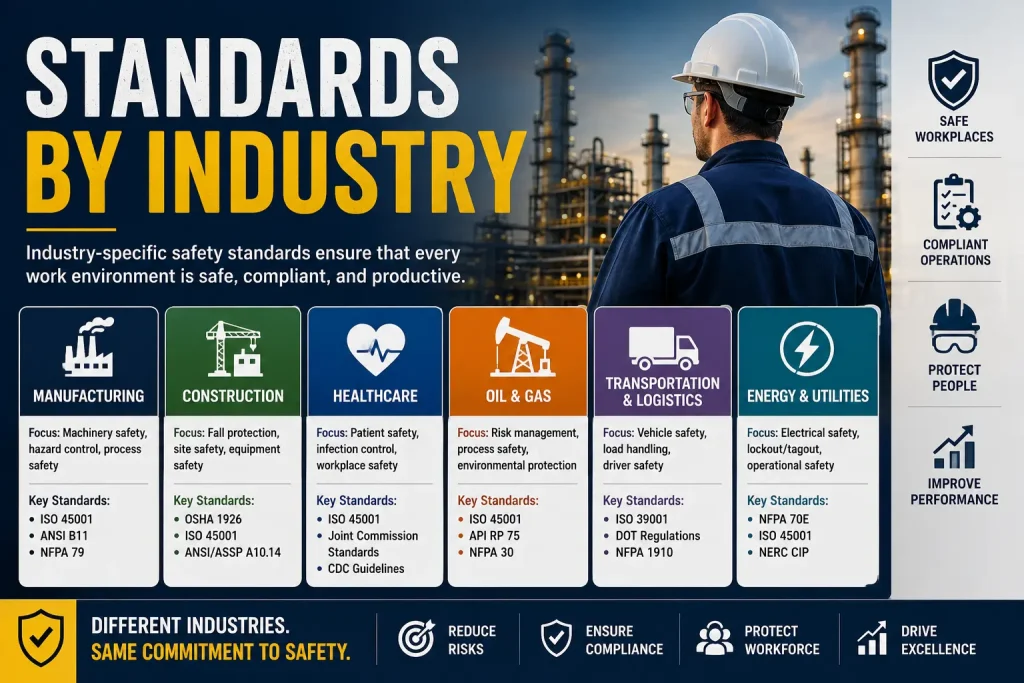
Standards don’t apply uniformly across sectors.
- Construction relies on site-specific hazard assessments rather than fixed facility controls, since the worksite changes with every project; fall protection and excavation safety dominate enforcement data.
- Chemical and process industries layer process safety management on top of general standards. A single missed valve inspection carries catastrophic-event risk, not just injury risk.
- Manufacturing centers on machine guarding, lockout-tagout, and ergonomics, since caught-in and caught-between incidents plus repetitive strain injuries make up most recordables.
- Mining typically operates under a separate dedicated regulator, such as MSHA in the US, rather than general industrial safety law, given its distinct hazard profile.
Running one unified checklist across multiple sectors usually produces something too generic to catch anything sector-specific.
Frequently Asked Questions
Are industrial safety standards the same as OSHA regulations?
No. OSHA regulations are one legally mandatory set of standards specific to the United States. “Industrial safety standards” is the broader umbrella that also includes voluntary standards like ISO and ASTM, plus other countries’ legal frameworks such as the EU Framework Directive or India’s OSH Code.
What’s the difference between a standard and a regulation?
A regulation is issued by a government body and carries legal force automatically. A standard is typically issued by a private or industry body, such as ISO, ASTM, or ANSI, and is voluntary unless a regulation, contract, or insurance policy specifically incorporates it.
Do small businesses have to meet the same safety standards as large factories?
Legal minimums generally apply regardless of size, though some set employee-count thresholds; India’s Factories Act, for instance, applies differently depending on whether a facility is power-driven and its headcount. Voluntary standards like ISO 45001 remain optional at any size, but smaller suppliers are increasingly asked to certify to win contracts with larger buyers.
Can a company be ISO 45001 certified and still fail a government inspection?
Yes. ISO 45001 certifies that a functioning management system exists, not that every individual control meets every legal requirement at every moment. The two audits check different things.
How often are industrial safety standards updated?
It varies. ISO reviews its management-system standards roughly every five years, ASTM standards go through rolling technical-committee reviews often every few years, and OSHA regulations update on no fixed schedule, sometimes reactively after a high-profile incident.
Who is legally responsible for enforcing safety standards inside a company?
The employer bears ultimate legal responsibility, but day-to-day enforcement is typically owned by a designated safety officer or EHS manager, supported by line supervisors catching violations in real time.
Do these standards cover contractors and temporary workers?
Yes, in most jurisdictions. OSHA’s multi-employer worksite policy, for example, can hold both a host employer and a contracting company responsible for hazards a temporary worker faces on site.
What happens when two safety standards conflict?
The stricter requirement generally applies, and legal minimums always take priority over voluntary standards. A contractual requirement stricter than local law still binds the parties to the contract, even though it isn’t a legal mandate on its own.
Key Takeaway
Industrial safety standards only function as protection when they’re treated as an operating system, not a one-time paperwork exercise: know which category a requirement falls into, keep hazard control, worker protection, and continuous improvement all active at once, understand which of the three enforcement systems will check it, fix life-safety gaps before documentation gaps, and close the loop on every finding. Organizations that certify and build the habit before a client demands it are the ones still bidding competitively three years from now.
You May Also Like It: