
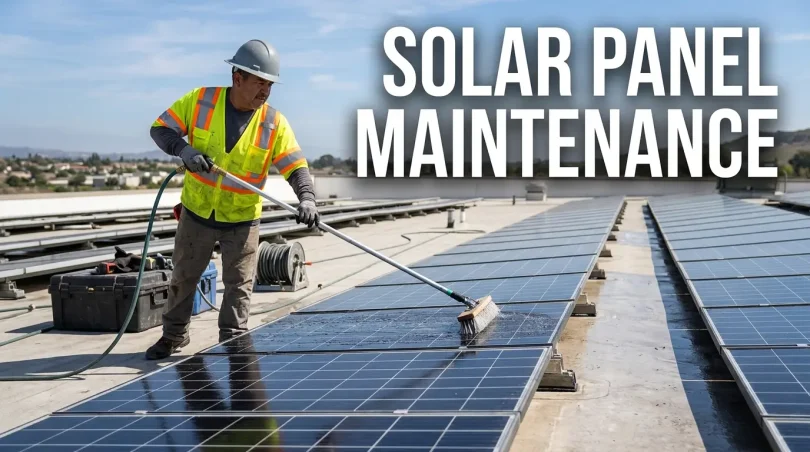

Solar panel maintenance mainly involves periodic cleaning, visual inspections, and monitoring your system’s production data. Most homeowners only need to clean panels once or twice a year and check their monitoring app monthly.
Key facts:
- Dirty panels can lose 25–35% efficiency
- Faulty wiring or inverter issues can silently cut output by 10–25% for months before being noticed
- Annual maintenance typically costs just 1–2% of the system’s value
- Proper maintenance can extend panel life to 25–30 years and protect your warranty
Cleaning frequency:
- Normal areas: 1–2 times per year
- Dusty, coastal, or tree-covered areas: every 3–4 months
Monthly monitoring plus an annual professional inspection ensures optimal performance and keeps your warranty intact.
Key Takeaways
- Solar panels are low maintenance, not zero maintenance. Rain removes most dirt naturally, but periodic cleaning still matters.
- Dirty panels can run 25 to 35 percent less efficient, which adds up quickly on a monthly power bill.
- A basic cleaning and inspection routine costs little and can be done safely from the ground in most cases.
- Annual maintenance spend is typically only 1 to 2 percent of your system’s value.
- Performance based monitoring, not just a calendar reminder, is the most reliable way to catch problems early.
- Improper DIY electrical work can void your warranty, so certain tasks always belong to a licensed technician.
Why Solar Panel Maintenance Matters
Solar panels are designed to run for decades with very little intervention. There are no moving parts, no oil to change, and no filters to replace — this is what makes solar energy low maintenance compared to most other home systems. But “low maintenance” does not mean “no maintenance.” Dust, pollen, bird droppings, tree sap, and salt residue near coastal areas gradually build up on the panel surface and block sunlight from reaching the cells underneath.
Left unchecked, that buildup alone can reduce output by 25 to 35 percent. Add in less visible issues, such as a failed optimizer, a partial string outage, a tripped breaker, or a communication failure between the inverter and your monitoring app, and a system can quietly underproduce for months while looking completely normal from the ground. A consistent solar system maintenance routine is what catches these issues before they cost you real money.
How Often Should You Clean Solar Panels?
Cleaning frequency depends heavily on your environment, not a fixed calendar date.
| Environment | Recommended Cleaning Frequency |
|---|---|
| Dry, dusty climate | Every 3 to 4 months |
| Near trees (pollen, sap, leaves) | 2 to 3 times per year |
| Coastal area (salt residue) | Every 3 to 6 months |
| Average suburban home | Once or twice per year |
| Heavy rainfall region | Once per year, rain does most of the work |
Most homeowners in average conditions only need solar panel cleaning once or twice a year. Homes near trees, in dusty regions, or in coastal zones with salt buildup need more frequent attention, since natural rainfall alone will not remove sap, pollen, or salt film effectively.
How to Clean Solar Panels Safely
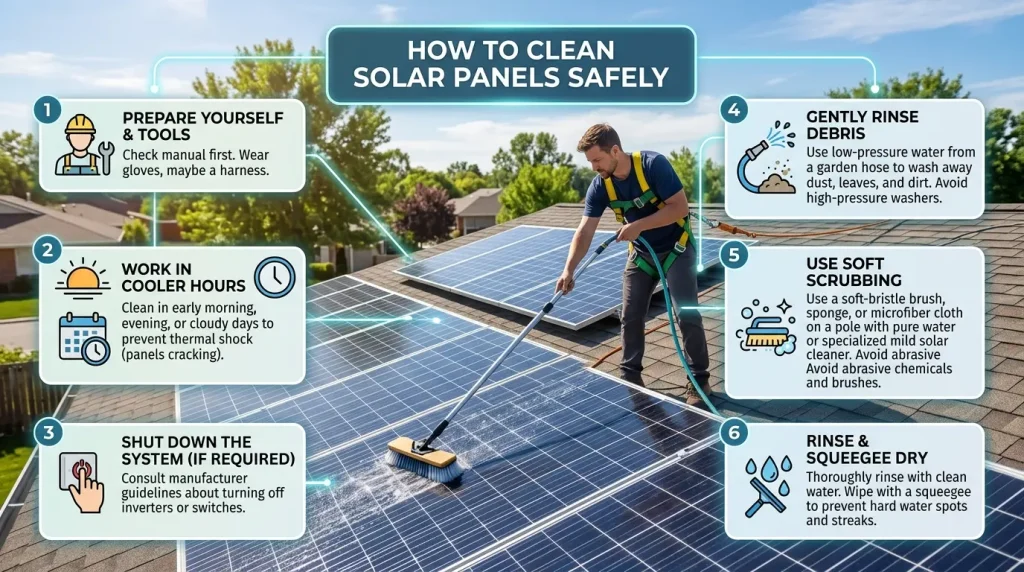
- Check your owner’s manual first. Manufacturers specify approved cleaning methods, and using the wrong approach can damage panels or void your warranty.
- Choose the right time of day. Early morning or late afternoon is best, since panels are cooler and less likely to crack from a sudden temperature change caused by cold water on a hot surface.
- Use soft tools only. A soft bristled brush or a microfiber squeegee with an extendable handle covers most cleaning needs. Avoid abrasive pads or high pressure washers.
- Rinse with plain water. Avoid harsh detergents unless your manufacturer specifically approves them, since residue can attract more dust over time.
- Work from the ground when possible. Use an extendable pole and, if needed, binoculars or a drone for visual inspection instead of climbing onto the roof.
- Skip the roof in bad conditions. Never clean or inspect panels during wet, icy, or windy weather.
DIY vs Professional Solar Panel Maintenance
| Task | DIY Friendly | Call a Professional |
|---|---|---|
| Ground level visual inspection | Yes | |
| Basic panel cleaning with a soft brush and pole | Yes | |
| Monitoring app review | Yes | |
| Roof access cleaning or inspection | Sometimes | Recommended if unsafe or unfamiliar |
| Inverter inspection or repair | Always | |
| Wiring, connectors, or electrical faults | Always | |
| Warranty related repairs | Always |
Basic cleaning and visual checks are safe for most homeowners to handle themselves. Anything involving the inverter casing, DC cables, or roof access in less than ideal conditions should go to a licensed solar technician. Improper DIY electrical work is dangerous and can void your warranty entirely.
Solar Panel Maintenance Checklist
| Frequency | Task |
|---|---|
| Monthly | Check the monitoring app for unusual production drops and confirm output matches the season |
| Quarterly | Visual inspection from the ground for debris, new shading, or visible damage |
| Every 6 Months | Clean panels if your environment warrants it (dust, pollen, sap, salt buildup) |
| Yearly | Book a professional inspection for wiring, mounting hardware, and inverter health; review warranty records |
| As Needed | Investigate any sudden or sustained output drop immediately, and call a technician for burning smells, scorch marks, or arc damage |
Common Solar Panel Maintenance Mistakes
- Using a pressure washer. High pressure water can damage seals, connectors, and the panel surface itself.
- Using harsh chemicals or detergents. Residue from strong cleaners can attract more dust and grime than plain water.
- Cleaning at midday. Splashing cold water on hot panels can cause thermal shock and micro-cracks.
- Going on the roof without safety precautions. Wet, icy, or windy conditions turn a simple cleaning job into a real fall risk.
- Not monitoring production. Skipping the monitoring app means slow, invisible efficiency losses can go unnoticed for months.
Benefits of Regular Solar Panel Maintenance
- Higher energy production
- Longer system lifespan
- Lower repair costs over time
- Better return on investment (ROI)
- Stronger warranty protection
Solar Panel Maintenance Cost in 2026
Routine solar panel maintenance is inexpensive relative to the size of the investment. Most homeowners spend roughly 1 to 2 percent of their system’s total value per year on cleaning and inspections.
| Service | Average Cost |
|---|---|
| Cleaning | $150–$300 |
| Annual Inspection | $150–$400 |
| Cleaning + Inspection | $250–$500 |
These figures reflect typical solar panel maintenance cost for a standard residential system in 2026 and can vary based on system size, roof access, and location. DIY cleaning can bring your out-of-pocket cost close to zero beyond basic tools.
Repairs are a separate cost category. Inverter replacement, wiring repairs, or panel replacement after storm damage cost significantly more, but many of these repairs are covered under manufacturer or installer warranties if maintenance records show the system was properly cared for.
Seasonal Solar Panel Maintenance Tips
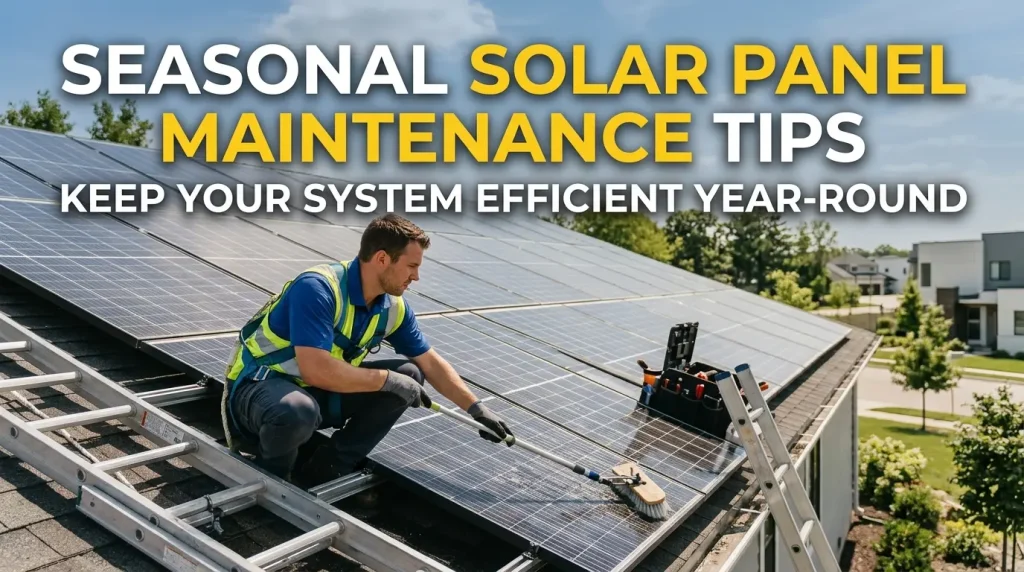
Spring: Watch for pollen buildup, which can cause a visible dip in production. Clean if your monitoring app shows a sustained drop.
Summer: High heat can affect inverter performance. Watch for midday output drops on otherwise clear days, which can signal an overheating inverter.
Fall: Falling leaves and debris accumulate quickly. This is also when small animals commonly look for nesting spots near panel edges.
Winter: Snow load and ice are the main concerns in colder climates. Do not attempt to remove snow or ice yourself unless your manufacturer specifically approves a safe method, since improper removal can scratch or crack panels.
Safety Guidelines for Solar Panel Maintenance
Working near a solar array carries real risk, and a few rules matter more than any cleaning technique.
- Stay off the roof during wet, icy, or windy conditions.
- Never open your inverter casing or handle DC cables yourself.
- If you detect a burning smell, scorch marks, or visible arc damage near wiring, stop immediately and call a qualified technician.
- Prefer ground level inspection tools, such as binoculars or a drone, over unnecessary roof access.
- Understand that improper DIY electrical work can be dangerous and may void your warranty.
Warranty Protection and Maintenance Records
Most manufacturer and installer warranties expect a reasonable level of care from the homeowner. Keeping a simple maintenance log, including cleaning dates, inspection notes, and any repairs, makes warranty claims faster and gives a professional technician a clear starting point if something goes wrong. If your panels are damaged, always check your warranty terms before paying out of pocket for repairs or replacement, since many issues are fully covered.
How We Evaluated This Guide
This guide was built by comparing manufacturer maintenance guidance, current industry cleaning and inspection recommendations, and real world service patterns described by solar maintenance technicians and installers, including guidance referenced from the Environmental Protection Agency and major panel and inverter manufacturers. Recommendations reflect standard 2026 industry practice for residential solar systems rather than generic advice that ignores climate and installation differences.
Frequently Asked Questions
How often should solar panels be cleaned?
Most homeowners in average conditions only need cleaning once or twice a year. Homes near trees, in dusty climates, or in coastal areas with salt buildup typically need cleaning every 3 to 4 months.
Do solar panels really need maintenance?
Yes, though far less than most home systems. Solar panels have no moving parts, but dirt buildup, wiring wear, and inverter issues can still reduce output significantly if left unchecked.
How much does solar panel maintenance cost per year?
Routine maintenance typically costs about 1 to 2 percent of the system’s value annually generally around $150 to $500 depending on the service and DIY cleaning can reduce that further to just the cost of basic tools.
Can I clean my solar panels myself?
In most cases, yes, using a soft brush or squeegee and plain water from the ground with an extendable pole. Avoid roof access in wet, icy, or windy conditions, and always check your manufacturer’s approved cleaning method first.
How much efficiency do dirty solar panels lose?
Dirty panels can lose 25 to 35 percent efficiency, depending on how much dust, pollen, or debris has built up on the surface.
What is the lifespan of solar panels with proper maintenance?
Well maintained solar panels commonly last 25 to 30 years, often continuing to produce power beyond their original warranty period at a slightly reduced capacity.
Should I remove snow from my solar panels myself?
Only if your manufacturer specifically approves a safe removal method. Improper snow or ice removal can scratch or crack panels, and most systems recover output naturally as snow melts or slides off.
How do I know if my solar panels are underperforming?
Compare your monitoring app’s production data against the same period last year or against your installer’s original production estimate. A sustained, unexplained drop usually signals a problem worth investigating.
What solar panel issues require a professional instead of DIY?
Anything involving the inverter casing, DC wiring, roof access in unsafe conditions, or visible signs of electrical damage should always go to a licensed technician.
Does solar panel maintenance affect my warranty?
Yes. Most warranties expect reasonable homeowner care. Keeping cleaning and inspection records can speed up warranty claims, while improper DIY electrical work can void coverage entirely.
How can I monitor my solar panel performance without climbing on the roof?
Use your system’s monitoring app to track daily and monthly production, and compare it against expected output for the season. Binoculars or a drone can also help with visual inspection from the ground.
What tools do I need for basic solar panel maintenance?
A soft bristled brush or microfiber squeegee with an extendable handle, plain water, and access to your monitoring app cover most routine solar panels maintenance needs.
Final Thoughts
Solar panel maintenance is one of the lowest effort, highest return habits a homeowner can build into owning a solar system. A simple routine, monthly monitoring checks, seasonal visual inspections, and cleaning once or twice a year in most climates, is usually enough to protect both your production and your warranty. The moments that matter most are catching a sustained output drop early and knowing exactly when a task belongs to a professional instead of a ladder and a garden hose.
You May Also Like It:
Consumers Energy Power Outage: How to Report, Track, and Stay Safe
Green Power Energy: The Complete Guide to Clean, Renewable Electricity
Power vs Energy: What Is the Difference and Why Does It Matter?



[…] buying guides frame the decision as diesel vs. gas vs. solar panel. In practice, engineers choosing equipment weigh a narrower set of questions […]