
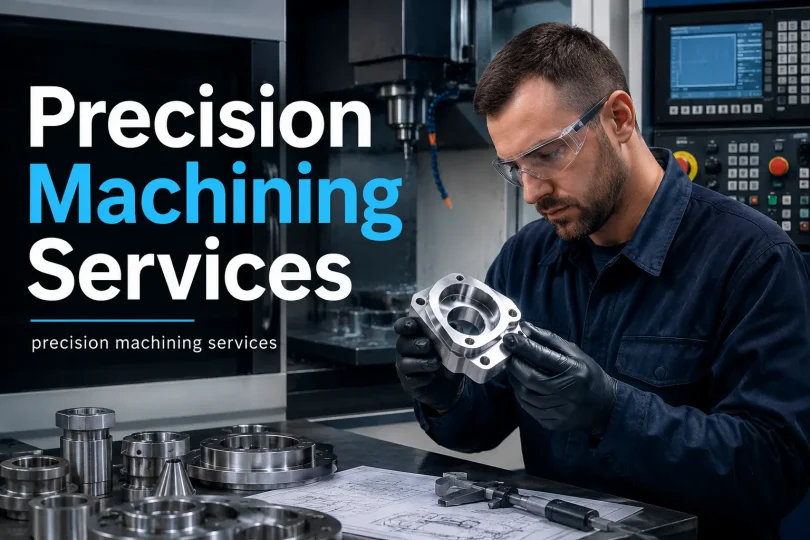

Precision machining services use advanced CNC machines and specialized manufacturing processes to produce highly accurate metal and plastic parts with tight tolerances, consistent quality, and precise dimensions. These services include CNC milling, turning, grinding, and 5-axis machining, commonly used in aerospace, medical, automotive, and robotics industries where accuracy and reliability are essential.
From single prototypes to high-volume production, precision machining helps manufacturers create complex components that meet strict engineering specifications. This guide covers different types of CNC machining services, materials, tolerances, costs, quality control, and how to choose the right manufacturing partner for your project.
1. What Are Precision Machining Services?
Precision machining services are a category of subtractive manufacturing processes that remove material from a raw workpiece using cutting tools, abrasives, or electrical energy to produce finished parts that conform to extremely tight dimensional specifications.
The defining characteristic of precision machining is tolerance control. A tolerance is the permissible deviation from a specified dimension. In standard machining, tolerances might range from plus or minus 0.01 inch to 0.03 inch. In precision machining, tolerances are routinely held to plus or minus 0.001 inch (one thousandth of an inch), and for ultra-precision applications such as optical components or semiconductor equipment, tolerances can reach plus or minus 0.0001 inch or better.
Precision machining services typically include:
- CNC Milling: multi-axis cutting to create complex 3D shapes
- CNC Turning / Lathe Work: rotating workpiece against a stationary cutting tool for cylindrical parts
- Precision Grinding: abrasive finishing to achieve ultra-smooth surfaces and final dimensional accuracy
- CNC Drilling and Boring: creating accurate holes with controlled diameters and depths
- Wire EDM (Electrical Discharge Machining): cutting conductive materials using controlled electrical sparks, ideal for hardened metals
- CNC Cutting Services: shaping raw stock including sheets, rods, and plates before further machining
- 5-Axis Machining: complex part geometry produced in a single setup, reducing errors introduced by repositioning
The process begins with a CAD (Computer-Aided Design) file, which is converted into a G-code program that controls the CNC machine’s cutting path, speed, feed rate, and depth of cut. Every movement is mathematically defined, and the machine executes it with a consistency that no manual process can replicate.
CNC Machining Services: Processes, Capabilities, and Applications
CNC machining services use computer-controlled equipment to manufacture metal and plastic components with consistent dimensions, repeatable accuracy, and complex geometries. These services include CNC milling, CNC turning, drilling, and multi-axis machining for both prototype development and production manufacturing.
While CNC machining refers to the computer-controlled manufacturing process, precision machining focuses on achieving specific dimensional tolerances and surface finish requirements. The two often work together, particularly in industries where component accuracy, consistency, and reliability are essential.
Modern CNC machining services support a wide range of manufacturing requirements, from simple aluminum brackets to complex aerospace components. Depending on the project, manufacturers may use 3-axis or 5-axis milling, CNC turning centers, and advanced inspection systems to deliver parts that meet engineering specifications.
2. How Precision Machining Differs From Standard Machining Services
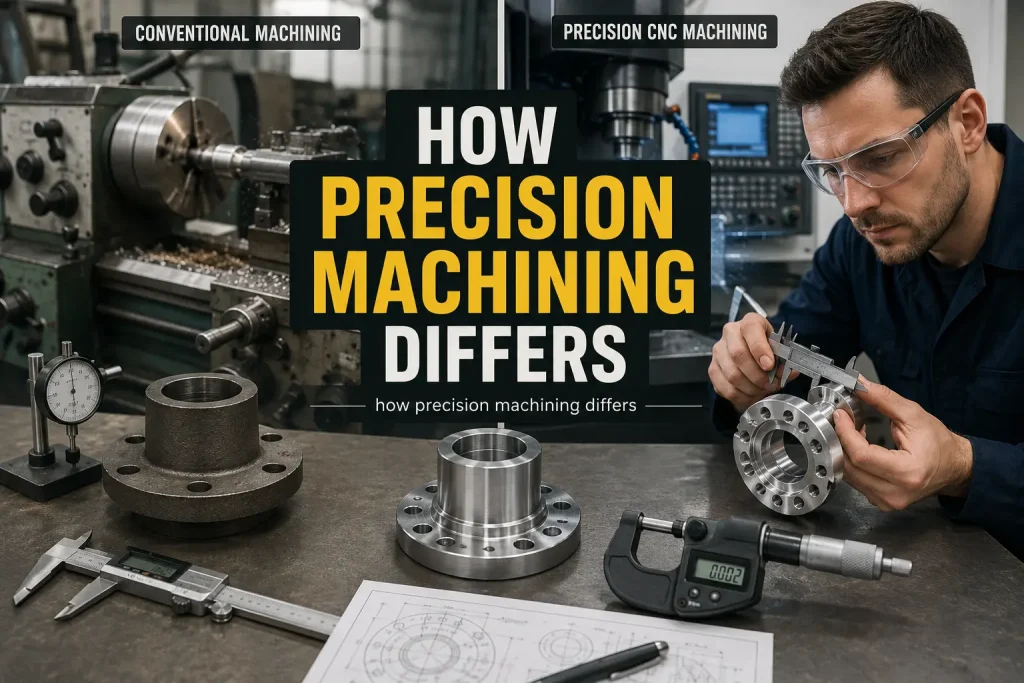
Many buyers confuse precision machining with general-purpose machining services. Understanding the distinction can save significant time and money, and prevent the costly mistake of hiring a standard job shop for work that demands precision-grade processes.
| Factor | Standard Machining Services | Precision Machining |
|---|---|---|
| Typical Tolerance | +/-0.010″ to +/-0.030″ | +/-0.001″ to +/-0.0005″ |
| Surface Finish (Ra) | 125-250 uin | 4-32 uin |
| Equipment | Basic 3-axis mills/lathes | 5-axis CNC, EDM, precision grinders |
| Inspection Method | Manual measurement | CMM (Coordinate Measuring Machine) |
| Best For | Brackets, enclosures, rough cuts | Aerospace, medical, optics, robotics |
| Cost Per Part | Lower | Higher (justified by performance) |
| Repeatability | Moderate | Extremely high across all units |
The fundamental difference is not just equipment. It is process discipline. Precision machining requires controlled environments (temperature-stable shops), calibrated tooling, rigorous inspection protocols, and operators trained specifically for tight-tolerance work. A shop running standard machining services cannot simply deliver precision results by adjusting machine settings.
3. Core Types of Precision Machining Services
When businesses search for a reliable CNC machining service, they often find that the term covers a wide range of distinct processes, each suited to different part geometries, materials, and tolerance requirements. Understanding what each machining service offers helps you match the right process to your project from the start.
CNC Milling Services
CNC milling is the most versatile precision machining process. A rotating cutting tool removes material from a stationary or repositioned workpiece, producing flat surfaces, complex contours, pockets, slots, and intricate 3D profiles.
3-axis milling handles flat and prismatic parts. 4-axis milling adds rotational positioning, enabling features on multiple faces without repositioning. 5-axis milling, the gold standard in precision manufacturing, moves the cutting tool and workpiece simultaneously across five directions, allowing the machining of complex aerospace and medical parts in a single setup, which eliminates cumulative repositioning errors.
Best suited for: housings, brackets, manifolds, mold cavities, impellers, structural aircraft components.
CNC Turning: A Core CNC Machining Service for Cylindrical Parts
CNC turning is one of the most in-demand machining services for components with round or cylindrical profiles. The workpiece rotates at high speed while a stationary cutting tool removes material from the outside diameter, inside diameter, or face. The result is a cylindrical or conical part with excellent concentricity and surface finish.
Modern CNC turning centers combine turning, drilling, and milling in one machine (live tooling), dramatically reducing lead times for complex round parts.
Best suited for: shafts, pins, bushings, fittings, valve bodies, medical implant stems, hydraulic cylinders.
CNC Grinding Services
Grinding uses abrasive wheels to remove very small amounts of material, achieving surface finishes and dimensional accuracies that cutting tools cannot match. Precision grinding is typically the final step in a machining sequence, used to hit the tightest tolerances and smoothest surface finishes.
Types include:
- Cylindrical grinding: outside and inside diameters
- Surface grinding: flat surfaces to +/-0.0001″ flatness
- Centerless grinding: high-volume round bar stock
- Jig grinding: precision holes and profiles in hardened steel
Best suited for: bearing races, gauge blocks, dies, tooling, hardened steel components.
Wire EDM (Electrical Discharge Machining)
Wire EDM cuts electrically conductive materials using a thin wire electrode that discharges controlled electrical sparks, eroding material without physical contact. This process achieves intricate profiles in hardened steel, carbide, and titanium that would be impossible to mill or grind.
Wire EDM tolerances routinely reach +/-0.0001″ with virtually no cutting force, meaning fragile or thin-walled parts can be machined without distortion.
Best suited for: punch and die sets, medical components, aerospace brackets, carbide tooling, micro-parts.
CNC Cutting Services
CNC cutting services prepare raw material stock for subsequent machining operations. Methods include laser cutting, plasma cutting, waterjet cutting, and sawing. These processes define the initial shape and dimensions of a workpiece, reducing material waste and machining time downstream.
Waterjet cutting, for example, cuts virtually any material up to 12 inches thick with no heat-affected zone, making it ideal for materials sensitive to thermal distortion.
4. Materials Used in Precision Machining
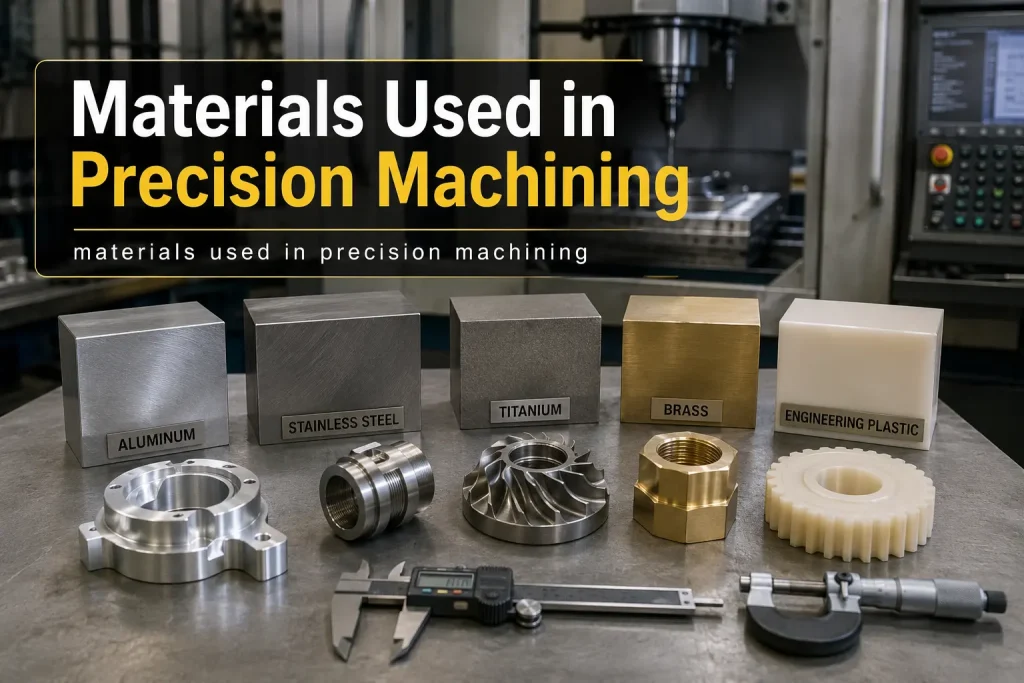
A capable precision machining shop should be able to work with a wide range of materials. Each material presents unique machinability challenges, and material expertise is a key differentiator between shops.
Metals
| Material | Key Properties | Common Applications |
|---|---|---|
| Aluminum (6061, 7075) | Lightweight, excellent machinability | Aerospace, automotive, electronics enclosures |
| Stainless Steel (303, 316, 17-4 PH) | Corrosion resistant, strong | Medical devices, food equipment, marine |
| Titanium (Grade 5 / Ti-6Al-4V) | High strength-to-weight, biocompatible | Aerospace, orthopedic implants |
| Steel (4140, D2, H13) | Hardness, wear resistance | Tooling, dies, structural components |
| Inconel (625, 718) | Extreme heat resistance | Turbine blades, exhaust systems |
| Copper / Brass | Electrical conductivity, easy machining | Connectors, valves, heat sinks |
Engineering Plastics
- Delrin (Acetal POM): excellent stiffness and dimensional stability
- PEEK: high-temperature resistance, chemical resistance, biocompatible
- Nylon (PA6, PA66): lightweight, wear resistant
- UHMW Polyethylene: food-grade, impact resistant
- Ultem (PEI): aerospace-grade, flame retardant
Material selection affects not only part performance but also machining strategy, tooling selection, cutting speeds, and coolant use. Always verify that a prospective machining partner has documented experience with your specific material.
5. Tolerances: What the Numbers Actually Mean
Tolerance specifications are the most misunderstood part of engineering drawings. Here is a practical breakdown:
Standard Machining Tolerances by Process
| Process | Typical Tolerance | Achievable Tolerance |
|---|---|---|
| CNC Milling (3-axis) | +/-0.005″ | +/-0.001″ |
| CNC Turning | +/-0.002″ | +/-0.0005″ |
| Precision Grinding | +/-0.001″ | +/-0.0001″ |
| Wire EDM | +/-0.001″ | +/-0.0001″ |
| 5-Axis Milling | +/-0.003″ | +/-0.001″ |
Why Tolerances Matter More Than People Think
A tolerance of plus or minus 0.001 inch may sound insignificant. That is roughly the thickness of a human hair. But in a hydraulic system where two components must seal against 3,000 PSI of pressure, or in a knee implant that must maintain precise articulation over millions of cycles, that fraction of an inch determines whether the assembly works at all.
Tighter tolerances drive up cost because they require:
- Longer machining cycles (lower feed rates, lighter cuts)
- More frequent tool changes
- In-process measurement and adjustment
- Final CMM inspection of every part
The right approach is to specify tolerances based on functional requirements, not habit. Over-tolerancing a non-critical feature wastes money. Under-tolerancing a mating surface causes assembly failures. Experienced machinists can advise on which features need to be held tight and where standard tolerances are sufficient.
6. Industries That Depend on Precision Machining
Aerospace and Defense
Aerospace parts must meet some of the strictest regulatory requirements of any industry. Standards such as AS9100, NADCAP, and FAR Part 21 govern everything from material traceability to operator qualifications. Components like turbine blades, landing gear parts, actuator housings, and missile guidance components require 5-axis machining, wire EDM, and certified inspection processes. A single out-of-tolerance part can ground an aircraft or compromise a mission-critical system.
Medical Device Manufacturing
Medical machining operates under FDA 21 CFR Part 820 and ISO 13485 requirements. Biocompatibility is non-negotiable. Surgical instruments, orthopedic implants, and diagnostic equipment must be machined from certified materials with full material traceability. Surface finish requirements are often extreme (Ra 8 uin or better) to prevent bacterial adhesion on implant surfaces.
Automotive and Motorsport
Production automotive components demand repeatability across millions of units. Engine blocks, crankshafts, transmission housings, and brake components must maintain tight tolerances to ensure performance, fuel efficiency, and safety. Motorsport applications push tolerances even further. Titanium connecting rods and carbon fiber composite end fittings routinely involve precision machining at the boundary of what is physically achievable.
Robotics and Automation
Robotic joints, encoder mounts, gear housings, and end-effector tooling require precision-machined components to maintain positional repeatability measured in microns. As automation expands into electronics assembly and pharmaceutical manufacturing, the demand for precision machined robotic components is accelerating rapidly.
Semiconductor and Electronics
The machines that manufacture computer chips require components machined to sub-micron tolerances in temperature-controlled environments. Wafer handling equipment, lithography stages, and vacuum chamber components are among the most demanding applications for precision machining.
Oil, Gas, and Energy
Subsea valves, wellhead components, and turbine parts face extreme pressures, temperatures, and corrosive environments. Precision machining in nickel alloys, duplex stainless steel, and titanium is essential for reliability in these applications.
7. How to Evaluate and Choose a Precision Machining Partner
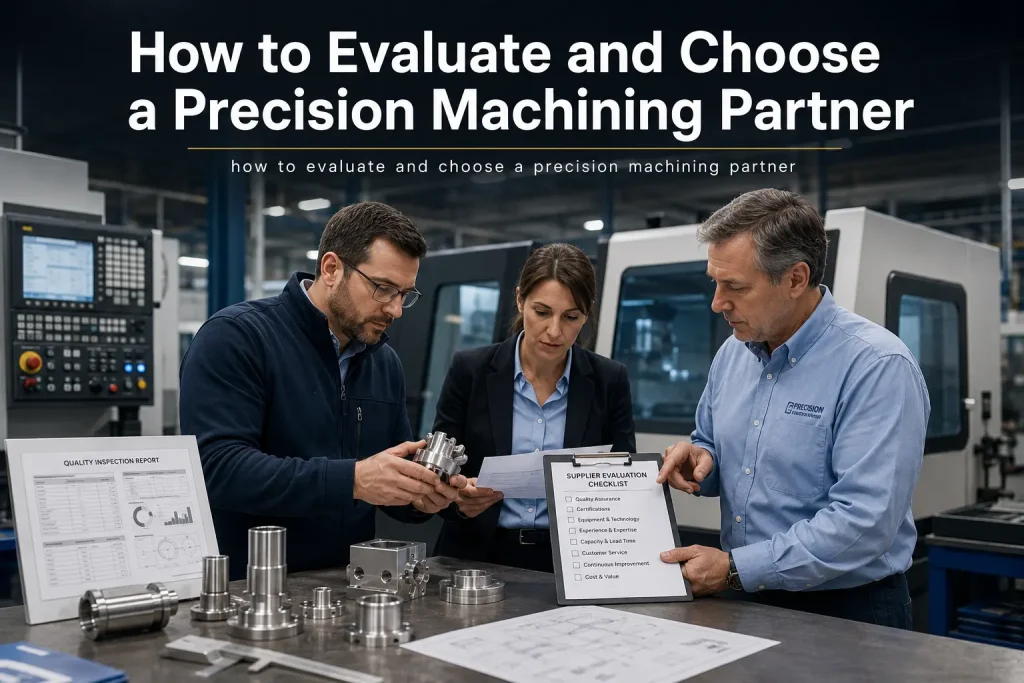
Choosing the wrong machining services provider costs more than the premium you save by going with the cheapest quote. Whether you need a full-production CNC machining service or a one-off prototype run, the selection process is the same. Here is a systematic framework for evaluating suppliers:
Step 1: Verify Certifications
Certifications are the baseline, not the ceiling. Look for:
- ISO 9001:2015: fundamental quality management system (minimum requirement)
- AS9100 Rev D: for aerospace supply chain
- ISO 13485: for medical device manufacturing
- ITAR Registration: required for defense components
- NADCAP: special process accreditation (heat treat, NDT, coatings)
Ask for current certificates and verify expiry dates. A lapsed certificate is as useful as no certificate.
Step 2: Assess Equipment Capability
Request a machine list. A credible precision machining shop should have:
- At least one 5-axis machining center
- CNC turning centers with live tooling
- Surface and/or cylindrical grinders
- CMM (Coordinate Measuring Machine) for inspection
- Wire EDM capability
If a shop cannot show you its equipment list, it likely cannot handle complex precision work.
Step 3: Evaluate Quality Control Process
Quality control is not just final inspection. It is built into every step of the process. Ask:
- Do you perform first-article inspection (FAI)?
- What inspection equipment do you use? (CMM, optical comparators, surface roughness testers)
- Do you provide full dimensional inspection reports with every shipment?
- What is your process for non-conforming material?
- How do you maintain material traceability?
Step 4: Review Sample Work and References
Request material certificates, inspection reports, and if possible, example parts from similar projects. Ask for references from customers in your industry and actually call them.
Step 5: Evaluate Communication and Responsiveness
Speed of response before you become a customer predicts speed of response after. A shop that takes four days to reply to a quote request will likely behave the same way when you need an urgent change in the middle of a production run.
The best precision machining partners assign a dedicated point of contact, provide proactive updates on job status, and flag potential design issues before cutting begins, not after.
Step 6: Understand Lead Times and Capacity
Ask about:
- Standard lead time for prototypes (typical: 3 to 7 business days for simple parts)
- Standard production lead time (varies widely: 2 to 8 weeks depending on complexity and volume)
- Whether they can accommodate rush orders, and at what premium
- Current capacity utilization (a shop running at 100% capacity will deprioritize your job)
8. Precision Machining Costs: What Drives the Price?
Precision machining is not cheap, and it should not be. The price of a CNC machining service varies enormously based on what is actually being asked of the machine and the operator. Understanding cost drivers helps you budget accurately, compare machining services quotes fairly, and avoid being caught off-guard.
Primary Cost Factors
1. Complexity of Geometry Simple turned parts are cheaper to machine than complex 5-axis milled components. Every additional setup, tool change, and axis of motion adds time and cost.
2. Tolerances Required Every step tighter in tolerance increases machining time significantly. Parts requiring +/-0.0001″ tolerance cost dramatically more than the same part at +/-0.005″. This is not because the machine is more expensive per hour, but because the cycle is slower, inspection is more intensive, and scrap rates are higher.
3. Material Titanium and Inconel cost several times more than aluminum, both in raw material price and machining cost (lower cutting speeds, faster tool wear). Stainless steel falls in the middle.
4. Surface Finish Requirement A 125 uin Ra finish comes off the mill with minimal extra work. An 8 uin Ra finish may require precision grinding as a separate operation.
5. Volume Setup time is amortized across parts. A 10-part run has a high per-piece cost because setup might take 4 hours for parts that each take 15 minutes to machine. A 1,000-part run spreads that same setup cost across the whole batch.
6. Inspection Requirements Full CMM inspection on every part, with printed reports, adds cost compared to sampling inspection. But for safety-critical applications, that cost is absolutely justified.
Typical Price Ranges
| Part Complexity | Volume | Approximate Cost Per Part |
|---|---|---|
| Simple turned part (aluminum) | 1-10 pcs | $50-$200 |
| Simple turned part (aluminum) | 500+ pcs | $8-$25 |
| Complex milled part (aluminum, 3-axis) | 1-10 pcs | $150-$600 |
| Complex milled part (aluminum, 5-axis) | 1-10 pcs | $400-$1,500 |
| Titanium medical component (5-axis + grind) | 1-10 pcs | $800-$3,000+ |
Note: These ranges are indicative. Actual pricing varies significantly by shop location, capacity, and part specifics.
9. Quality Control in Precision Machining
A part that does not meet its specifications is not just a cost. It is a liability. Robust quality control is what separates a precision machining shop from a general job shop.
Key Quality Control Processes
First Article Inspection (FAI) The first part produced from a new setup is fully inspected against every dimension on the drawing before production continues. FAI catches setup errors before they become production scrap.
In-Process Inspection Operators measure critical dimensions during machining, not just at the end. Modern CNC machines can incorporate probing systems that measure the workpiece automatically and adjust tool offsets in real time.
Coordinate Measuring Machine (CMM) Inspection CMM is the gold standard for dimensional verification. A touch probe or laser scanner maps the part’s geometry to micron-level accuracy, and the results are recorded in a dimensional report that accompanies the shipment.
Surface Roughness Measurement Surface finish is measured with a profilometer, which drags a stylus across the surface and calculates Ra (average roughness) and other parameters. This is critical for sealing surfaces, mating faces, and implant surfaces.
Material Certification Every batch of raw material should come with a mill certificate (chemical composition and mechanical properties), and that certificate number should be traceable to the finished parts. For aerospace and medical applications, this traceability is non-negotiable.
10. Common Mistakes Buyers Make When Sourcing Precision Machined Parts
After working across machining services environments for over two decades, from small job shops to AS9100-certified production facilities, here are the most costly mistakes we see repeatedly from buyers at every level of experience:
1. Choosing the Lowest Quote Without Verifying Capability A quote that is 40% cheaper than everyone else is a warning sign, not a bargain. Either the shop is cutting corners on material, inspection, or setup time, or it has misunderstood the scope of the job.
2. Over-Specifying Tolerances Engineers sometimes apply tight tolerances uniformly across all features “to be safe.” This can triple the cost of a part without improving its function. Only specify tight tolerances where the design genuinely requires them.
3. Sending Incomplete or Outdated Drawings Machining from an incomplete drawing or a file that does not match the latest design revision leads to scrapped parts and finger-pointing. Always send a clearly titled, fully dimensioned drawing in PDF along with the native CAD file.
4. Not Discussing Machinability Early Engage your machining partner early in the design phase. A small design change such as rounding an inside corner from sharp to 0.010″ radius, for example, can reduce machining time by hours on a complex part. Design for manufacturability (DFM) feedback from an experienced machinist is worth its weight in gold.
5. Ignoring Lead Time Requirements Until the Last Minute Precision machining shops plan capacity weeks ahead. Expecting a complex 5-axis job to be completed in 48 hours without prior notice is unrealistic and usually results in paying a significant rush premium, if the shop can accommodate at all.
6. Not Requesting Inspection Documentation Accepting parts without dimensional reports is accepting parts on faith. Always require documentation, especially for safety-critical or regulated applications.
11. Ready to Get a Quote?
If your project requires tight tolerances, fast turnaround, and dependable quality, the next step is straightforward: contact a certified precision machining services provider with your drawings and specifications.
When submitting a quote request, have the following ready:
- A fully dimensioned engineering drawing in PDF format
- 3D CAD file in STEP format (or SolidWorks, IGES, Parasolid)
- Material specification and any required certifications (e.g., RoHS, food-grade, biocompatible)
- Required tolerance callouts for critical features
- Target quantity and delivery date
- Any industry standards your parts must comply with (AS9100, ISO 13485, ITAR, etc.)
A good machining services provider will review your drawings, flag any Design for Manufacturability (DFM) concerns, and return a detailed quote that breaks down cost by operation, material, and inspection. If a shop returns a one-line quote with no breakdown, treat that as a red flag.
12. Frequently Asked Questions
What is the tightest tolerance precision machining can achieve?
With ultra-precision processes such as diamond turning or precision grinding combined with controlled-environment machining, tolerances of plus or minus 0.000050 inch (50 millionths of an inch) are achievable for optical components and semiconductor equipment. For standard CNC machining, plus or minus 0.0005 inch is a common achievable tolerance.
How long does a typical precision machining project take?
Simple CNC turned or milled prototypes typically take 3 to 7 business days. Complex 5-axis parts or jobs requiring multiple operations (milling plus grinding plus EDM) can take 2 to 4 weeks. Production runs are scheduled based on volume, complexity, and shop capacity.
What is the difference between a CNC machining service and precision machining?
A CNC machining service refers to any computer-controlled material removal process, including milling, turning, drilling, or cutting, performed on a CNC machine. Precision machining describes the level of accuracy achieved, with tolerances held to plus or minus 0.001 inch or tighter. Most precision machining is delivered through a CNC machining service, but not every CNC machining service is precision-grade. The shop’s process control, inspection capability, and operator expertise determine whether precision is actually achieved.
How much do precision machining services cost?
Cost depends on part complexity, material, tolerance requirements, surface finish, and volume. Simple aluminum parts can cost $10 to $50 each in production quantities. Complex titanium or Inconel components with tight tolerances may cost $500 to $3,000 or more per piece in prototype quantities. Always request a detailed quote based on your specific drawing.
What certifications should a precision machining shop have?
At minimum, look for ISO 9001:2015. For aerospace work, require AS9100 Rev D. For medical devices, require ISO 13485. For defense or military components, ITAR registration is required. Ask for current certificates and verify their validity.
Can precision machining services work with plastic and non-metallic materials?
Yes. Engineering plastics such as PEEK, Delrin, Nylon, PTFE, and Ultem are routinely precision machined. These materials require different cutting parameters than metals, and not all shops have experience with them. Always confirm material capability before sending your project.
What is the minimum order quantity for precision machined parts?
Most precision machining shops have no formal minimum order quantity. However, the economics of precision machining mean that 1-piece prototype orders cost significantly more per part than production runs, due to setup time. Many shops have a minimum order value (often $250 to $500) rather than a minimum part count.
What file formats are needed for a precision machining quote?
Provide a fully dimensioned engineering drawing in PDF (essential) and a 3D CAD model in STEP format (the universal standard). IGES, Parasolid, and SolidWorks native files are also widely accepted. Without a fully dimensioned drawing, a quote cannot be accurate.
What is a first article inspection (FAI) and when is it required?
FAI is a full dimensional inspection of the first part produced from a new setup, verifying that every dimension on the drawing is within tolerance before production continues. It is standard practice for aerospace and medical components and highly recommended for any precision part going into production, regardless of industry.
How do I know if my design is manufacturable?
Request a design for manufacturability (DFM) review from your machining partner before finalizing the drawing. Experienced machinists can identify features that are unnecessarily difficult or costly to machine, such as deep narrow pockets, sharp internal corners, or features that require multiple setups, and suggest alternatives that maintain function while reducing cost.
What is GD&T and does my drawing need it?
GD&T (Geometric Dimensioning and Tolerancing) is an engineering drawing language that defines tolerances for form, orientation, location, and runout, not just size dimensions. For complex precision parts with mating surfaces, tight positional requirements, or cylindrical features, GD&T provides more precise control than plus/minus dimensions alone. It is strongly recommended for aerospace, medical, and any high-precision application.
What happens if parts do not meet specifications?
A reputable precision machining shop has a documented non-conformance procedure. Non-conforming parts should be quarantined, reported to the customer, and either reworked (if possible) or scrapped and remade at the shop’s cost if the non-conformance is due to a machining error. Always confirm a supplier’s non-conformance process before placing an order.
Final Word: Precision Is Not a Feature. It Is a Commitment.
Precision machining services are not a commodity. The difference between a shop that holds tolerances and one that does not may not be visible until a part fails in the field. By then, the cost of that failure dwarfs whatever was saved on the original quote.
The right precision machining partner brings three things that no machine tool can substitute: engineering expertise, process discipline, and accountability. When you find a shop that combines all three with the certifications and equipment to back them up, you have found a manufacturing partner worth keeping.
Whether you need a single prototype to validate a design or a high-volume production run for a regulated industry, the principles are the same: define your requirements precisely, verify your supplier’s capability thoroughly, and demand documentation at every stage. The right CNC machining service provider will treat every job, large or small, with the same level of process discipline. That is how machining services are supposed to work, and when they do, the results speak for themselves.
You May Also Like It:
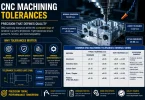
CNC Machining Tolerances: The Complete Expert Guide
Prototype CNC Machining: The Complete Expert Guide
Steel Grade: The Complete Guide to Understanding Every Type of Steel

[…] types rely heavily on precision machining. Parts such as gears, shafts, housings and bearings seats must hold very tight tolerances, which is […]