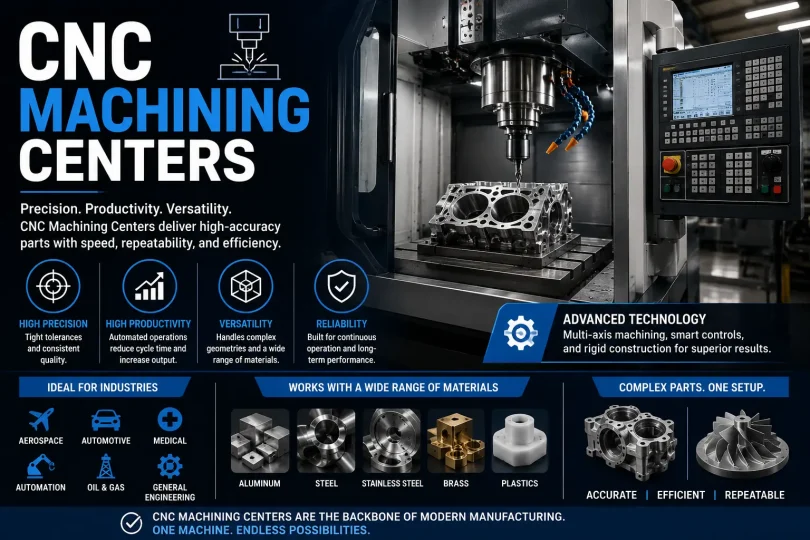

Walk into almost any modern manufacturing facility and you will find a CNC machining center at the heart of it. These machines transformed how the world makes parts. What used to take skilled machinists days of careful manual work can now be completed in hours, with repeatable precision measured in thousandths of an inch, shift after shift, without fatigue.
But choosing the right CNC machining center, understanding its true cost, and keeping it running at peak performance are far more complex than most buying guides let on. This article covers what those guides skip: the decisions that separate profitable shops from ones sitting on expensive, underutilized machines.
What Is a CNC Machining Center?
A CNC machining center is a computer-controlled machine tool that removes material from a workpiece using rotating cutting tools. Unlike a basic CNC mill, a machining center has an automatic tool changer (ATC), which lets it swap cutting tools mid-program without operator intervention. This single capability is what makes machining centers so productive: one setup can complete milling, drilling, tapping, boring, and contouring operations in sequence, automatically.
The “CNC” part stands for Computer Numerical Control. Every movement of the machine’s axes, spindle speed, feed rate, and tool change is directed by a program written in G-code (or generated by CAM software and then post-processed into G-code). The controller reads that program and translates it into precise commands to servo motors, which move the machine with micron-level accuracy.
Key components of every CNC machining center:
- Spindle: The rotating axis that holds and drives the cutting tool. Spindle speed (RPM), torque, and taper size determine what materials and operations the machine handles well.
- Automatic Tool Changer (ATC): A carousel or arm-type mechanism that stores tools and swaps them on command. Capacity ranges from 16 tools on basic machines to 300 or more on high-production horizontal centers.
- Axis drives and ballscrews: Precision-ground ballscrews driven by servo motors move the machine’s table and spindle. The quality of these components determines accuracy and long-term repeatability.
- CNC controller: The brain of the machine. It reads the program, manages all motion, and provides the operator interface.
- Coolant system: Delivers cutting fluid to the tool and workpiece to control heat, flush chips, and extend tool life.
- Machine structure (casting): The frame, column, and base. Rigidity here determines the machine’s ability to cut without vibration, which directly affects surface finish and tool life.
Types of CNC Machining Centers
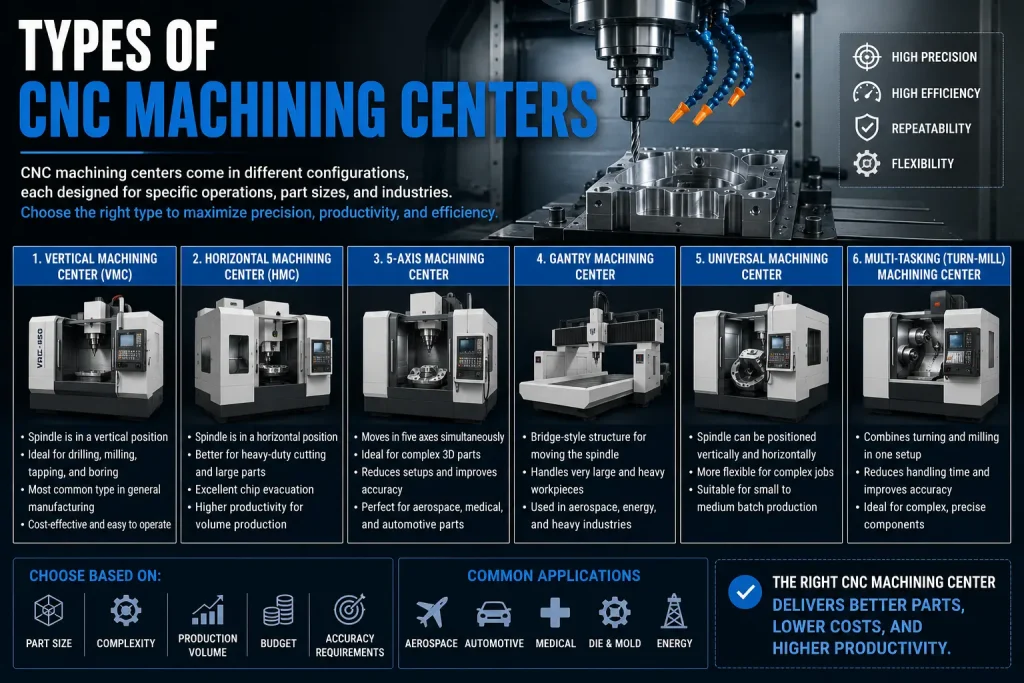
Understanding the different configurations is the first step to choosing the right machine for your work.
Vertical Machining Centers (VMC)
In a vertical machining center, the spindle is oriented vertically, pointing straight down at the workpiece. The cutting tool approaches the work from above.
Advantages:
- Lower initial cost than comparable horizontal machines
- Easier setup and part loading
- Good chip visibility during cutting
- Compact footprint
- Ideal for flat parts, mold cavities, and 3-axis work
Limitations:
- Chips can accumulate on the workpiece and re-cut, which affects finish and tool life
- Less suitable for complex multi-face parts without repositioning
- Gravity works against chip evacuation in deep pockets
VMCs are the most common choice for job shops, prototype shops, and general manufacturing where 3-axis work dominates.
Horizontal Machining Centers (HMC)
In a horizontal machining center, the spindle is horizontal, cutting into the side of the workpiece. Parts are typically fixtured on a rotary pallet, allowing the machine to access multiple faces in a single setup.
Advantages:
- Gravity-assisted chip evacuation: chips fall away from the workpiece instead of piling on it
- Pallet changer integration is standard on most HMCs, enabling continuous unmanned production
- Higher rigidity in many designs, allowing heavier cuts
- Excellent for prismatic parts needing access to four faces (or more with a rotary B-axis)
Limitations:
- Higher cost: HMCs typically run 2 to 3 times the price of a comparable VMC
- Larger footprint
- More complex setups
- Steeper learning curve for operators new to horizontal work
HMCs are the machine of choice for high-volume production, automotive components, and any application where continuous unmanned operation is the goal.
3-Axis, 4-Axis, and 5-Axis: What the Numbers Actually Mean
Most machining centers are described by how many axes of movement they have. This is one of the most misunderstood specifications in the industry.
3-Axis Machining Centers
Movement in X (left-right), Y (front-back), and Z (up-down). The workpiece stays fixed in one orientation throughout the cut.
- Best for: flat parts, simple prismatic parts, mold bases, 2D profiles
- Limitation: accessing more than one face requires manual repositioning, which introduces setup error and adds time
4-Axis Machining Centers
Adds a rotary A-axis (rotation around X), typically a fourth-axis rotary table mounted on the VMC table. This lets the machine index the part to cut features on multiple faces.
- Best for: parts needing features on two or more faces, camshafts, crankshafts, cylindrical parts with flats or holes around their circumference
- Note: Many 4-axis machines index (position and lock) rather than continuously interpolate. True continuous 4-axis interpolation is more capable but also more expensive
5-Axis Machining Centers
Adds two rotary axes of motion. In a trunnion (tilting rotary table) configuration, this is typically A and C axes. In a swivel-head configuration, it may be A and B. True simultaneous 5-axis machining means all five axes move at the same time during cutting.
What 5-axis actually gives you:
- Complex contoured surfaces (impellers, turbine blades, orthopaedic implants) in one setup
- Better tool access on deep features: the part tilts toward the tool, shortening effective tool length and dramatically improving rigidity and surface finish
- Reduced setups: a part that took five setups on a 3-axis machine may need only one on a 5-axis center
- Improved accuracy: each time you remove a part and refixtured it, you add potential positional error. Fewer setups means fewer error sources
What most guides miss: 5-axis does not mean 5-axis simultaneous. Many machines sold as “5-axis” are really 3+2, meaning they can position in 5 axes but only cut in 3 at a time. 3+2 is genuinely useful and significantly cheaper than full simultaneous 5-axis. Know which one you are buying.
Universal Machining Centers
A growing category that combines the benefits of vertical and horizontal configurations. The spindle head can tilt or rotate to orient the tool at various angles. Some universal centers can present the spindle both vertically and horizontally, effectively functioning as both a VMC and HMC on one footprint. These are particularly popular in aerospace and die/mold work.
The CNC Controller: The Decision Most Buyers Undervalue
The controller is the interface between your operator, your programs, and the machine’s axes. It affects programming complexity, training time, parts availability, service cost, and resale value. Most buyers focus entirely on the machine’s mechanical specs and treat the controller as an afterthought. That is a mistake.
Fanuc
Fanuc holds more than 65% of the global CNC controller market share. That number matters for several practical reasons:
- The widest service network of any controller brand
- The easiest to find service technicians who know it
- Parts are available almost everywhere in the world
- Post-processors for every major CAM package exist and are well-tested
- The highest resale value on the used machine market
Fanuc’s interface is not the most modern-looking, but it is proven, reliable, and supported for decades. If you are running a job shop or general-purpose manufacturing, Fanuc is the lowest-risk choice.
Siemens Sinumerik
Siemens Sinumerik (especially the 828D and 840D sl) is widely used in Europe and increasingly common in aerospace and high-precision shops in North America. Its CAD/CAM integration, surface quality cycles, and 5-axis interpolation capabilities are considered best-in-class by many engineers.
- More complex to program manually than Fanuc
- Excellent for shops doing high-complexity 5-axis work
- Strong in automotive and aerospace supply chains where European OEMs specify it
- Service can be harder to find outside major manufacturing regions
Haas Control
Haas machines run a proprietary control developed in-house. It is intuitive, well-documented, and backed by Haas’s own service network, which is one of the best in North America. If you buy a Haas machine, you get the Haas control. The ecosystem is tightly integrated.
- Very good for shops new to CNC
- Lower price point
- Some limitations in advanced 5-axis interpolation compared to Fanuc or Siemens at similar price points
Mazatrol (Mazak) and Okuma OSP
Both Mazak and Okuma run proprietary controls tied exclusively to their own machines. Mazatrol uses conversational programming that many operators find faster for simpler parts. Okuma’s OSP is known for reliability and its thermal compensation systems. Both companies have strong service networks in North America.
Practical advice: If your shop already runs a particular controller, standardizing on it across new machines reduces training costs and simplifies your programming workflow significantly.
Spindle Selection: High Speed vs. High Torque
The spindle is the most performance-critical component in a machining center, and the high-speed vs. high-torque tradeoff is one that many buyers get wrong.
Understanding the Tradeoff
Spindle power is the product of torque and speed. A spindle can be designed to produce its power at high RPM (high-speed, lower torque) or at lower RPM (higher torque). These are fundamentally different machines for different applications.
High-speed spindles (15,000 to 40,000+ RPM):
- Ideal for aluminum, plastics, and light alloys
- Small-diameter tools run at their required surface footage (SFM) without stress
- Better surface finish achievable on non-ferrous materials
- Not suitable for heavy steel roughing: high RPM with the torque demand of deep steel cuts will stall or damage the spindle
High-torque spindles (typically 6,000 to 15,000 RPM):
- Required for heavy steel, stainless, titanium, and Inconel machining
- Can run large-diameter face mills and heavy interrupted cuts
- Overkill for aluminum at light depths of cut
The common mistake: Buying a high-speed spindle because the RPM number sounds impressive, then struggling to rough steel efficiently. Or buying a high-torque machine and then finding it underpowered for the aluminum aerospace parts that make up 80% of your work.
Spindle Taper: BT, CAT, HSK, and Capto
The taper is how toolholders connect to the spindle. It is an often-overlooked spec that affects rigidity, tool change speed, and accuracy.
| Taper | Common Use | Notes |
|---|---|---|
| CAT 40 / CAT 50 | General industry, North America | CAT 40 is the most common in U.S. job shops. CAT 50 for heavier machines. |
| BT 40 / BT 50 | Asia and globally | Similar to CAT but with a different pull-stud thread. Not interchangeable with CAT. |
| HSK-A63 | High-speed, high-precision | Hollow taper with simultaneous face and taper contact. Superior rigidity and repeatability at high RPM. |
| Capto (Sandvik) | Modular tooling systems | Excellent for multi-tasking machines and turning centers. |
For most general-purpose shops: CAT 40 in North America, BT 40 elsewhere. For high-speed aluminum work or precision aerospace: consider HSK.
The Real Cost of a CNC Machining Center: Total Cost of Ownership (TCO)
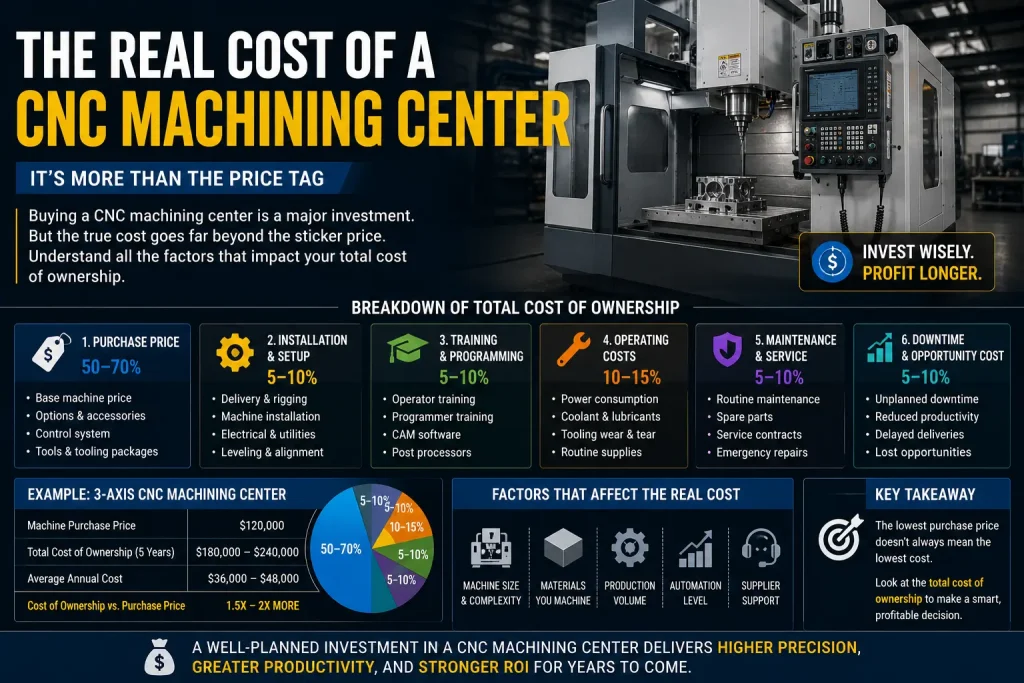
The purchase price of a machining center is only a fraction of what it will actually cost you. Most buyers anchor entirely on the sticker price and underestimate the 5-year cost by 40% to 70%.
Here is what a realistic TCO model must include:
Purchase Price and Financing
A basic vertical machining center from a reputable brand starts around $50,000 to $80,000. A mid-range VMC with full CNC runs $100,000 to $300,000. A quality horizontal machining center with a pallet changer runs $400,000 to $1,000,000 or more. 5-axis simultaneous machining centers start around $250,000 and can exceed $2,000,000 for large-format aerospace machines.
Financing at current rates adds 15% to 25% to the cost over a typical 5-year loan term.
Installation and Commissioning
Foundation work, rigging, leveling, coolant hookup, compressed air, and electrical work can add $5,000 to $30,000 depending on machine size and facility condition. Large machines on soft floors may require engineered concrete pads. Budget for this before the machine arrives.
Tooling
Tooling is a perpetual cost that most first-time buyers drastically underestimate. A starter tooling package for a new VMC, including toolholders, end mills, drills, taps, boring heads, probing, and workholding, routinely runs $15,000 to $50,000. Carbide cutting tools wear out and must be replaced continuously.
Energy
A typical 30 HP VMC running at full production draws 15 to 20 kW. At $0.12 per kWh and two-shift operation (roughly 4,000 hours per year), that is $7,200 to $9,600 per year in electricity alone. Larger machines cost more.
Maintenance and Consumables
Preventive maintenance costs for a well-maintained VMC typically run 1% to 3% of purchase price per year. This includes way oil, coolant replenishment, filter changes, lubrication system service, spindle bearing inspection, and ballscrew checks. Reactive repairs are far more expensive. A single spindle rebuild can cost $5,000 to $25,000 and takes the machine offline for days or weeks.
Coolant concentration must be checked and maintained every week. Neglecting coolant causes bacterial growth, corrosion of machine components, and drastically reduced tool life.
Labor
An experienced CNC machinist earns $25 to $60 per hour depending on region and skill level. A machine that runs well-written programs with good fixturing may need only periodic attention. A machine running poorly set up jobs requires constant intervention. The machine cost is often the smallest part of the total.
Downtime
Unplanned downtime is the most destructive hidden cost. Studies put the average cost of CNC machine downtime at $1,000 to $5,000 per hour when you include lost production, late delivery penalties, overtime to recover, and customer relationship damage. A single unplanned spindle failure can wipe out months of margin.
Calculating ROI Before You Buy
Buying a machining center is a capital investment, and it deserves the same financial rigor you would apply to any other major asset purchase.
A practical ROI calculation covers:
Revenue capacity added:
- How many parts can the machine run per shift, per year?
- What is the margin per part?
- What is the revenue value of that additional capacity?
Cost reduction:
- Are you replacing outside (subcontract) machining with in-house production?
- Are you replacing multiple older machines with one more capable one?
- Are you reducing setup time, scrap rate, or rework?
Payback period: A simple payback calculation: divide the total investment (machine + tooling + installation) by the annual net benefit (revenue added or cost reduced minus operating cost). Most shops target a 3- to 5-year payback on CNC capital equipment.
What most ROI calculations miss:
- Tooling cost is almost always underestimated
- Utilization rate: a machine running at 60% utilization produces 60% of its theoretical revenue. Plan realistically, not optimistically
- Training time: productivity ramps slowly in the first 3 to 6 months as programmers and operators develop proficiency on a new machine
- CAM software cost: professional CAM packages run $5,000 to $30,000 per seat plus annual maintenance
How to Buy a CNC Machining Center: A Practical Framework
Step 1: Define Your Work
Before talking to any dealer, document:
- The materials you will machine (aluminum, steel, stainless, titanium, plastics, composites?)
- Typical part dimensions and weights
- Required tolerances and surface finish
- Expected production volume (prototype, low-volume, high-volume?)
- How many operations a typical part requires
These answers determine axis configuration, spindle requirements, table size, and workholding strategy more precisely than any sales conversation will.
Step 2: Choose the Configuration
Use this as a starting framework:
| Work Type | Recommended Configuration |
|---|---|
| General job shop, 3-axis parts | VMC, CAT 40, 10,000 to 12,000 RPM spindle |
| Aluminum, high-speed work | VMC, HSK or CAT 40, 15,000+ RPM spindle |
| Four-face prismatic parts | VMC with 4th-axis or HMC |
| Heavy steel roughing | VMC with 40-taper high-torque spindle |
| Complex contours, aerospace | 5-axis simultaneous, HSK taper |
| High-volume production | HMC with pallet changer, automation-ready |
Step 3: Evaluate the Builder, Not Just the Machine
The machine you buy ties you to its builder’s service, parts supply, and application support for 10 to 20 years. Ask every potential supplier:
- How many service technicians do you have within 200 miles of my facility?
- What is your average response time for a spindle-down emergency?
- What is the parts availability guarantee and for how long after I buy?
- Can I speak with three current customers running a similar machine?
- What is the lead time for a spindle rebuild if mine fails?
- How is firmware and controller software updated, and what does that cost?
Step 4: Inspect the Demo Carefully
Never buy a machining center without a cutting demonstration in material similar to your work. During the demo, check:
- Spindle warm-up procedure: a well-designed machine has a programmed thermal warm-up cycle
- Listen for bearing noise or vibration during spindle runup
- Run a test part and measure it: verify the machine achieves the tolerances it is rated for
- Tool change speed: watch several tool changes. Arm-type changers are typically faster than carousel types
- Coolant system: confirm through-spindle coolant if you need it, check pressure and flow
Step 5: Negotiate Beyond Price
Price is negotiable, but so are:
- Extended warranty (move from 1 year to 2 or 3 years)
- Free operator and programmer training at the builder’s facility
- Included tooling or workholding package
- Installation and commissioning included
- First service or PM visit included
- Trade-in value for your existing equipment
Step 6: Plan Your Automation Strategy Early
If you plan to add a pallet changer, robotic loading, or bar feeder in the future, specify that intent before you buy. The machine must be automation-ready from the factory: this means the correct door orientation, sufficient table travel, compatible communication interfaces, and a controller that supports the interface your automation partner needs. Retrofitting these features after purchase is expensive and sometimes impossible.
Preventive Maintenance: What to Do and When
Maintenance is where machine life is made or lost. A machining center with a rigorous PM program will outperform a neglected machine of higher specifications. Here is a practical schedule:
Daily (every shift)
- Check coolant level and concentration (target: 6% to 10% for most applications, per fluid manufacturer’s data)
- Inspect coolant for signs of bacterial contamination (smell, discoloration, foaming)
- Check way lube oil level
- Verify chip conveyor is clear
- Wipe down guideways if accessible
- Run spindle warm-up cycle before production (especially in cold environments)
- Check for any active alarms or unusual sounds during the first cycle
Weekly
- Check lubrication unit oil level and alarm contacts
- Inspect and clean tool changer: remove chips from the magazine and changer arm
- Check coolant sump level and top up
- Inspect all axis covers and way wipers for damage
- Check filter elements on coolant and hydraulic systems
- Verify probe calibration if a probing system is in use
Monthly
- Check spindle bearings for temperature and noise with a contact thermometer or vibration analyzer
- Inspect ballscrew wipers
- Verify axis home position repeatability using a test bar and indicator
- Check and adjust coolant nozzles
- Inspect toolholders for wear, runout, and pull-stud condition
Quarterly
- Have a factory-trained technician check geometric accuracy: squareness, flatness, positioning error
- Drain and refill coolant sump with fresh coolant (or biannually depending on usage)
- Check spindle runout with a precision test bar and tenths indicator
- Inspect ATC arm and magazine for wear
Annually
- Full geometric inspection per ISO 10791 or equivalent
- Ballscrew backlash check and adjustment if needed
- Complete lubrication system service
- Controller battery replacement (prevents parameter loss on power failure)
- Verify calibration of any machine probing system
The number one maintenance mistake shops make: Neglecting coolant management. Bacterial contamination of coolant is the leading cause of corrosion damage inside machine tools, respiratory issues for operators, and accelerated way seal failure. Test concentration weekly. Change the coolant on a schedule, not just when it smells bad.
Automation and Lights-Out Manufacturing
The real productivity gain from a machining center comes when it runs unattended. Here are the main automation approaches:
Pallet Changers
A pallet changer lets the machine load and machine one pallet while an operator sets up the next one outside the machine. This eliminates setup time from the machine’s cycle. On an HMC, a linear pallet system (6, 12, or more pallets) can run an entire shift with minimal operator attention.
Robotic Loading
A robotic arm loads and unloads workpieces from the machine automatically. Works well for: high-volume repeat parts with consistent geometry, parts too heavy for safe manual handling, and facilities pursuing lights-out night shift production.
Requirements: the machine must have a load/unload position the robot can reach, a suitable gripper for the part geometry, and a controller interface the robot can communicate with (typically through M-codes or a digital I/O handshake).
Bar Feeders and Part Catchers
Common on turning centers but increasingly used on VMCs with 4th-axis rotary systems. The bar feeder supplies raw stock automatically; a parts catcher catches finished parts. Together, they can run unattended for hours.
In-Process Gauging
Touch probes mounted in the tool changer measure the part during machining, automatically offset tool wear, and catch out-of-tolerance conditions before the part is finished. This is one of the highest-ROI automation investments a shop can make: it eliminates scrapped parts, reduces manual inspection time, and enables true unattended production.
Industry Applications: Where CNC Machining Centers Work Hardest
| Industry | Typical Parts | Machine Preference |
|---|---|---|
| Aerospace | Structural frames, brackets, impellers, housings | 5-axis simultaneous, titanium and aluminum |
| Automotive | Engine blocks, cylinder heads, transmission cases | HMC with pallet automation, high volume |
| Medical devices | Implants, surgical instruments, housings | 5-axis, tight tolerances, often titanium or stainless |
| Oil and Gas | Downhole components, valve bodies, flanges | Heavy VMC or HMC, stainless and Inconel |
| Electronics | Enclosures, heat sinks, precision housings | High-speed VMC, aluminum |
| Mold and Die | Mold cavities, cores, electrodes | High-speed VMC or 5-axis, precise surface finish |
| General Job Shop | Mixed parts, prototypes, small batches | General-purpose VMC, 3- or 4-axis |
Emerging Technologies in CNC Machining Centers
Thermal Compensation Systems
Heat causes machine components to expand, which shifts the spindle position and degrades accuracy. Leading builders now use onboard sensors and software to measure and compensate for thermal displacement in real time. This is especially important for machines that run long programs or shift to shift in facilities without climate control.
IIoT and Machine Monitoring
Modern machining centers can transmit spindle load, axis currents, temperature, and cycle data to plant monitoring software through MTConnect or OPC-UA protocols. This enables:
- Real OEE (Overall Equipment Effectiveness) tracking
- Predictive maintenance based on actual spindle and axis performance trends
- Remote diagnostics by the builder’s service team
- Integration with ERP and MES systems for real-time production visibility
AI-Assisted Programming and Process Optimization
Several CAM and controller manufacturers are integrating AI tools that suggest optimal cutting parameters based on material database entries and machine-specific power data. These tools can reduce programming time and improve first-article success rates, especially on complex 5-axis work.
Hybrid Additive-Subtractive Machining
A small but growing category of machines combines directed energy deposition (a form of metal 3D printing) with CNC milling in one platform. Material is added and then immediately machined to final dimensions. Useful for repairing high-value components and creating complex geometries that cannot be machined from solid. Not yet mainstream but worth watching for shops in aerospace and energy repair work.
Common Mistakes to Avoid
Buying too small “to start.” A machine that is too small for your work creates bottlenecks immediately. The cost savings on a smaller machine are erased within months by the constraints it places on part sizes and cycle times.
Ignoring the service network. A great machine from a brand with no local service presence is a liability. Find out exactly how many service technicians the builder has within a reasonable drive of your facility before you sign anything.
Underestimating programming and training time. A new machine is not productive on day one. Budget 3 to 6 months of reduced efficiency as your team learns the machine’s characteristics, develops proven programs, and builds reliable fixturing.
Buying used without a spindle inspection. Spindle bearings and ballscrews are the most expensive wear items on any machining center. Before buying a used machine, insist on a third-party inspection that includes spindle vibration analysis and geometric accuracy checks. A machine that appears to run fine can have bearings close to failure.
Overlooking the controller software version. Old controller firmware can limit compatibility with modern CAM post-processors. Ask what version the controller is running and whether it can be updated.
Forgetting about chips. High-volume production generates enormous quantities of chips. Plan your chip management: conveyor type, chip cart size, coolant recovery, and how chips are removed from the facility. This is unglamorous but genuinely important for keeping cycle times consistent and machines clean.
Quick Glossary of Key Terms
- ATC (Automatic Tool Changer): Mechanism that stores and swaps cutting tools automatically during a program.
- Ballscrew: Precision-threaded screw that converts motor rotation to linear axis movement.
- G-code: The programming language CNC machines read. Contains movement coordinates, speeds, feeds, and machine commands.
- OEE (Overall Equipment Effectiveness): Metric combining availability, performance, and quality rate. World-class is generally considered 85%+.
- RPM: Revolutions per minute. Spindle speed.
- SFM (Surface Feet per Minute): The speed of the cutting edge against the workpiece. The right SFM depends on material and tool type.
- VMC: Vertical Machining Center.
- HMC: Horizontal Machining Center.
- Post-processor: Software that translates CAM toolpaths into G-code specific to a machine and controller combination.
- Runout: The amount a rotating tool or spindle deviates from a perfect circle. High runout reduces tool life and surface finish quality.
- Thermal compensation: Software that adjusts axis positions in real time to correct for heat-induced dimensional changes.
Final Words
A CNC machining center is not a commodity purchase. The machine you choose shapes what work you can take on, how profitably you can run it, and how competitive your shop is over the next decade or more.
The shops that get it right do the same things consistently: they define their work clearly before they buy, they evaluate service networks as seriously as specifications, they invest in tooling and software from the start, and they treat maintenance as a production activity, not an afterthought.
The machines that sit underutilized or go down at the worst moments almost always trace back to one of those areas being rushed. Take the time to get it right. The ROI will follow.
You May Also Like It:
CNC Machining Tolerances: The Complete Expert Guide
Prototype CNC Machining: The Complete Expert Guide
Steel Grade: The Complete Guide to Understanding Every Type of Steel