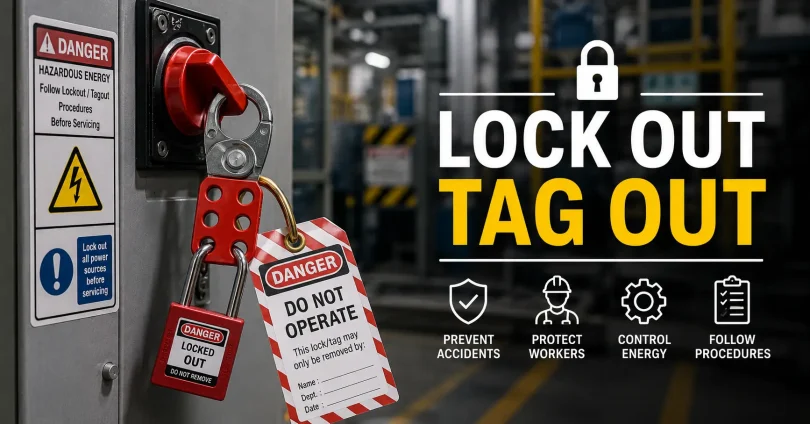

What Is Lock Out Tagout? (LOTO Meaning)
Lockout Tagout, or LOTO, is a critical workplace safety procedure under OSHA standard 29 CFR 1910.147 that protects workers from the unexpected release of hazardous energy while servicing or maintaining machinery. “Lockout” means physically locking a machine’s power source so it can’t be switched back on; “tagout” means attaching a tag warning others that it’s off-limits until work is finished. OSHA estimates that proper compliance prevents roughly 120 fatalities and 50,000 injuries in the U.S. every year making LOTO one of the most important, and most frequently cited, safety standards in the workplace.
Why Lock Out Tag Out Matters – The Real Risk
Every year, workers are killed or permanently injured because a machine unexpectedly started while someone was inside it, working on it, or standing nearby. Hazardous energy is not limited to electricity it includes:
- Electrical energy (most common circuit breakers, power lines, wiring)
- Mechanical energy (moving parts, rotating shafts, gears)
- Hydraulic energy (pressurized fluid lines)
- Pneumatic energy (compressed air systems)
- Thermal energy (steam, heat trapped in systems)
- Chemical energy (pressurized chemicals, reactive substances)
- Gravitational energy (suspended parts that can fall or shift)
A hydraulic press that appears powered down can still crush a hand if residual pressure remains. A chemical line that is valved off but not bled still holds dangerous pressure. A spring-loaded mechanism stores mechanical energy whether the power is on or off. This is exactly why lockout tagout procedures exist and why they must be followed every single time.
OSHA Lockout Tagout Standard – 29 CFR 1910.147
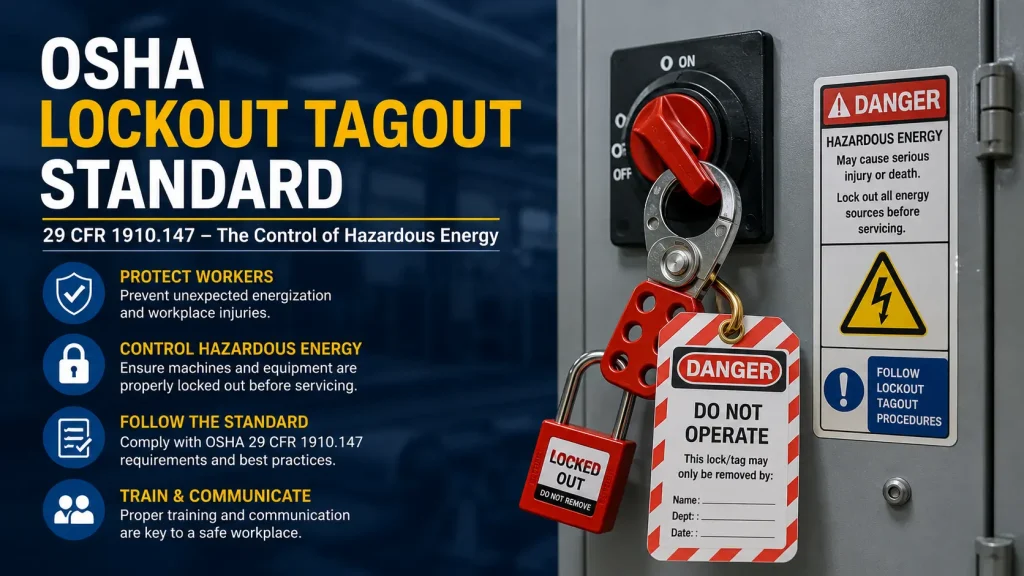
The legal foundation for all lockout tagout work in the United States is OSHA Standard 29 CFR 1910.147, officially titled “The Control of Hazardous Energy (Lockout/Tagout).”
This standard, first issued in 1989, applies to general industry and covers all servicing and maintenance activities where unexpected energization or release of stored energy could cause injury. It does not apply to:
- Construction work (covered under 29 CFR 1926 Subpart K)
- Agriculture or maritime sectors (separate standards apply)
- Minor tool changes or routine adjustments integral to production, if the machine is adequately guarded
OSHA LOTO Violation Penalties (2026 Update)
OSHA updated penalty amounts effective January 15, 2026:
| Violation Type | Maximum Penalty |
|---|---|
| Serious Violation | $16,550 per violation |
| Willful or Repeat Violation | $165,514 per violation |
Lockout tagout was cited as the 5th most frequently violated OSHA standard in fiscal year 2024, with 2,443 citations recorded. This makes LOTO compliance not just a safety priority but a financial and legal one.
Lockout vs. Tagout – What’s the Difference?
Many workers confuse these two terms. Here’s the clear distinction:
Lockout is the physical placement of a lock on an energy-isolating device (such as a circuit breaker, disconnect switch, or valve). The lock physically prevents the device from being turned on. Only the authorized employee who placed the lock holds the key.
Tagout is the placement of a standardized warning tag on the energy-isolating device. The tag identifies who applied it, when, and why serving as a communication tool, not a physical barrier.
Critical rule: Under OSHA 1910.147, lockout is always preferred over tagout alone. Tagout-only is permitted only when the energy-isolating device cannot physically accept a lock and even then, the employer must demonstrate that the tagout program provides equivalent protection. New equipment installed after January 2, 1990 must be designed to accept a lock.
The 8 Essential Lockout Tagout Steps (Step-by-Step Procedure)
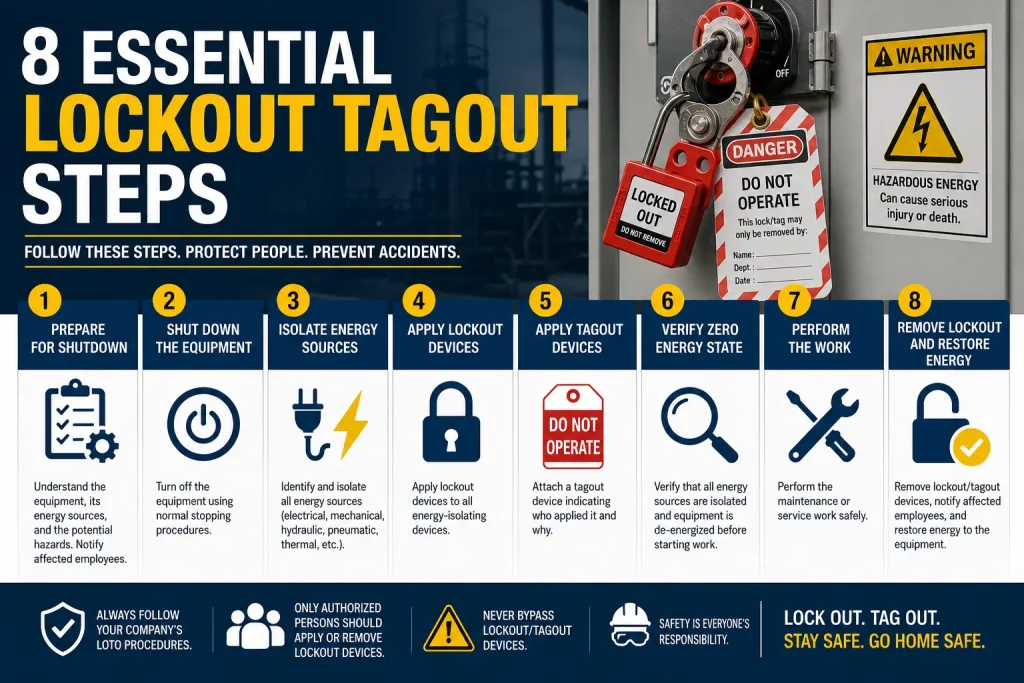
This is the heart of any LOTO program. Whether you’re following lockout tagout steps for the first time or training new employees, these 8 steps must be followed in order every time, without exception.
Step 1: Prepare for Shutdown
Before touching any equipment, the authorized employee must gather complete knowledge of:
- All energy sources connected to the equipment (electrical, hydraulic, pneumatic, thermal, etc.)
- The type, magnitude, and location of each energy source
- The specific hazards associated with those energy sources
- All required personal protective equipment (PPE)
- The documented energy control procedure for that specific machine
This step also means reviewing the written LOTO procedure for that piece of equipment. Never rely on memory alone documented procedures exist for a reason.
Step 2: Notify All Affected Employees
Communication is not optional it is a requirement. Before any shutdown begins:
- Inform all employees who operate or work near the equipment
- Tell them exactly which equipment will be taken offline
- Provide an estimated duration for the lockout
- Explain any changes to workflow or alternative equipment they can use during this period
If the lockout extends across shift changes, both the outgoing and incoming authorized employees must be present during the transition. The lockout must remain active and properly documented across all shifts.
Step 3: Shut Down the Equipment
Following the manufacturer’s recommended shutdown procedure and your documented energy control procedure:
- Bring the machine to a complete stop
- Follow the specific sequence outlined for that equipment some machines have multi-step shutdown sequences that differ from simply pressing “off”
- Do not rush or skip steps in the shutdown sequence
This step is about controlled, systematic de-energization not a quick switch-off.
Step 4: Isolate All Energy Sources
Once the equipment is powered down, isolate every energy source not just the primary one. This means:
- Switching off and opening all circuit breakers
- Closing all valves controlling hydraulic or pneumatic supply
- Unplugging power cords from their sources
- Pulling fuses or disconnecting electrical lines where required
- Employing blocking devices on moving parts to prevent gravitational energy release
Energy isolation must cover every source electrical, chemical, pneumatic, hydraulic, and mechanical. Missing even one source is where serious accidents begin.
Step 5: Apply Lockout/Tagout Devices
Now comes the physical lockout:
- Apply a lockout device (hasp and padlock) to each energy-isolating device
- Each authorized employee working on the equipment must attach their own individual lock no shared locks, no master keys permitted
- Attach a tagout tag to every lockout device, clearly listing the employee’s name, date, time, and reason for the lockout
If multiple workers are involved (group lockout), each person applies their own personal lock to the group lockbox. The group lockout device cannot be removed until every individual has removed their personal lock.
Step 6: Release or Restrain All Stored Energy
This step is where many workers make dangerous errors. Even after isolation, residual energy can remain in the system:
- Bleed hydraulic lines to release trapped pressure
- Vent compressed air or gas from pneumatic systems
- Release tension from springs and spring-loaded components
- Block or support suspended or elevated parts that could fall under gravity
- Allow thermal systems to cool down before proceeding
- Discharge electrical capacitors
Do not proceed to maintenance work until all stored energy has been fully dissipated or rendered non-hazardous.
Step 7: Verify the Isolation (LOTOTO – Tryout Step)
This step sometimes called the “tryout” in the LOTOTO (Lockout, Tagout, Tryout) framework is the most critical verification in the entire procedure:
- First, confirm that no personnel are in a position to be exposed to any hazard
- Attempt to operate the equipment using its normal controls (press the start button, activate controls)
- Check gauges and indicators visually to confirm zero energy state
- Return all controls to the OFF position immediately after verification
If the machine does not respond to the start command and gauges read zero the lockout is verified. If it does respond, stop immediately and return to Step 4 to identify the missed energy source.
This tryout step must not be skipped. It has saved lives.
Step 8: Perform Maintenance – Then Restore Equipment Safely
With the lockout verified, maintenance work can begin safely. When work is complete:
Restoration procedure:
- Remove all tools and non-essential items from the work area
- Ensure all machine components (guards, safety devices, access panels) are reassembled and intact
- Confirm that all workers have cleared the area and are in a safe position
- Return all controls to the neutral/off position
- Each authorized employee removes only their own lock never remove another worker’s lock
- Notify all affected employees that the lockout is being removed and the machine is returning to service
- Remove lockout/tagout devices and restore energy to the machine
Follow Lockout/Tagout Procedures in This Situation: When Does LOTO Apply?
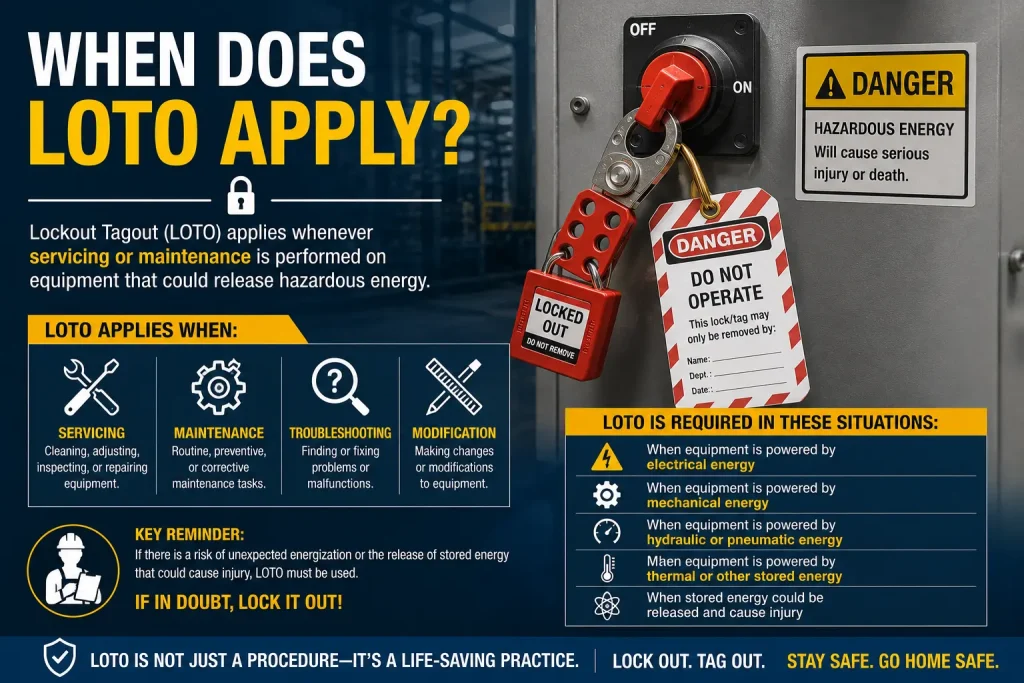
A common question: “In what situation do I follow lockout/tagout procedures?”
You must follow lockout tagout procedures in any situation where:
- A machine or equipment requires servicing, maintenance, repair, cleaning, or unjamming
- An employee could be exposed to unexpected energization or startup of that equipment
- Stored energy (electrical, hydraulic, pneumatic, etc.) could be released during the work
- An employee must place any body part into a point of operation or danger zone of a machine
LOTO is NOT required for:
- Normal production operations where the machine operates as designed with proper guarding
- Minor tool changes or adjustments that are routine, with the machine adequately guarded
- Work on cord-and-plug connected equipment, where the plug is under the exclusive control of the employee performing the work (plugging out serves as the “lockout”)
The 3 Types of Employees in a LOTO Program
OSHA identifies three distinct employee categories under 1910.147, each with different training requirements:
1. Authorized Employees These are the workers who actually perform lockout/tagout. They must be trained in:
- Recognition of all hazardous energy sources in their workplace
- The type and magnitude of energy present
- Methods for isolating and controlling energy
- How to use all LOTO equipment and devices
2. Affected Employees These are workers who operate the equipment that is being locked out, or who work in the same area. They must know:
- The purpose of the energy control procedure
- That they must never attempt to restart or re-energize equipment that is locked or tagged out
3. Other Employees Any employee who works in an area where energy control procedures are in use must be instructed in the purpose of the procedure and the prohibition against tampering with LOTO devices.
Building a Complete OSHA-Compliant LOTO Program
A proper lockout tagout program is not just a checklist it is a documented, living system. According to OSHA 1910.147(c), a compliant program must include:
1. A Written Energy Control Policy
Document your organization’s overall approach to hazardous energy control. This is the foundation.
2. Equipment-Specific Energy Control Procedures
For each piece of equipment, create a written procedure that details:
- All energy sources and their locations
- The type and magnitude of energy at each source
- Specific steps for shutdown, isolation, lockout, and restoration
- Photos identifying all energy isolation points (strongly recommended as best practice)
3. Proper LOTO Hardware
Select appropriate devices for each lockout point:
- Padlocks – individual, keyed differently for each authorized employee
- Hasps – allow multiple locks on a single isolation point
- Circuit breaker lockouts – designed to fit over breaker handles
- Valve lockouts – for ball valves, gate valves, plug valves
- Plug lockouts – for electrical cords and pneumatic hoses
- Cable lockouts – flexible devices for irregular isolation points
- Group lockboxes – for multi-worker lockout scenarios
4. Employee Training
Initial and ongoing training for authorized, affected, and other employees. Retraining is required whenever:
- An employee’s job changes
- There is reason to believe the employee does not understand the procedure
- A new or revised energy control procedure is introduced
5. Annual Periodic Inspections
Under OSHA 1910.147(c)(6), employers must conduct a periodic inspection at least once per year for each energy control procedure. The inspection must be performed by an authorized employee who is not currently using the procedure being inspected. Results must be certified in writing.
6. Regular Program Review
Your LOTO program should evolve with your workplace. Review it whenever:
- New equipment is added
- Existing equipment is modified
- Incidents or near-misses occur related to hazardous energy
- Regulatory requirements are updated
Group Lockout Tagout: Multi-Worker Procedures
When maintenance requires a team of workers, group lockout tagout adds an additional layer of coordination. Key requirements:
- A single authorized employee must assume overall responsibility for the group
- That employee implements the energy control procedures and coordinates the operation
- Each worker in the group applies their own personal lock to the group lockbox or hasp before beginning work
- The group lockout device cannot be removed until every individual has removed their personal device, confirming they have completed their portion of the work
- If the task spans multiple crews or departments, the coordination requirements increase accordingly
This system ensures no one can restore energy to the equipment while any team member is still working on it.
Common LOTO Mistakes That Lead to OSHA Citations
Understanding what commonly goes wrong helps you build a stronger program. These are the errors that appear most frequently in OSHA enforcement actions:
- Lack of documented procedures Using a verbal or informal process instead of written, equipment-specific procedures.
- Failure to address stored energy Isolating the primary power source but neglecting residual hydraulic pressure, charged capacitors, or spring tension.
- Shared or master keys Using a single key for multiple authorized employees defeats the individual-control requirement.
- Skipping the tryout step Not verifying isolation before beginning maintenance work.
- Inadequate training records Training was provided but not documented.
- Using tags in place of locks Applying a tagout tag where a lockout device could and should be used.
- LOTO not maintained across shift changes Removing locks at end of shift before work is complete.
Lockout Tagout Across Industries
LOTO is not limited to manufacturing. Any industry with equipment maintenance requirements must implement these procedures:
- Manufacturing The most common LOTO environment. Conveyor systems, presses, robotic equipment, packaging lines.
- Construction Covered under OSHA 29 CFR 1926 Subpart K, with specific requirements for construction sites.
- Healthcare HVAC systems, medical equipment maintenance, sterilization equipment.
- Food & Beverage Mixing equipment, conveyors, bottling lines, refrigeration systems.
- Oil & Gas Valve isolation, pipeline maintenance, pump servicing.
- Utilities Electrical distribution, water treatment equipment, power generation.
- Warehousing & Logistics Conveyor systems, forklifts, dock equipment.
LOTO Training: Who Needs It and How Often
Initial training must be completed before any employee performs lockout tagout duties or works in an area where LOTO is in use.
Retraining is required when:
- An inspection reveals an employee is not following the procedure correctly
- There are changes in the workplace or equipment that present new hazards
- There are new or revised energy control procedures
Training must be documented with employee names, dates, and the specific subjects covered. This documentation is what OSHA inspectors will ask for during an audit.
Reputable training sources include:
- OSHA’s own eTool: Lockout-Tagout Interactive Training Program (osha.gov)
- ANSI/ASSE Z244.1 Control of Hazardous Energy standard
- National Association of Safety Professionals (NASP) certification courses
Quick Reference: Lockout Tagout Checklist
Use this checklist before every lockout/tagout procedure:
Before starting:
- [ ] Energy control procedure reviewed for this specific equipment
- [ ] All energy sources identified and located
- [ ] All LOTO devices and PPE gathered
- [ ] Affected employees notified
During lockout:
- [ ] Equipment shut down per documented procedure
- [ ] All energy sources isolated
- [ ] Individual lock applied to every isolation point
- [ ] Tagout tag attached to every lock with name, date, and reason
- [ ] All stored/residual energy released or restrained
- [ ] Isolation verified via tryout (LOTOTO)
Before restoring equipment:
- [ ] All tools and materials removed from work area
- [ ] All machine guards and components reinstalled
- [ ] All workers cleared from the area
- [ ] All authorized employees removed their own locks only
- [ ] Affected employees notified of restoration
- [ ] Energy restored and equipment tested
Frequently Asked Questions About Lock Out Tag Out
Q: What does LOTO stand for?
LOTO stands for Lockout/Tagout a safety procedure that controls hazardous energy during equipment maintenance.
Q: What does lock out tag out mean in practice?
It means physically locking energy-isolating devices so a machine cannot be started, and attaching warning tags identifying who locked it out and why preventing accidental energization during maintenance.
Q: When must lockout tagout procedures be followed?
Whenever any employee is performing servicing or maintenance on equipment where unexpected energization or energy release could cause injury. This includes cleaning, unjamming, adjusting, inspecting, and repairing.
Q: Can a tagout tag replace a lock?
No. Under OSHA 1910.147, lockout is always preferred. Tagout alone is only permitted when the energy-isolating device cannot physically accept a lock, and equivalent protection must be demonstrated.
Q: How often must LOTO procedures be inspected?
At least once per year for each energy control procedure, by an authorized employee who is not the one using that procedure.
Q: What are the penalties for LOTO violations in 2026?
Serious violations can result in fines up to $16,550 per violation. Willful or repeat violations can reach $165,514 per violation.
Final Word: Lock Out Tag Out Saves Lives
Lockout tagout is not bureaucratic paperwork it is the difference between workers going home safely and catastrophic workplace accidents. The procedure is clear, the steps are proven, and OSHA’s standard provides a solid legal and practical framework.
Whether you are building a LOTO program from scratch, training new employees, or updating existing procedures to reflect changes in your workplace the principles remain constant: identify the hazards, isolate the energy, lock it out, verify it, and never skip a step.
Every worker who follows lockout tagout procedures properly is protected. Every shortcut is a gamble with someone’s life.
You May Also Like It:
CNC Machining Tolerances: The Complete Expert Guide
Prototype CNC Machining: The Complete Expert Guide
MIG vs TIG Welding: Complete Guide to Differences and Procedures