

Power to Choose is Texas’s official electricity shopping program that lets eligible residents in deregulated areas choose their electricity provider and plan. Through PowerToChoose.org, consumers can compare electricity rates, plans, contract terms, fees, and other details before switching providers.
However, having the right to choose does not always mean knowing which plan is best. This guide explains how Power to Choose works, what PowerToChoose.org offers, its limitations, how it applies in Houston and other deregulated Texas cities, and how to avoid common issues such as bill-credit traps and misleading teaser rates.
What Is Power to Choose in Texas?
Power to Choose is Texas’s official electric choice program. It exists because in 1999, the Texas Legislature passed Senate Bill 7, which restructured the state’s electricity market and separated the wires business (delivering power) from the retail business (selling power plans). Deregulation took effect for most of the state in 2002.
The result: instead of one monopoly utility billing you for both delivery and generation, Texans in deregulated areas now choose a Retail Electric Provider (REP) the company that sells the electricity while a separate Transmission and Distribution Utility (TDU), like CenterPoint Energy or Oncor, still owns the poles, wires, and meters and handles outages.
The Public Utility Commission of Texas (PUCT) built and maintains the official comparison tool for this system at powertochoose.org. It’s not a private company, it doesn’t sell your data to providers, and every licensed REP in the state is required to list its plans there. That’s what makes it “official,” and it’s the single most important fact to know before you start comparing electricity companies in Texas.
How powertochoose.org Actually Works
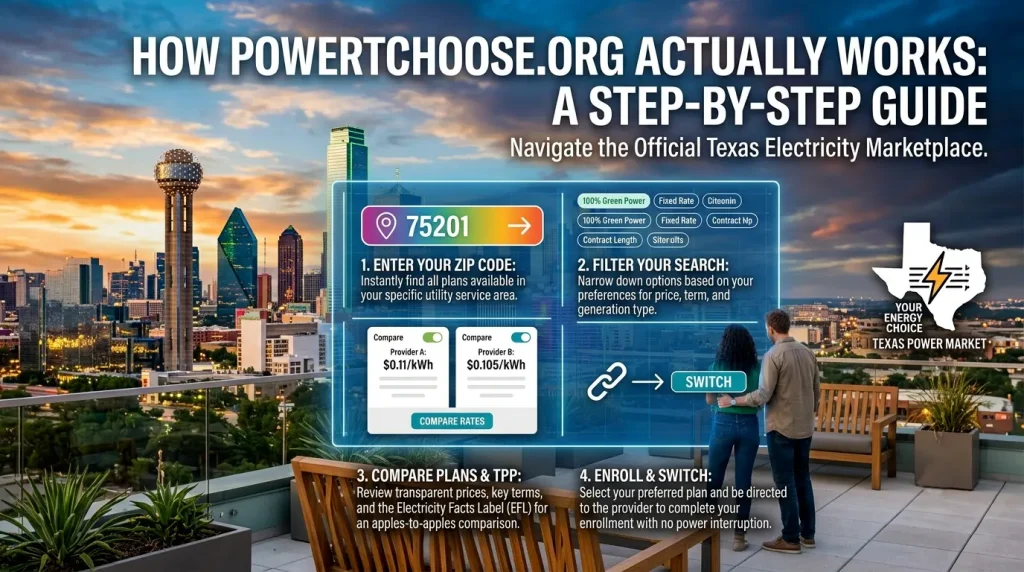
Using the official site is simple in concept:
- Enter your ZIP code. This tells the system which utility delivers power to your address and which providers are licensed to sell in that territory.
- Browse the plan list. You’ll see the provider name, plan name, contract length, renewable energy percentage, and an advertised price per kWh.
- Compare rates at three usage levels. PUCT displays pricing at 500, 1,000, and 2,000 kWh per month, along with a rating system and access to each plan’s official Electricity Facts Label (EFL) a standardized PDF that discloses the real rate structure, fees, and cancellation terms.
- Sign up directly with the provider you pick, either through the site or by phone.
That’s the theory. In practice, this is where most people get stuck and where being an informed shopper actually saves money.
Where Power to Choose Falls Short (Read This Before You Shop)
The official site is unbiased, but “unbiased” doesn’t mean “easy” or “complete.” A few structural issues catch new shoppers off guard:
- The three usage tiers don’t match real usage. Rates are shown at 500, 1,000, and 2,000 kWh. The average Texas home uses closer to 1,000–1,300 kWh a month, and usage swings by season so the advertised rate on the results page is frequently not the rate you’ll actually pay.
- Bill credits distort the “cheapest” price. Many plans include a bill credit that only kicks in at an exact usage level (say, 1,000 kWh). Use 999 kWh or 1,050 kWh instead, and the effective rate can jump several cents per kWh. This is the single biggest source of “why is my bill so much higher than advertised” complaints in Texas.
- No reviews, ratings, or provider vetting. Any licensed REP can list a plan. The site doesn’t flag customer service quality, complaint history, or how aggressive a provider’s marketing tends to be.
- Reading a stack of EFL PDFs is the only way to see the real terms, and there’s no side-by-side, plain-English summary built into the tool.
None of this makes powertochoose.org untrustworthy it’s still the authoritative source of what plans legally exist in your area. It just means the advertised top-of-list rate is a starting point for research, not a final answer.
Power to Choose Houston: What’s Different Locally
Houston is one of the largest and most competitive deregulated markets in Texas, which is good news and bad news at the same time: good news because it means dozens of providers actively compete for Houston customers, bad news because the sheer number of plans makes comparison shopping more overwhelming than in smaller markets.
A few things specific to using your power to choose in Houston:
- Your utility (TDU) is CenterPoint Energy, regardless of which retail provider you pick. CenterPoint delivers the electricity and handles outages; it does not set your energy rate and cannot be changed by switching providers.
- CenterPoint’s delivery charges are added to every plan, so they’re identical across providers the number that actually varies between plans is the energy rate, not the delivery fee.
- Providers commonly active in Houston include names like TXU Energy, Reliant, Gexa Energy, 4Change Energy, Frontier Utilities, APG&E, and Champion Energy Services, among 100+ others licensed statewide.
- Seasonality matters more in Houston than in milder climates summer air-conditioning load and winter cold snaps both push demand and, at times, plan pricing. Shoppers who lock in a fixed-rate plan during a mild season (spring or fall) tend to get better long-term rates than those shopping mid-heatwave.
- Because Houston’s deregulated market is so large, it’s also the market where alternative comparison tools and third-party marketplaces are most active which brings us to the next section.
Power to Choose vs. Third-Party Comparison Sites
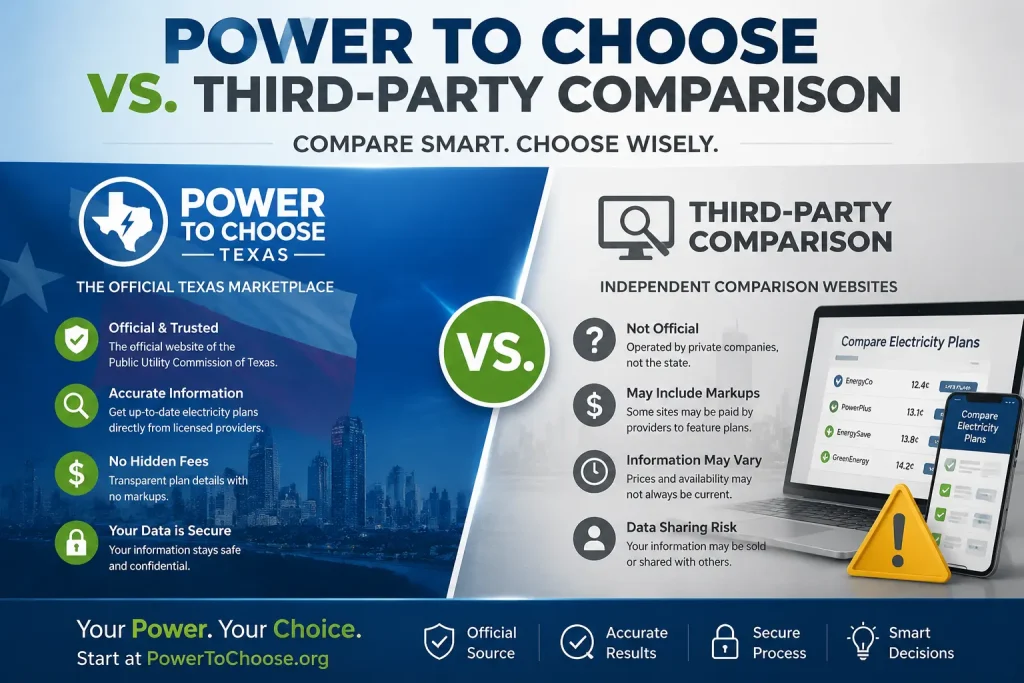
Searching for “power to choose” in Texas often surfaces more than the official government site. You’ll also see privately owned marketplaces such as ChooseTexasPower.org, Choose Energy, ElectricityPlans, and others. It’s worth understanding the difference clearly, because names like “Choose Texas Power” closely resemble the state’s own site despite being unaffiliated with the PUCT.
| powertochoose.org (Official) | Third-party marketplaces | |
|---|---|---|
| Operated by | Public Utility Commission of Texas | Private companies |
| Lists every licensed plan? | Yes, by law | No only partnered providers |
| Shows usage-based real bill estimates? | No (fixed 500/1,000/2,000 kWh tiers) | Some do, varies by site |
| Earns commission from sign-ups? | No | Usually yes |
| Editorial ratings/reviews? | No | Sometimes |
| Best for | Seeing the full, unfiltered market | Faster comparison with added tools, but a narrower provider list |
Neither option is “wrong.” The official site gives you the complete, neutral picture of every legal plan in your ZIP code. Third-party sites can simplify the process and sometimes model your actual bill more accurately but they only show you the providers they partner with, and their revenue comes from your enrollment, which is worth knowing going in.
How to Actually Choose a Good Plan (Step by Step)
- Know your real usage. Pull your last 12 months of bills if you have them, or estimate based on home size a typical Texas home uses roughly 1,000–1,300 kWh/month, more in summer.
- Filter by contract type first. A fixed-rate plan locks your per-kWh rate for the term (commonly 12, 24, or 36 months) and is the safer default for most households. A variable-rate plan moves with the wholesale market month to month flexible, but riskier during price spikes.
- Open the Electricity Facts Label, not just the headline rate. The EFL will show you the rate at your actual usage level, any base/minimum-usage fees, and the early termination fee (ETF) if you break the contract.
- Watch for credit-cliff pricing. If a plan’s low rate depends on hitting an exact usage number, calculate your cost a little above and a little below that number before committing.
- Match the contract length to your plans. Moving in the next year? A 12-month term avoids an early termination fee. Staying put? Locking a longer fixed term protects you from future rate increases.
- Confirm your utility (TDU) separately. Your delivery company doesn’t change no matter who you pick so don’t let a provider’s marketing conflate “switching providers” with “switching utilities.”
Who Actually Has the Power to Choose in Texas?
Not every Texas address is deregulated. Roughly 85% of the state falls under deregulated, ERCOT-served territory, primarily delivered by:
- Oncor (Dallas–Fort Worth and much of North/Central Texas)
- CenterPoint Energy (Houston and the surrounding Gulf Coast area)
- AEP Texas (Central and South Texas)
- TNMP (Texas-New Mexico Power, scattered service areas)
- LP&L (Lubbock, which joined deregulation in 2023)
Cities like Austin, San Antonio, and El Paso are served by municipally owned utilities and are not part of the deregulated market residents there don’t use Power to Choose because there’s no REP market to shop in. If you’re unsure which category your address falls into, entering your ZIP code on powertochoose.org will tell you immediately whether plans are available.
Frequently Asked Questions
Is powertochoose.org actually run by the government, or is it a private company?
It’s run by the Public Utility Commission of Texas, a state agency. It’s the only comparison site with a legal mandate to list every licensed provider’s plans.
Why do sites like “Choose Texas Power” show up when I search for Power to Choose?
Several private marketplaces have adopted similar names and .org domains. They are legitimate businesses in most cases, but they are not affiliated with the PUCT and only display a subset of providers typically the ones they’ve partnered with.
What’s the difference between my utility and my electricity provider?
Your utility (TDU) like CenterPoint Energy in Houston or Oncor in Dallas owns the physical wires and responds to outages. Your electricity provider (REP) is the company you pay for the energy itself and the one you’re actually “choosing” under this program.
Can businesses use Power to Choose too?
Yes. Commercial customers can shop for electricity providers the same way residential customers do, though business rates and contracts are typically more complex and are often negotiated directly with a provider or broker rather than through the standard residential comparison tool.
What’s a good electricity rate in Texas right now?
As of 2026, a competitive fixed-rate plan at 1,000 kWh of usage, all-in with delivery charges, generally falls in the 7–10¢/kWh range, with anything under 8¢/kWh considered a strong deal. Rates vary by utility territory and season, so always check current listings for your ZIP code rather than relying on a fixed benchmark.
Does deregulation cover natural gas too?
No. Power to Choose applies to electricity only. Texas does not have a comparable residential natural gas choice market.
The Bottom Line
Power to Choose gives Texans something genuinely valuable: a real, competitive market for electricity instead of a single monopoly bill. The official powertochoose.org site is the most complete and neutral place to see what’s legally available at your address, whether that’s in Houston, Dallas, or anywhere else in ERCOT territory. The real skill isn’t finding the site it’s reading past the advertised headline rate, checking the Electricity Facts Label, and matching a plan’s fine print to how your household actually uses power. Do that once, and you’ll likely lock in a fair rate for the length of your contract instead of an accidental teaser trap.
You May Also Like It:
Xcel Power Shut Off: Everything You Need to Know About PSPS Outages
Consumers Energy Power Outage: How to Report, Track, and Stay Safe
Green Power Energy: The Complete Guide to Clean, Renewable Electricity
Power vs Energy: What Is the Difference and Why Does It Matter?