
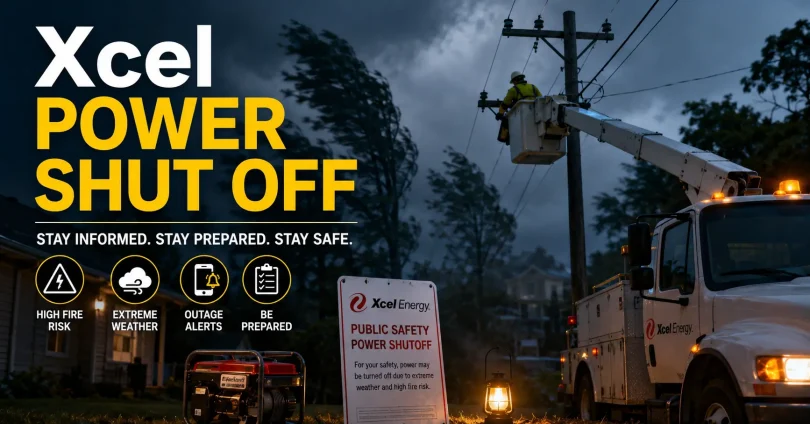

If your lights went out during a windstorm and someone mentioned “Xcel power shut off” or “PSPS,” you are not alone. Thousands of Xcel Energy customers across Colorado, Texas, New Mexico, and other service states have faced planned power shutoffs this year as the utility works to prevent wildfires during extreme weather.
This guide breaks down exactly what an Xcel power shut off is, why it happens, how long it usually lasts, and what you can do right now to protect your home, your medical devices, and your peace of mind before the next event.
What Is an Xcel Power Shut Off (PSPS)?
A Public Safety Power Shutoff, commonly shortened to PSPS, is a planned power shut off Xcel Energy uses to reduce the chance that its power lines spark a wildfire. Instead of waiting for damage to happen during dangerous wind and drought conditions, Xcel proactively cuts power to specific neighborhoods until the weather calms down and crews confirm the lines are safe.
This is different from a normal storm outage. A public safety power shutoff is a deliberate, planned decision made hours or sometimes a day in advance, based on forecasted conditions rather than actual equipment failure.
Xcel Energy has described PSPS as a last resort risk reduction strategy, used only after weighing wind speed, humidity, dry vegetation, and temperature, along with the location of critical infrastructure and vulnerable customers.
Why Does Xcel Shut Off Power?
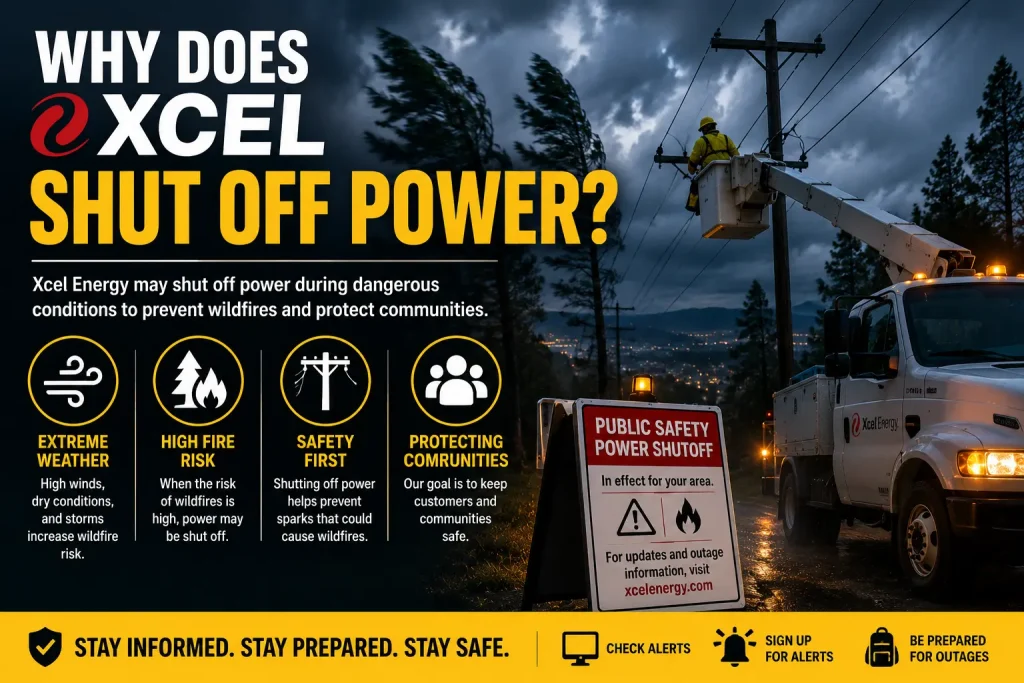
Xcel and other utilities across the western and central United States turn to power shutoffs mainly because of one thing: wildfire risk. Downed or damaged power lines during high winds can throw sparks into dry grass or brush, and a single spark under the wrong conditions can turn into a fast moving wildfire.
The main triggers Xcel monitors before calling a PSPS include:
- Sustained high winds, often 40 to 65 mph gusts or higher
- Red Flag Warnings issued by the National Weather Service
- Low relative humidity combined with dry ground conditions
- Elevated fire danger ratings in a specific region
- Proximity of power lines to dry vegetation or active wildfire activity
In several recent events, Xcel also activated Enhanced Powerline Safety Settings, or EPSS, alongside PSPS. EPSS makes power lines more sensitive so they shut off instantly if something like a tree branch touches them, which can cause additional short outages even outside the official shutoff zone.
Recent Xcel Power Shutoff Events
Xcel power shutoffs are not rare anymore. Over the past several months, the utility has enacted multiple PSPS events across its service territory:
- In mid-January, around 9,000 customers in Larimer and Weld counties, Colorado, lost power during a red flag wind event with gusts near 65 mph.
- In mid-February, roughly 14,500 customers across more than a dozen Texas Panhandle counties, including Potter, Randall, and Hutchinson, were affected by a shutoff tied to critical wildfire danger.
- In mid-March, Xcel planned for a shutoff impacting up to 18,000 customers in Boulder and Jefferson counties, Colorado, after initially warning as many as 43,000 residents could be affected.
Xcel restored power to all of these areas within a day or two once wind speeds dropped and crews finished inspecting lines, but the pattern shows these events are becoming a regular part of life in high fire risk regions.
How Long Does a Public Safety Power Shutoff Last?
There is no fixed timeline, and that is one of the most frustrating parts of a PSPS outage for customers. Restoration is not just about the weather clearing up. Xcel Energy has to physically patrol every mile of an affected power line and repair any damage before it is safe to turn the electricity back on.
Because of this inspection requirement, a power shut off tied to weather or PSPS can take anywhere from several hours to several days to fully restore, even after the wind has calmed down. Larger shutoff zones and widespread damage naturally take longer to clear.
Xcel Energy Outage Map and Address Lookup
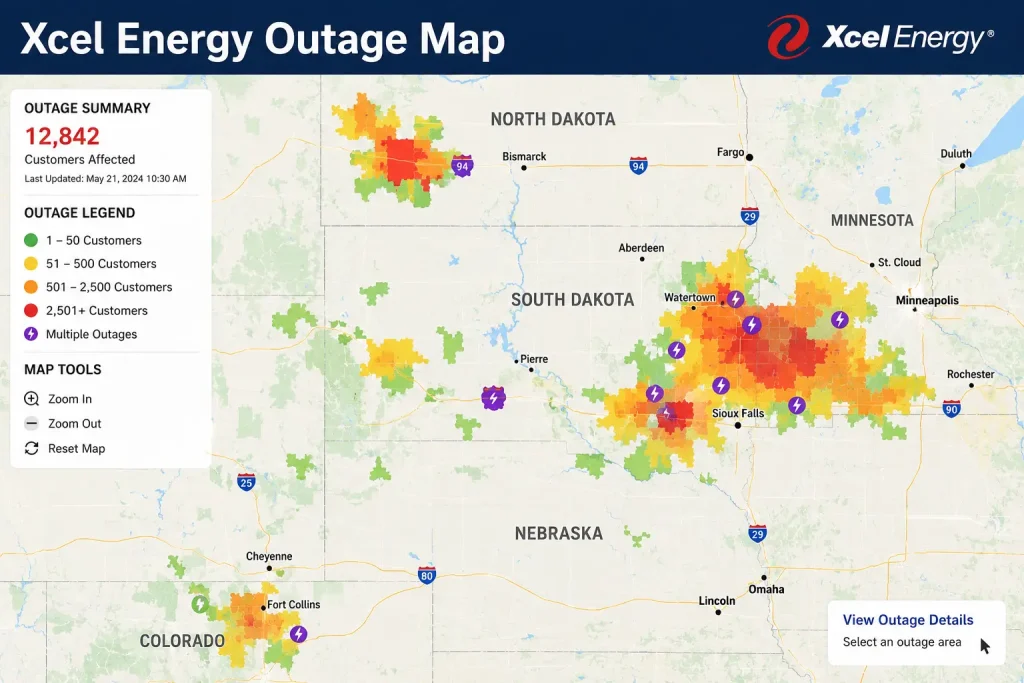
Before or during a PSPS event, Xcel Energy customers can check the utility’s outage map and PSPS lookup tool to see if their specific address falls inside a planned shutoff zone. This is the fastest way to know whether a power shut off in your area is planned, weather related, or something else like equipment failure.
If you are outside a designated PSPS zone but still lose power during a high wind event, Xcel recommends reporting it separately, since that outage is likely storm related rather than part of the planned shutoff.
How to Report an Outage or Check Status
Xcel Energy gives customers a few quick ways to report a power shut off or check on restoration progress:
- Xcel Energy mobile app, available on iOS and Android
- Text OUT to 98936 to report an outage, or text STAT to the same number for a status update
- Call 1-800-895-1999 for residential customers, or 1-800-481-4700 for business customers
- The Xcel Energy outage map and PSPS event update page online
Reporting downed lines or damaged poles helps crews prioritize repairs, so it is worth doing even if you assume everyone in your neighborhood is already affected.
How to Prepare for a Public Safety Power Shutoff
Because PSPS events are planned in advance, there is usually a short window to prepare once Xcel issues a warning. Here is a practical checklist:
Before an event is announced
- Sign up for Xcel Energy alerts by text, email, or phone so you get advance notice
- Keep a backup battery pack or generator ready if you rely on medical equipment
- Build a basic outage kit with flashlights, batteries, a battery powered radio, and non-perishable food
- Learn how to manually open a power operated garage door in case of an outage
Once a shutoff is likely
- Charge phones, laptops, and any backup batteries fully
- Fill your car’s gas tank in case you need to relocate or run a phone charger
- Set your refrigerator and freezer to their coldest settings to extend food safety
- Unplug sensitive electronics to protect them from any power fluctuation during restoration
- Check in on elderly neighbors or family members who may depend on electric medical devices
Are Customers Compensated for a Power Shut Off?
This is one of the most common questions customers ask, especially after losing food, income, or time due to an outage. Xcel Energy addresses this directly in its customer support materials, and the answer depends on the specific circumstances of each event and applicable state regulations. Customers with questions about reimbursement for spoiled food or lost income should contact Xcel Energy support or check their state’s public utilities commission for current rules, since this is an evolving area. In Colorado, for example, the Public Utilities Commission is actively developing permanent rules for how PSPS events should be communicated and managed, partly in response to customer feedback about the financial impact of repeated shutoffs.
PSPS vs. Regular Power Outage: What Is the Difference?
| Factor | PSPS (Planned Shutoff) | Regular Outage |
|---|---|---|
| Cause | Proactive wildfire prevention | Equipment failure, storm damage, accidents |
| Warning | Usually announced hours to a day ahead | Often no warning |
| Restoration | Requires full line inspection first | Repair crews go straight to the damage |
| Duration | Hours to several days | Varies, often shorter |
| Who is affected | Specific mapped zones | Localized to the fault point |
Frequently Asked Questions
What counties are most affected by Xcel power shutoffs?
Recent events have concentrated in Boulder, Jefferson, Larimer, and Weld counties in Colorado, along with several Texas Panhandle counties near Amarillo, though any part of Xcel’s eight state service territory can be affected during extreme wildfire risk weather.
Will my power definitely go out if I am in a PSPS zone?
Being inside a mapped PSPS zone means you are at high risk of losing power, but Xcel sometimes reduces the number of affected customers if conditions improve before the planned start time. Always check the latest update rather than assuming the original estimate is final.
Can I lose power even if I am outside the PSPS zone?
Yes. High winds themselves can knock out power lines outside the official shutoff area, and Enhanced Powerline Safety Settings can cause brief outages near the mapped zone as well.
Does Xcel Energy call this a blackout?
No. Xcel and most utilities avoid the term blackout for these events and instead use Public Safety Power Shutoff, since the outage is a deliberate safety measure rather than a grid failure.
The Bottom Line
An Xcel power shut off is not a sign of a broken grid. It is a deliberate wildfire prevention tool that Xcel Energy is using more frequently as wind events and dry conditions become more common across its service area. The best defense is preparation: sign up for alerts, know how to check the outage map for your address, and keep a basic emergency kit ready so a planned shutoff is an inconvenience rather than an emergency.
Stay ahead of the next event by bookmarking Xcel Energy’s PSPS update page and testing your outage reporting method before you actually need it.
You May Also Like It:
CNC Machining Tolerances: The Complete Expert Guide
MIG vs TIG Welding: Complete Guide to Differences and Procedures



[…] Xcel Power Shut Off: Everything You Need to Know About PSPS Outages […]