What Is HIRA?
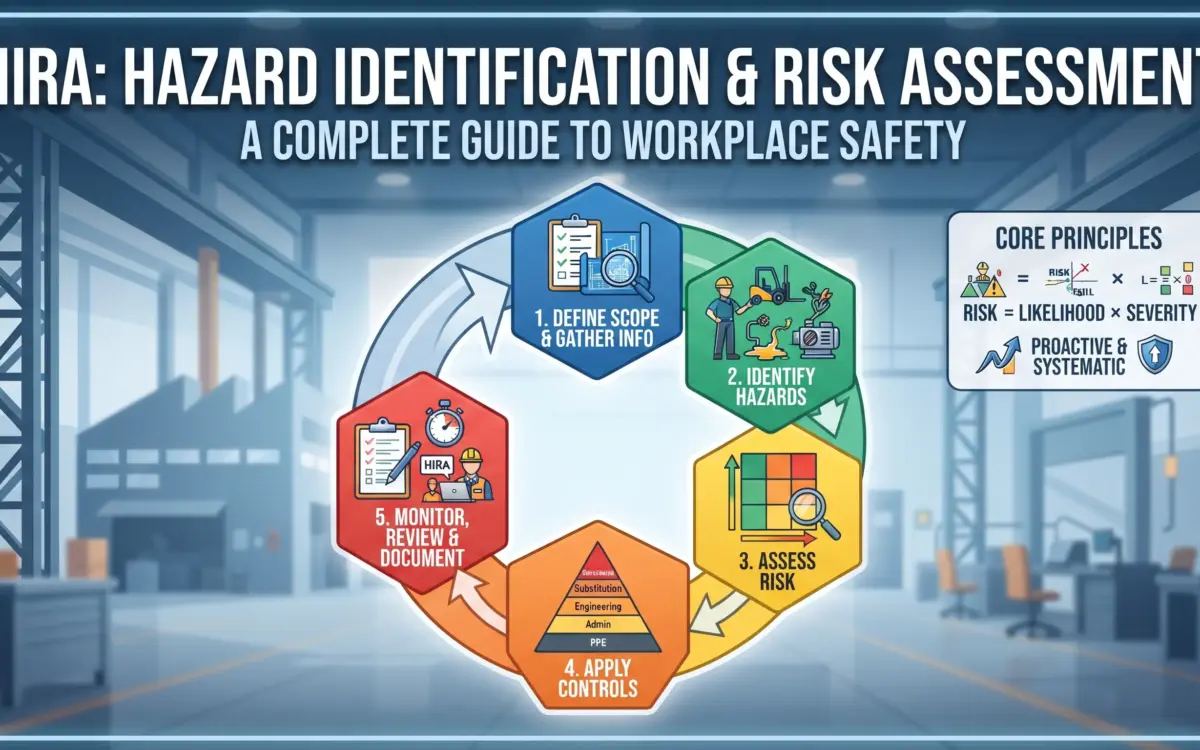
HIRA stands for Hazard Identification and Risk Assessment. It is a systematic safety process used to find what can cause harm at a workplace (hazards), measure how likely and how severe that harm could be (risk), and decide the controls needed to reduce it before an accident happens.
HIRA full form in safety: Hazard Identification and Risk Assessment. HIRA meaning in one line: a step-by-step method to spot hazards, rate their risk and control them.
| Quick Facts | Details |
|---|---|
| Full form | Hazard Identification and Risk Assessment |
| Purpose | Prevent accidents, injuries, illness and property loss |
| Core formula | Risk = Likelihood × Severity |
| Main steps | Identify hazards → Assess risk → Apply controls → Document → Monitor and review |
| Related standards | ISO 45001, ISO 31000, IEC 31010, OSHA |
| Used in | Factories, construction, oil and gas, chemical plants, warehouses, CNC workshops |
HIRA Full Form and Meaning
The term breaks down into two parts:
- Hazard Identification (HI): recognising anything with the potential to cause harm, such as moving machine parts, chemicals, noise, electricity, working at height or poor ergonomics.
- Risk Assessment (RA): estimating the chance that the hazard causes harm and how serious that harm would be, then ranking it so the worst risks are handled first.
People often search for “HIRA meaning”, “meaning of HIRA”, or “HIRA full form in safety”. In an industrial or HSE (Health, Safety and Environment) context, all of them point to the same answer: Hazard Identification and Risk Assessment.
Other Meanings of “Hira”
Outside safety, the word has other meanings, which is why some searches show unrelated results:
- Hira (هیرا / हीरा): in Urdu and Hindi, “heera/hira” means diamond. It is also a common given name.
- HIRA (Korea): the Health Insurance Review and Assessment Service in South Korea.
This article is only about HIRA in occupational health and safety.
Hazard vs Risk: The Key Difference
| Term | Meaning | Example |
|---|---|---|
| Hazard | Anything that can cause harm | A rotating spindle on a CNC machine |
| Risk | The chance that the hazard harms someone, combined with how severe the harm would be | The chance of an operator’s hand touching the spindle and losing a finger |
| Control measure | Action that removes or reduces the risk | Interlocked machine door, training, gloves |
A hazard can exist without much risk (a sharp tool locked in a cabinet). Risk increases when exposure, likelihood and severity increase.
Why HIRA Is Important
- Prevents accidents before they happen: it is proactive, not reactive.
- Meets legal and standard requirements: ISO 45001 requires hazard identification and risk assessment, and OSHA-style regulations expect employers to assess workplace hazards.
- Prioritises resources: high-risk items get attention and budget first.
- Reduces cost: fewer injuries, downtime, insurance claims and equipment damage.
- Builds safety culture: involving workers makes them aware and accountable.
- Supports audits and training: the HIRA register is evidence of due diligence.
Types of HIRA
- Baseline risk assessment: the first assessment done for a process, area or job to identify all existing hazards.
- Issue-based (or change-based) risk assessment: done when something changes, such as a new machine, material, process, incident or regulation.
- Continuous risk assessment: ongoing, part of daily observations, inspections and toolbox talks.
Types of Hazards Covered in HIRA
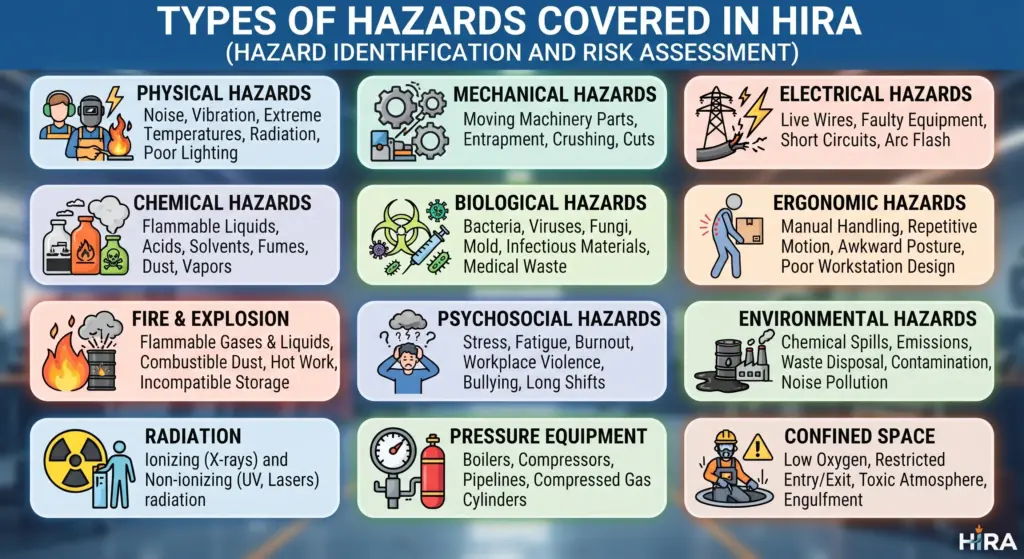
| Hazard Type | Examples |
|---|---|
| Physical | Noise, vibration, heat, radiation, poor lighting |
| Mechanical | Moving parts, pinch points, flying chips, unguarded machines |
| Electrical | Live wires, damaged cables, static, arc flash |
| Chemical | Coolants, solvents, acids, fumes, dust |
| Biological | Bacteria, mould, infectious materials |
| Ergonomic | Heavy lifting, repetitive motion, poor posture |
| Fire and explosion | Flammable liquids, gases, combustible dust |
| Psychosocial | Stress, fatigue, long shifts, violence |
| Environmental | Spills, emissions, waste |
HIRA Process: Step-by-Step
Step 1: Define the Scope and Gather Information
Decide which activity, area, machine or process you are assessing. Collect process descriptions, SOPs, drawings, incident records, safety data sheets (SDS) and maintenance history.
Step 2: Identify the Hazards
Break the job into small tasks and ask “what can go wrong?” for each. Use workplace inspections, worker interviews, job observation, checklists and past accident data. Involve the people who actually do the work.
Step 3: Assess the Risk
For each hazard, decide who can be harmed, how often they are exposed, how likely an incident is and how severe it would be. Rate it using a risk matrix (shown below).
Step 4: Decide and Apply Controls
Select controls using the hierarchy of controls, assign a responsible person and a deadline, then re-rate the risk to get the residual risk (risk remaining after controls).
Step 5: Document, Communicate, Monitor and Review
Record everything in the HIRA register, communicate it to workers and supervisors, and review it regularly and after any incident, change in process, or new equipment.
Risk Matrix (Likelihood × Severity)
The most common method is a 5×5 risk matrix. Likelihood and severity are each scored from 1 to 5 and multiplied.
| Likelihood ↓ / Severity → | 1 Negligible | 2 Minor | 3 Moderate | 4 Major | 5 Catastrophic |
|---|---|---|---|---|---|
| 5 Almost certain | 5 | 10 | 15 | 20 | 25 |
| 4 Likely | 4 | 8 | 12 | 16 | 20 |
| 3 Possible | 3 | 6 | 9 | 12 | 15 |
| 2 Unlikely | 2 | 4 | 6 | 8 | 10 |
| 1 Rare | 1 | 2 | 3 | 4 | 5 |
| Risk Score | Risk Level | Action Required |
|---|---|---|
| 1–4 | Low | Accept; monitor |
| 5–9 | Medium | Control within a defined timeframe |
| 10–16 | High | Immediate attention; senior approval to continue |
| 17–25 | Extreme | Stop work until controls reduce the risk |
Bands vary between organisations; use the scale defined in your company’s safety management system.
Hierarchy of Controls
Controls should be selected from the most effective to the least effective.
| Level | Control | Example |
|---|---|---|
| 1 | Elimination | Remove the hazard completely (e.g., automate a manual loading task) |
| 2 | Substitution | Replace with something safer (e.g., a less toxic coolant) |
| 3 | Engineering controls | Guards, interlocks, ventilation, emergency stops |
| 4 | Administrative controls | Procedures, training, signage, job rotation, permits |
| 5 | PPE | Safety shoes, glasses, gloves, ear protection (last line of defence) |
PPE should never be the only control for a serious hazard because it does not remove the hazard.
HIRA Methods and Techniques
| Technique | Best For |
|---|---|
| Checklists | Routine inspections, simple work areas |
| JSA / JHA (Job Safety/Hazard Analysis) | Task-level hazards for specific jobs |
| What-If Analysis | Brainstorming possible failures |
| HAZOP | Chemical and process plants |
| FMEA | Equipment and component failures |
| Fault Tree Analysis (FTA) | Tracing causes of a major incident |
| Bow-Tie Analysis | Showing causes, consequences and barriers visually |
HIRA vs JSA: HIRA is broader and covers the whole process, area or activity, while a JSA (Job Safety Analysis) focuses on the steps of one specific job.
HIRA Format (Template)
A standard HIRA register contains these columns:
| Column | What to Write |
|---|---|
| Activity / Process | The task or area being assessed |
| Hazard | What can cause harm |
| Risk / Consequence | What could happen |
| Who may be harmed | Operator, maintenance staff, visitors, etc. |
| Existing controls | What is already in place |
| Likelihood (L) | 1–5 |
| Severity (S) | 1–5 |
| Risk rating (L×S) | Score and level |
| Additional controls | Actions required |
| Responsible person and deadline | Who and by when |
| Residual risk | Rating after controls |
HIRA Example: CNC Machine Shop
| Activity | Hazard | Consequence | L | S | Risk | Controls | Residual Risk |
|---|---|---|---|---|---|---|---|
| Loading a workpiece on a CNC milling machine | Rotating spindle and cutter | Cuts, amputation | 3 | 5 | 15 (High) | Door interlock, spindle stops before opening, training, lockout during setup | 1×5 = 5 (Medium) |
| Machining with coolant | Slippery floor, mist inhalation | Slips, respiratory irritation | 4 | 3 | 12 (High) | Mist extractor, anti-slip mats, spill kit, housekeeping schedule | 2×2 = 4 (Low) |
| Handling heavy fixtures | Manual handling | Back injury | 3 | 4 | 12 (High) | Overhead crane, lifting aids, training | 1×4 = 4 (Low) |
| Chip removal | Sharp hot chips | Cuts, burns | 4 | 3 | 12 (High) | Chip hook and brush (never bare hands), cut-resistant gloves, safety glasses | 2×3 = 6 (Medium) |
See also: CNC Machine Safety Rules and CNC Milling Machine.
Who Conducts HIRA?
HIRA should be carried out by a competent team, not a single person. A typical team includes the HSE officer or safety engineer, process or area supervisors, operators who do the actual work, maintenance personnel, and where needed, a process or equipment specialist.
When Should HIRA Be Reviewed?
- At least once a year, or as per company policy
- Before starting a new process, project or job
- After installing new machinery or changing materials
- After an accident, near-miss or audit finding
- After a change in law or standards
HIRA and Safety Standards
- ISO 45001: requires organisations to have processes for ongoing hazard identification and risk assessment.
- ISO 31000 and IEC 31010: general risk management principles and assessment techniques.
- OSHA (US): requires employers to assess hazards and protect workers.
- Local factory and labour laws: many countries have specific requirements for risk assessment in factories.
Always check the regulations that apply in your country and industry.
Common HIRA Mistakes to Avoid
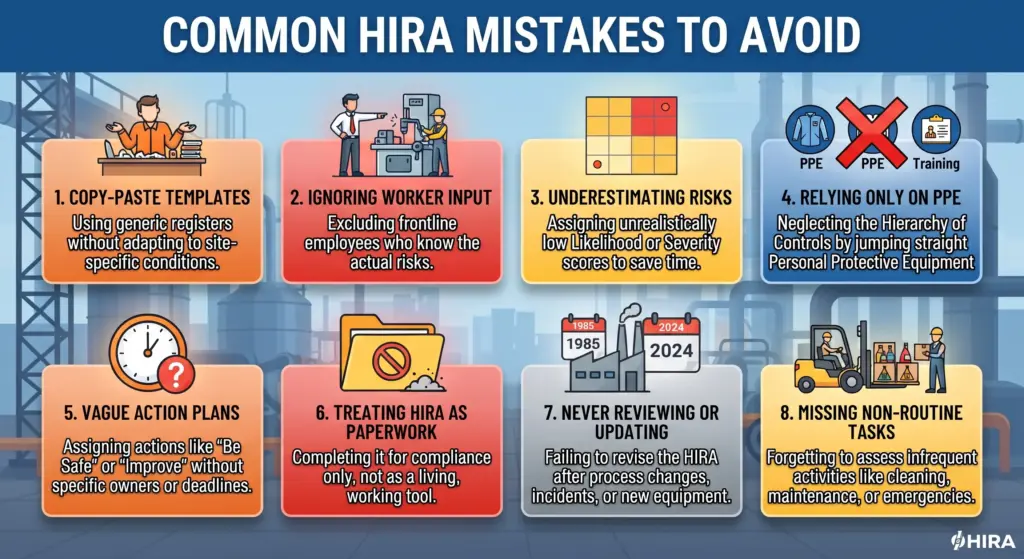
- Copying a template without adapting it to the actual site
- Assessing only the job and ignoring maintenance, cleaning and emergencies
- Not involving workers
- Relying on PPE and administrative controls only
- Giving vague actions with no owner or deadline
- Never reviewing the register after changes
- Treating HIRA as paperwork instead of a working tool
Frequently Asked Questions
What is the full form of HIRA?
HIRA stands for Hazard Identification and Risk Assessment.
What is HIRA in safety?
In safety, HIRA is the process of identifying workplace hazards, evaluating their risk and putting controls in place to prevent injuries and incidents.
What are the steps of HIRA?
Define scope, identify hazards, assess risk, apply controls, then document, communicate, monitor and review.
What is the formula for risk in HIRA?
Risk = Likelihood × Severity (probability of occurrence multiplied by the seriousness of the outcome).
What is the difference between hazard and risk?
A hazard is something that can cause harm. Risk is the chance of that harm happening combined with how severe it would be.
What is the difference between HIRA and JSA?
HIRA assesses hazards across a whole process or area, while JSA breaks one specific job into steps and checks hazards at each step.
How often should HIRA be done?
At least annually, and whenever there is a process change, new equipment, an incident or a regulatory change.
Is HIRA mandatory?
In many industries and countries, risk assessment is a legal requirement, and ISO 45001 certification requires it. Check your local regulations.
Conclusion
HIRA, or Hazard Identification and Risk Assessment, is the foundation of any workplace safety programme. By identifying hazards, scoring risks with a matrix, applying the hierarchy of controls and reviewing regularly, organisations can prevent injuries, stay compliant and build a stronger safety culture. A good HIRA is practical, specific to your site, built with worker input and kept up to date.
You May Also Like It:
Industrial Safety Products: The Complete Guide to Protecting Your Workforce
Industrial Fire Safety Checklist: The Complete Guide
Industrial Safety Signs: The Complete Guide to Types, Meanings, Colors, and Standards