
You pull out the oil dipstick for a routine check, take a whiff, and something stops you cold it smells like gasoline. That is not normal, and your instinct to worry is correct. When oil smells like gas, it almost always means one thing: fuel has found its way into your engine oil, a condition mechanics call fuel dilution. And if you leave it alone, it can quietly destroy your engine from the inside.
The good news? You caught it. That means you have time to diagnose the cause and fix it before serious damage sets in.
This guide covers every major reason your engine oil smells like gas, the symptoms that confirm it, how serious the problem really is, and exactly what you need to do next explained in plain language, no mechanical degree required.
What Does It Mean When Oil Smells Like Gas?
When your engine oil smells like gas, it means gasoline has leaked into the crankcase the lower part of the engine where oil lives. Engine oil and gasoline are two completely separate fluids that travel through entirely different systems inside your engine. They are never supposed to mix. When they do, the gasoline dilutes the oil, weakening its ability to lubricate, cool, and protect your engine’s moving parts.
Mechanics call this condition fuel dilution. Even a small amount of gasoline in the oil as little as 2 to 3 percent of the total oil volume can noticeably degrade the oil’s protective performance. More than that, and you are looking at real engine risk.
Is It Serious? What Fuel Dilution Does to Your Engine
Yes fuel dilution is serious, and the reason comes down to simple chemistry. Engine oil is designed to be thick and viscous. That thickness is what allows it to coat metal surfaces and keep them separated, preventing metal-on-metal contact. Gasoline is thin, light, and volatile. When it mixes into the oil, it acts like a solvent thinning the oil and destroying the protective film it forms on engine components.
Here is what that means in practice:
Gasoline in the oil reduces viscosity. The oil becomes too thin to properly lubricate bearings, cylinder walls, and camshaft lobes. Those components then run with insufficient protection, generating excess heat and accelerating wear.
The oil loses its ability to absorb and transfer heat away from engine parts, increasing the risk of overheating.
Gasoline also degrades oil’s oxidation resistance, causing the oil to break down faster and form sludge deposits that clog oil passages.
In worst-case scenarios particularly if the contamination is severe or goes unaddressed for a long time fuel dilution can cause premature bearing failure, scored cylinder walls, and the kind of engine damage that requires a full rebuild or replacement.
The bottom line: do not drive a vehicle whose oil smells like gas. Change the oil, find the cause, and fix it.
7 Reasons Your Engine Oil Smells Like Gas
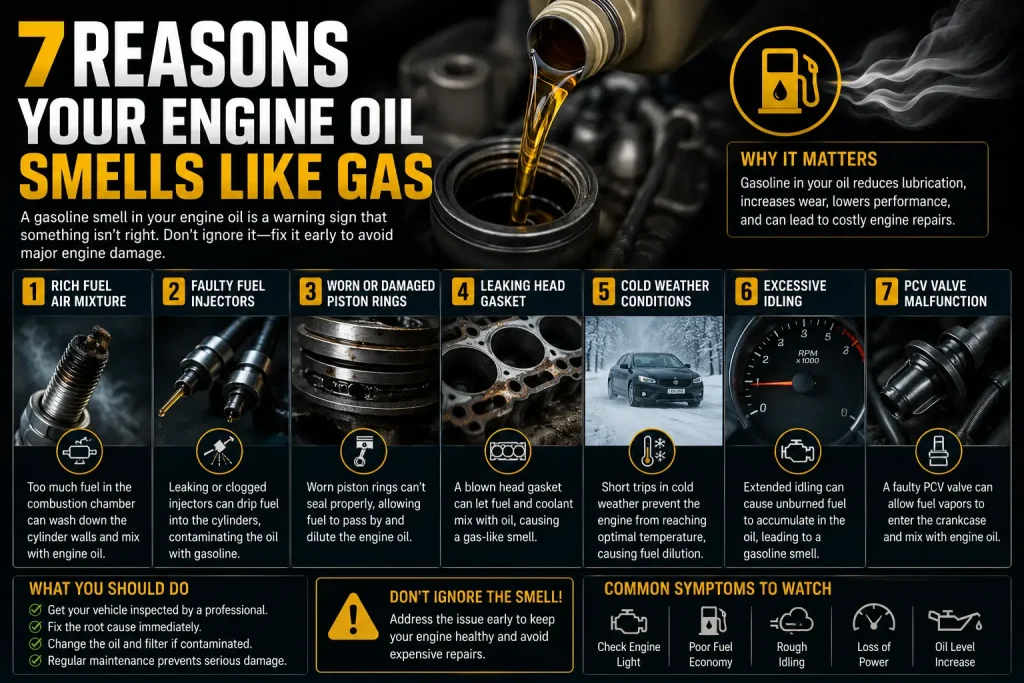
1. Short Trip Driving – The Most Common Cause Nobody Talks About
This is the cause that surprises most people, and it is far more common than any mechanical failure.
Every engine produces a small amount of fuel blow-by during normal operation a tiny quantity of unburned fuel that slips past the piston rings and into the crankcase. Under normal driving conditions, this is not a problem. When the engine reaches full operating temperature (usually around 195–220°F / 90–104°C), that trace fuel simply evaporates from the oil.
The problem occurs when you never let the engine get there. If your typical drive is less than 10–15 minutes school runs, quick grocery trips, short commutes the engine may never fully warm up. The fuel that drips into the crankcase has no chance to evaporate. Over weeks and months, it accumulates. Eventually, you pull the dipstick and smell gas.
This is especially common in colder climates, where engines take longer to reach operating temperature, and during winter months.
The fix is simple: take your car on longer drives at least once a week. A 20–30 minute highway drive gives the engine time to fully heat up and burn off any accumulated fuel in the oil.
2. Piston Ring Blow-By
Piston rings are the metal rings that wrap around each piston and seal the gap between the piston and the cylinder wall. Their job is to keep the air-fuel mixture in the combustion chamber where it belongs and out of the crankcase below.
When piston rings wear down, lose tension, or become damaged, they no longer seal properly. The air-fuel mixture and unburned gasoline escapes past them and enters the crankcase, mixing with the oil. This is called blow-by.
A small amount of blow-by is normal in any engine. All engines experience it. But excessive blow-by the kind that causes a noticeable gas smell in the oil indicates worn or damaged rings. As engines age and accumulate miles, ring wear is inevitable. It tends to appear earlier in engines that have run with dirty oil, have overheated, or have been operated at high RPMs without adequate warmup.
Worn piston rings are one of the more serious causes because ring replacement is not a minor repair it typically involves removing the engine or at minimum the cylinder head and pistons. A compression test can confirm whether your rings are the culprit.
3. Faulty or Leaking Fuel Injectors
Modern fuel-injected engines rely on injectors to spray a precise, atomized mist of fuel into the combustion chamber at exactly the right moment. When an injector is functioning correctly, nearly all of the fuel burns completely during combustion.
When an injector becomes faulty whether due to a stuck-open solenoid, a worn tip, or internal deposits it may drip or spray fuel continuously, or fail to fully close between injection cycles. The excess, unburned fuel washes down the cylinder walls (a phenomenon called cylinder wash or bore wash), slips past the piston rings, and ends up in the oil.
Faulty injectors also tend to produce other symptoms: rough idling, poor fuel economy, misfires, or a slight fuel smell from the exhaust. If you notice any of these alongside oil that smells like gas, suspect the injectors.
A mechanic can test injector performance using a pressure test or remove the injectors for bench testing. Replacement costs vary widely depending on the vehicle, but it is far cheaper than dealing with the engine wear that contaminated oil causes over time.
4. Engine Misfires
An engine misfire occurs when one or more cylinders fails to ignite the air-fuel mixture at the correct time or at all. When a cylinder misfires, the unburned fuel that was supposed to ignite has nowhere to go but down. It washes the cylinder walls, reduces compression, and ultimately seeps past the piston rings into the crankcase and oil.
Misfires and piston ring blow-by reinforce each other. Blow-by worsens compression, which worsens misfires, which leads to more fuel wash, which leads to more contamination. It becomes a cycle.
Common misfire causes include worn spark plugs, faulty ignition coils, bad fuel injectors, vacuum leaks, and low compression. A check engine light with a misfire code (P0300 to P0312 in OBD-II systems) is the fastest way to confirm a misfire. Do not ignore those codes.
5. Rich Fuel Mixture
For an engine to run efficiently, the air-fuel mixture must be precisely balanced typically around 14.7 parts air to 1 part fuel by weight (the stoichiometric ratio). When the mixture contains too much fuel relative to air, it is described as running “rich.”
A rich mixture means more fuel enters the combustion chamber than can be fully burned. The excess fuel washes down the cylinder walls and finds its way into the oil, producing a noticeable gas smell.
Running rich can be caused by a defective mass airflow (MAF) sensor, a bad manifold absolute pressure (MAP) sensor, a faulty oxygen sensor, stuck-open fuel injectors, or a failing fuel pressure regulator. Modern engine control units (ECUs) try to compensate for sensor errors, but they can only correct within a limited range.
Symptoms of running rich include poor fuel economy, black or dark sooty exhaust smoke, a strong fuel smell from the exhaust, and eventually oil that smells like gas.
6. A Failing Carburetor (Older Vehicles)
If you drive a vehicle manufactured before the mid-1980s, it likely uses a carburetor rather than fuel injectors to deliver fuel to the engine. The carburetor uses a float mechanism to control the amount of fuel entering the engine. When the float sticks open or becomes damaged, it allows too much fuel into the system more than the engine can burn.
The excess fuel runs down the intake manifold, past the valves, and into the crankcase, contaminating the oil. This is a well-known failure mode in carbureted engines and is one reason why old-school mechanics always sniff the oil on high-mileage classic cars.
If you have a carbureted vehicle and the oil smells like gas, the carburetor’s float and needle valve are the first things to inspect.
7. Infrequent Oil Changes
This one does not cause the gas contamination directly but it makes everything worse. Every engine produces trace amounts of fuel blow-by as a normal part of operation. In a properly maintained engine with regular oil changes, this trace fuel evaporates during driving or gets removed with the old oil at each change. The contamination never builds up to a level that causes a noticeable smell.
When oil changes are overdue, the small amounts of fuel that have seeped in continue to accumulate. The oil also breaks down, losing its ability to hold and suspend contaminants. Eventually, the gas concentration reaches 2.5% or more of the oil volume the point at which the smell becomes clearly detectable.
Think of infrequent oil changes less as a cause and more as the condition that allows every other minor source of contamination to compound into a real problem.
Warning Signs: How to Know Gas Is in Your Oil
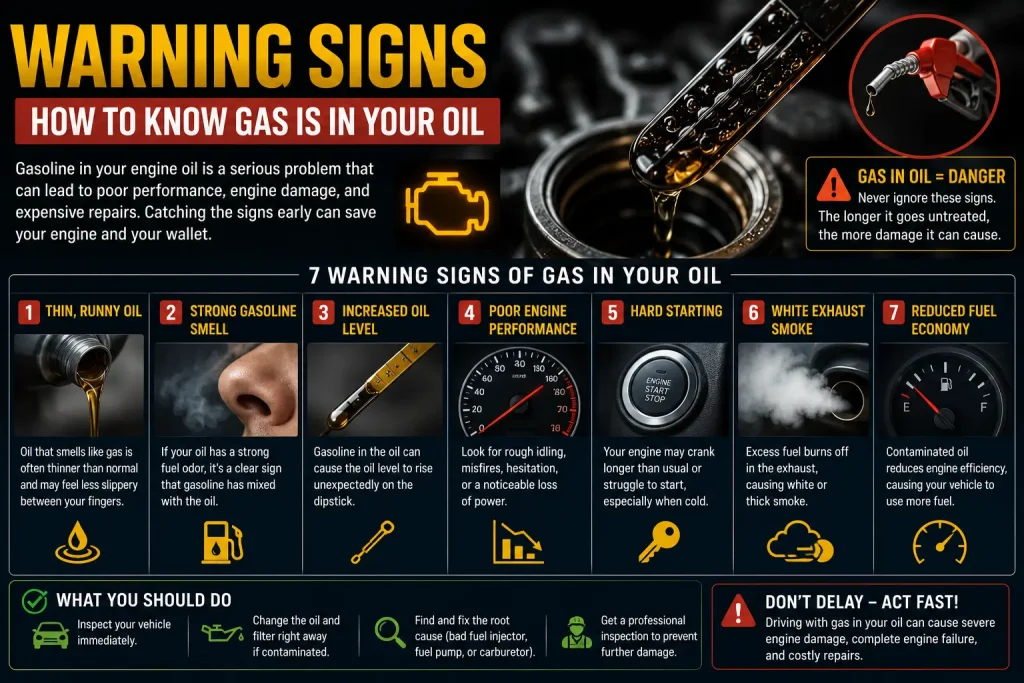
Beyond the obvious gas smell on the dipstick, several other symptoms point to fuel contamination in your engine oil.
The oil level on the dipstick appears higher than normal. If gasoline is leaking into the crankcase in significant quantities, it increases the total fluid volume in the oil pan, pushing the reading above the full mark. Some manufacturers now include an additional dipstick marking specifically to flag this condition.
The oil looks unusually thin or watery when you wipe it on a cloth or paper towel. Normal engine oil has a thick, syrupy consistency. Fuel-diluted oil feels thinner and may leave a wet ring around the oil drop on a paper towel as the lighter fuel component wicks outward.
Engine performance drops. You may notice sluggish acceleration, rough idling, or a general loss of power all consistent with an engine running on degraded lubricant.
Fuel economy declines. If the same tank of gas covers noticeably fewer miles than usual, a rich fuel condition or leaking injectors could be responsible for both the mileage drop and the oil contamination.
Black smoke or a strong fuel smell from the exhaust. These indicate incomplete combustion excess fuel that did not burn in the cylinders.
The check engine light comes on. Misfire codes, oxygen sensor codes, and injector fault codes are all common when fuel is contaminating the oil.
How to Check If Gas Is Really in Your Oil
You do not need special equipment for an initial check. Here is a simple field test any driver can do.
Pull the dipstick and wipe a drop of oil onto a clean white paper towel. Watch the drop for 30 to 60 seconds. If a thin, lighter-colored liquid slowly weeps outward from the oil droplet into the surrounding paper, that lighter fluid is either water or gasoline separating from the oil. Normal oil stays as a compact, uniform drop.
Smell the dipstick directly. Engine oil has a mild, slightly chemical plastic smell. Gasoline has an unmistakable sharp, solvent-like odor. If the dipstick smells like a gas station, you have confirmed contamination.
For a definitive answer, take an oil sample to a laboratory for analysis. Oil analysis services offered by companies like Blackstone Laboratories can tell you the exact percentage of fuel dilution in your oil, along with wear metal content and other useful diagnostic information. This is the gold standard for confirming fuel contamination.
How to Fix Oil That Smells Like Gas
Step 1: Change the Oil Immediately
The first thing to do is remove the contaminated oil and replace it with fresh oil and a new filter. This is not a permanent fix it treats the symptom but it protects your engine while you diagnose the root cause. Do not continue driving on fuel-diluted oil.
Step 2: Diagnose and Fix the Root Cause
If the problem was simply short-trip driving, changing your driving habits may be all that is needed. Start taking longer drives to let the engine fully heat up.
If you suspect a mechanical cause worn piston rings, faulty injectors, a misfire, or a rich-running condition take the car to a trusted mechanic for a proper diagnosis. A compression test checks piston ring integrity. An OBD-II scan reveals any stored fault codes. Injector testing confirms whether individual injectors are leaking.
Trying to guess at the cause without proper testing wastes money and risks missing the real problem.
Step 3: Change the Oil Again After Repairs
Once the underlying cause is fixed, change the oil a second time. Even after repairs, residual contamination may remain in the crankcase. A second fresh oil change ensures you are starting clean.
Step 4: Monitor Closely
For the next several weeks after the fix, check the oil smell and level more frequently than usual. Pull the dipstick every week or two. If the gas smell returns, something was missed in the diagnosis.
How to Prevent It from Happening Again
Regular oil changes on the manufacturer’s recommended schedule are the single most effective preventive measure. Fresh oil cannot accumulate fuel contamination the way old, degraded oil can.
Avoid exclusively short-trip driving. Make sure your engine reaches full operating temperature regularly at least once a week on longer drives.
Address check engine lights promptly. Misfire codes and sensor fault codes that trigger a rich fuel condition are direct contributors to fuel contamination. Fixing them early prevents downstream problems.
Use quality fuel from reputable stations. Contaminated or low-quality fuel burns less cleanly, contributing to higher residual fuel in the combustion process.
Follow your vehicle’s service schedule for spark plugs, ignition coils, and fuel injectors. These components directly affect combustion quality and their deterioration accelerates fuel contamination.
Oil Smells Like Gas After an Oil Change – Is That Normal?
Some drivers notice a gas smell in fresh oil immediately after an oil change and wonder if something went wrong. In most cases, this is not a cause for alarm.
Some engine oil products particularly certain synthetic oils have a slightly fuel-like chemical smell straight from the bottle. A small number of drivers using products like Mobil 1 FS X2 5W-40 have reported this. The smell typically fades within a few hundred miles of driving.
There is also a brief period after an oil change where the fresh oil picks up trace combustion residue from engine surfaces before the next full heat cycle. A very faint gas scent during this period is not unusual.
The difference to watch for: a mild chemical smell that fades after a few drives is probably normal. A strong, sharp gasoline smell that persists or gets stronger is a sign of active contamination and should be investigated.
People Also Ask
Can I drive if my oil smells like gas?
You should avoid driving if your oil smells strongly of gas. Fuel-diluted oil provides inadequate lubrication, increasing friction and heat inside the engine. Short, unavoidable trips are low-risk if you act quickly but do not make a habit of driving on contaminated oil. Change the oil and diagnose the cause as soon as possible.
Will an oil change fix the gas smell?
An oil change removes the contaminated oil and gives the engine a clean slate, but it does not fix whatever caused the contamination. If the underlying issue leaking injectors, worn rings, misfires is not addressed, the gas smell will return within days or weeks. Always find and fix the root cause.
What does it mean if the oil level is higher than normal and smells like gas?
A rising oil level combined with a gas smell is a strong indicator that gasoline is physically accumulating in the crankcase. This is a more serious situation than a faint smell, because it means a meaningful volume of fuel is entering the oil. Have the car inspected by a mechanic promptly.
Can short trips really cause oil to smell like gas?
Yes and it is more common than most drivers realize. Short trips prevent the engine from reaching full operating temperature, so trace fuel that enters the crankcase during normal blow-by never evaporates. Over time, it builds up to detectable levels. Taking a 20–30 minute highway drive at least once a week helps prevent this.
How much gas in oil is dangerous?
Research and field experience suggest that fuel dilution above about 2 to 3 percent of the oil volume begins to noticeably degrade lubrication performance. At 5 percent or more, the risk of accelerated wear increases significantly. At this level, the oil may also appear thinner than normal and the gas smell is usually unmistakable.
FAQs
Q: Why does my oil dipstick smell like gas but there are no other symptoms? A: The most likely explanation is short-trip driving the trace fuel that enters the crankcase during normal operation has accumulated because the engine never gets hot enough to burn it off. Try taking longer drives and see if the smell disappears after your next oil change.
Q: How do I know if it is gas or water in my oil? A: Both can contaminate oil, but they look and smell different. Water-contaminated oil often appears milky or foamy and may smell slightly musty. Gas-contaminated oil smells unmistakably like fuel and may appear thinner than normal. The paper towel drop test described above can help both water and fuel will wick outward from the oil drop, but only fuel carries that sharp gasoline scent.
Q: Can a bad PCV valve cause oil to smell like gas? A: Yes, indirectly. The PCV (Positive Crankcase Ventilation) valve is designed to recirculate blow-by gases back into the intake rather than letting them accumulate in the crankcase. A stuck or clogged PCV valve can cause crankcase pressure to build up, increasing blow-by and contributing to fuel accumulation in the oil.
Q: How much does it cost to fix gas in oil? A: It depends entirely on the cause. If short-trip driving is the issue, the fix costs only an oil change typically $30 to $100. A faulty fuel injector replacement runs $150 to $400 per injector depending on the vehicle. Worn piston rings requiring engine work can run from $1,000 to $4,000 or more. Early diagnosis and action are always cheaper than delayed repairs.
Q: Can I use an oil additive to fix fuel dilution? A: No oil additive can reverse fuel dilution or repair whatever mechanical issue is allowing fuel into the crankcase. Changing the oil and fixing the root cause is the only real solution. Be skeptical of any product claiming to “treat” contaminated oil.
Q: Does the type of engine gas vs. diesel affect this problem? A: Diesel engines can also experience fuel dilution, though the causes are somewhat different. Diesel blow-by, injector leaks, and DPF (Diesel Particulate Filter) regeneration cycles where small amounts of diesel are injected into the exhaust to burn off soot can all contribute to fuel in diesel engine oil. The same principle applies: fuel-diluted oil should be changed, and the cause should be found.
Q: How often should I check my oil if I suspect fuel contamination? A: Check it once a week while the issue is active or under investigation. Pull the dipstick, note the level, and smell it. If the level is rising or the gas smell is getting stronger between checks, the problem is actively worsening and needs immediate professional attention.
Conclusion
Oil that smells like gas is your engine trying to tell you something is wrong. In many cases, the cause is as simple as too many short trips an easy fix with no parts required. In others, it points to faulty injectors, worn piston rings, or an engine running rich, all of which need proper diagnosis and repair.
What you should never do is ignore it. Fuel-diluted oil cannot protect your engine the way clean oil can. The cost of an oil change and a mechanic’s diagnostic fee is a fraction of what engine rebuild or replacement costs. Catch it early, fix it right, and your engine will thank you with years of reliable service.
If you pulled that dipstick and the gas smell hit you you made the right call by looking into it. Now take the next step.
You May Also Like It:
CNC Machining Tolerances: The Complete Expert Guide
MIG vs TIG Welding: Complete Guide to Differences and Procedures