

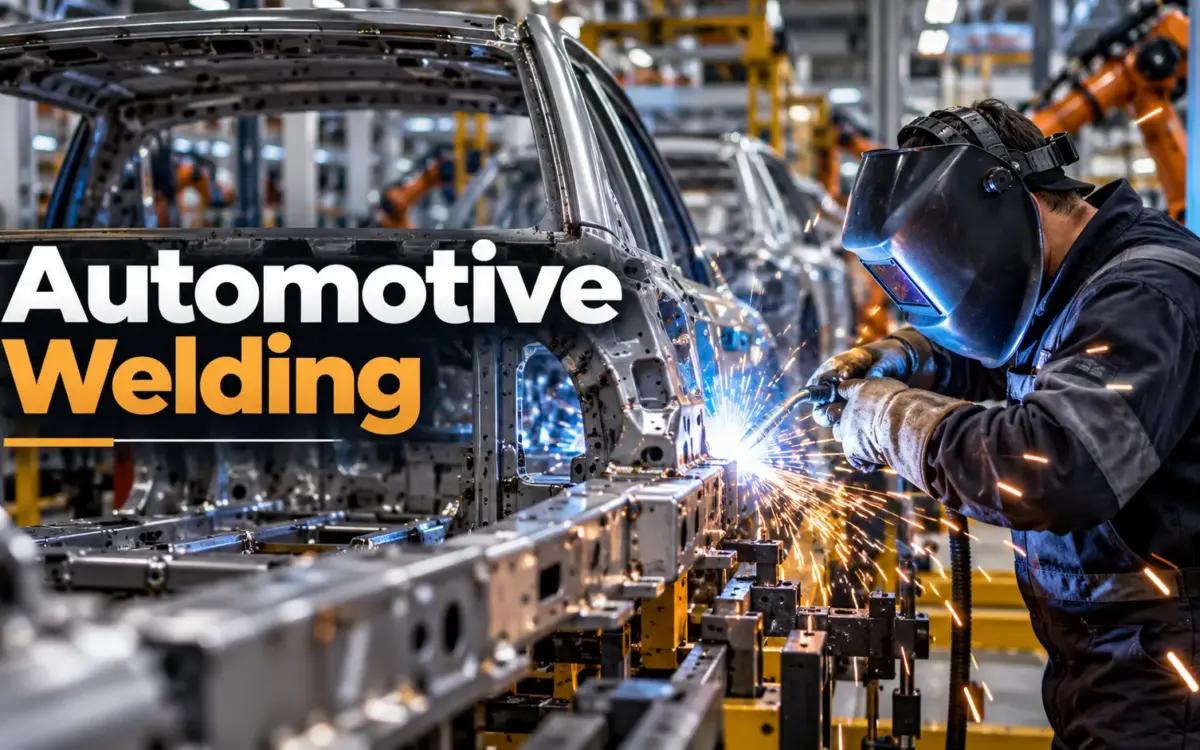
Most guides treat automotive welding like fabrication welding with a car attached. It isn’t. Modern vehicles mix steel grades, aluminum, adhesives, and electronics, and one wrong heat input can ruin a safety structure.
Automotive welding is the group of joining processes used to build and repair vehicle bodies, frames, exhausts, and components, mainly resistance spot welding on factory lines and MIG welding in repair shops. The right method depends on the base metal and the manufacturer’s repair procedure, because heat can weaken high-strength alloys and damage nearby parts.
Which Process Belongs Where
We rarely pick a process by preference. The panel, the metal, and the access decide it.
| Process | Typical automotive use | Why it fits | Field watch-out |
|---|---|---|---|
| Resistance spot welding | Factory body-in-white, repair on accessible flanges | Fast, low distortion, no filler | Needs access to both sides and correct electrode force |
| MIG (GMAW) | Panel patches, plug welds, floor pans, frames | Forgiving and widely available | Too much heat warps thin sheet and burns off zinc |
| MIG brazing | Galvanized and some high-strength panels, per OEM | Lower heat, less coating damage | Joint is weaker than a fusion weld, so only where permitted |
| TIG (GTAW) | Exhausts, roll cages, aluminum brackets, custom work | Precise heat control | Slow, and demands clean metal |
| Laser welding | Roof seams, tailored blanks (factory) | Narrow, tidy, high speed | Rarely a shop option |
| Friction stir welding | Aluminum battery trays, castings (factory) | No melting, strong joints | Specialized equipment only |
Why Newer Steels Change Your Technique
A decade ago, a patch panel and a spool of ER70S-6 wire solved most jobs. Today, a B-pillar or door intrusion beam may be press-hardened boron steel with tensile strength around 1,500 MPa.
Heat is the enemy here. Excess heat can soften the zone around the weld and quietly remove the strength engineers designed in.
Our rules of thumb on high-strength steel:
- Heat control: Use short tacks, let the metal cool between them, and never “chase” a weld along a seam.
- Cutting limits: Check the OEM position statement before sectioning. Some structural members can only be replaced at factory seams.
- Torch ban: Never use an oxy-acetylene torch to free or straighten high-strength parts. It can ruin the steel without any visible sign.
Aluminum and Mixed-Material Bodies

We see the same mistake every year: a shop welds an aluminum panel with a steel-contaminated tool and the repair corrodes within months.
Aluminum melts near 660°C, yet its surface oxide melts above 2,000°C. That gap explains most beginner failures. You must remove the oxide right before welding, with a stainless brush used only on aluminum.
Pulsed MIG with 4043 or 5356 filler and pure argon covers most repairs. Keep aluminum work physically separated from grinding dust, because steel particles embedded in the surface set off galvanic corrosion.
Many aluminum-intensive vehicles also use self-piercing rivets and structural adhesive. These joints cannot be replaced by a bead.
When Not to Weld
This is the section competitors skip, and it saves the most money.
Many modern joints are rivet-bonded, weld-bonded, or glued, and the adhesive does real structural work. Welding next to it can burn it, and ignoring it leaves the repair weaker than the original.
Pause and check the repair manual when you see:
- Structural adhesive squeezed out along a seam
- Flow-drill screws or rivets where you expect spot welds
- Foam or sealer inside a cavity close to the joint
- Sensor brackets for cameras, radar, or ultrasonic parking sensors nearby
Calibration is part of the job too. A rail repair that shifts a radar bracket by a few millimeters can send the car to the dealer for ADAS recalibration.
Step-by-Step: A Safe MIG Plug-Weld Panel Repair
This is the workflow we use when a spot welder can’t reach the flange.
- Look up the procedure. Confirm the panel can be replaced and how the OEM wants it joined.
- Disconnect the battery. Then wait for airbag capacitors to discharge, and shield wiring and the fuel tank.
- Strip the coating. Remove paint and zinc about 1 inch around each weld location, and save a sample of the original weld spacing.
- Drill the factory spot welds. Use a spot-weld cutter rather than a grinder to avoid thinning the lower panel.
- Fit the new panel dry. Clamp it, check gaps, and drill 6 to 8 mm plug holes to match the original spot count.
- Weld with short bursts. Run a plug weld, let it cool, and move to a point far from the last one.
- Dress lightly. Grind only to level the surface, because over-grinding removes the strength you just made.
- Restore protection. Apply weld-through primer before welding where accessible, then seam sealer, cavity wax, and paint.
Defects We See Most Often
The second table is the one we hand to new technicians.
| Defect | Likely cause | Fix |
|---|---|---|
| Burn-through on thin sheet | Too much current or slow travel | Lower voltage, use 0.023 in wire, add copper backing |
| Porosity (tiny holes) | Zinc fumes, wind, dirty metal, low gas flow | Clean the surface, check gas, shield from drafts |
| Cold lap (bead sits on top) | Low heat or poor angle | Raise heat slightly, aim at the leading edge of the puddle |
| Panel warping | Continuous long bead | Stitch weld, use skip sequence, apply heat-sink paste |
| Cracking in the weld zone | High-strength steel with excess heat or wrong filler | Follow OEM wire spec and cool between tacks |
Safety Issues Beginners Underestimate
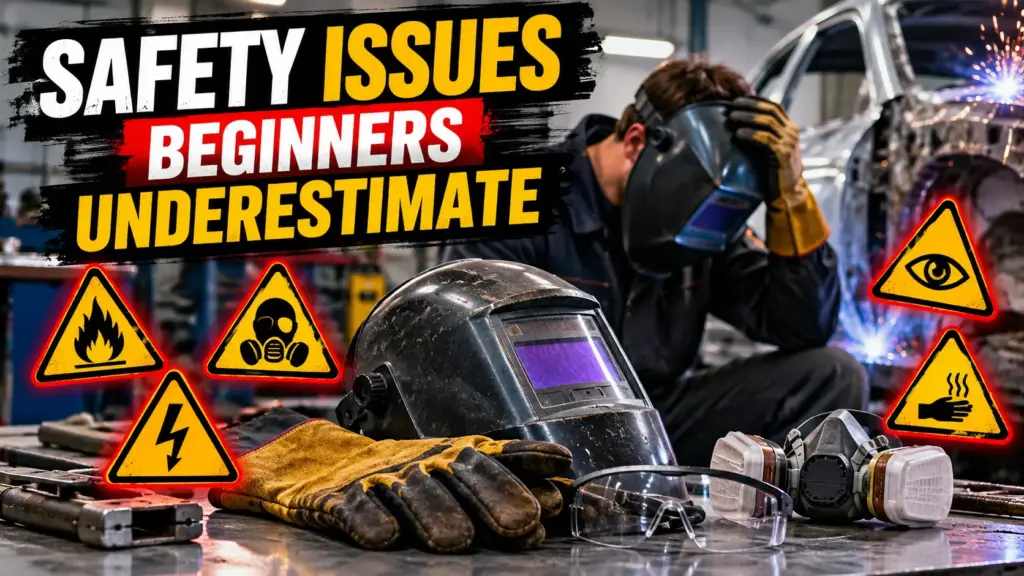
Galvanized panels are the main fume risk. Zinc vaporizes near 907°C, far below the 1,500°C where steel melts, so the vapor leaves the weld cloud right at your face.
Metal fume fever feels like the flu a few hours later. A proper respirator and local extraction cure that.
Other hazards we flag in every shop briefing:
- Fuel system: Remove or isolate the tank and plug open lines before any hot work nearby.
- Underseal and sound deadener: These burn quietly and flare up later, so keep a fire watch for 30 minutes afterward.
- Ground clamp placement: Clamp close to the weld so current doesn’t pass through ECUs or bearings.
How to Tell a Weld Is Good
For spot welds, the chisel or peel test is the shop standard. A good joint tears a plug out of one panel instead of separating cleanly at the interface.
A common rule of thumb for minimum nugget size is about four times the square root of sheet thickness. AWS D8.1M covers resistance spot weld quality for automotive sheet steel, and the I-CAR welding qualification is the credential most collision shops look for.
For MIG plug welds, we look for full fusion into the lower panel, a slightly convex surface, and no undercut at the edge.
Where the Work Is Heading
Electric vehicles shift the demand toward aluminum enclosures, laser-welded battery connections, and large castings that replace dozens of stamped parts.
Fewer welds per vehicle does not mean easier repair. It means more repairs follow sectioning rules from the manufacturer, and more shops lean on certified techs.
FAQ
How much does automotive welding cost?
Labor rates commonly run from about $100 to $150 per hour, so a small patch can land in the low hundreds of dollars. Structural rail repair, especially on aluminum, can reach several thousand.
Is a welded repair as strong as the factory joint?
It can be, if the process, filler, and spacing follow the OEM procedure. Strength drops quickly when someone improvises on high-strength steel or bonded joints.
Can I weld my own car frame at home?
You can on older mild-steel frames with a quality 220V MIG and good prep. On unibody cars with airbags and crush zones, we recommend professional repair.
Does a welded repair hurt resale value?
Visible, well-documented repairs by a certified shop usually matter less than a vehicle history report listing structural damage. Keep photos and invoices.
What certification should an auto welder have?
Look for I-CAR welding qualifications for steel or aluminum, and manufacturer certification if you drive a brand with its own network.
Which welder should a beginner buy for car panels?
A 140 to 180 amp MIG machine with 0.023 or 0.030 in wire and 75/25 argon-CO2 gas handles most sheet metal. Add a spool gun only if you plan to weld aluminum.
How long does a welded repair last before rusting?
A properly protected repair can outlast the surrounding panels. Rust returns when the zinc, primer, and cavity wax are skipped after welding.
Can I weld near a catalytic converter or exhaust sensor?
Not without shielding. Weld heat can damage oxygen sensors and catalyst substrate, so remove or heat-shield the components first.
You May Also Like It:
What Is an Industrial CNC Machine?
CNC Machining Centers: The Complete Buyer’s and Operator’s Guide


2 Comments