Updated November 2026. Figures come from Kelley Blue Book/Cox Automotive, BloombergNEF, Tesla’s 2025 Form 10-K, the ICCT, Hyundai, dealer-industry data and automaker filings. Sources are listed at the end.
The average new car bought in the U.S. in September 2026 cost $50,562, according to Kelley Blue Book. That is a retail number, not a factory cost. Between the assembly line and the showroom sit suppliers, labor, plant depreciation, engineering, warranty reserves, freight, tariffs, dealer margin and automaker profit.
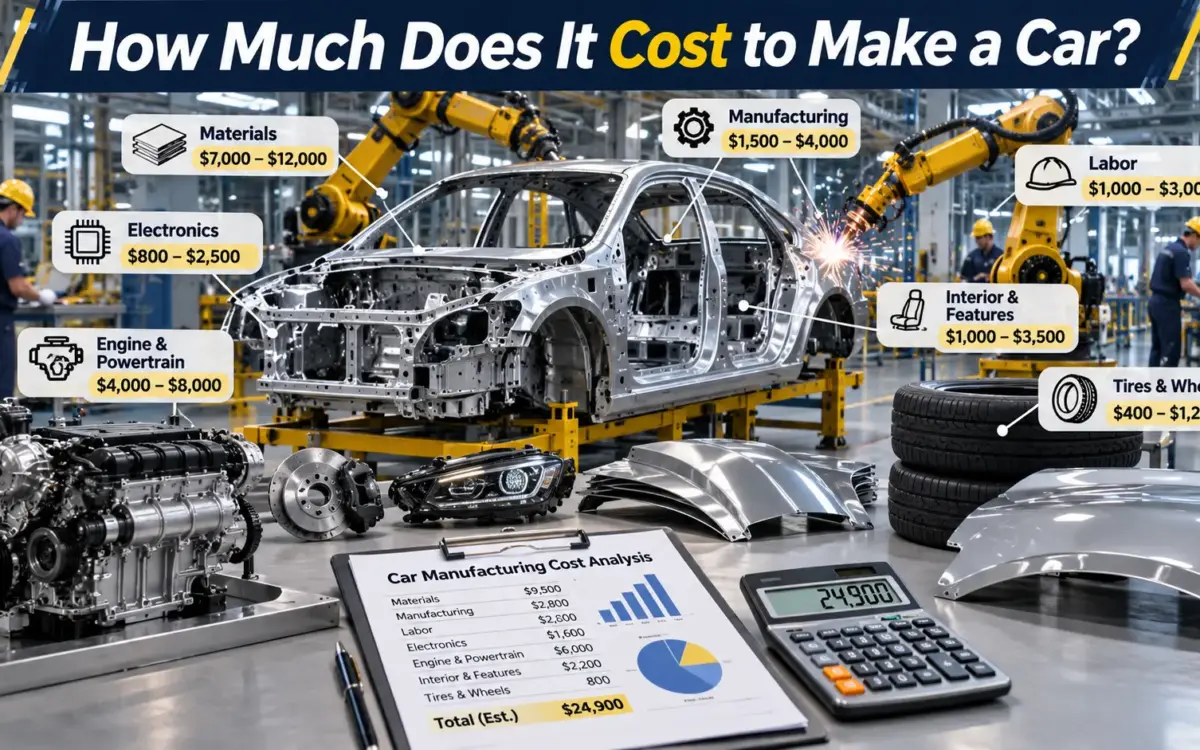
So what does it actually cost to make a car? For a mainstream gasoline model, roughly $25,000–$35,000 all-in. For an EV, roughly $30,000–$60,000, depending mostly on battery size. Tesla’s 2025 annual report implies about $34,400 of automotive cost per car delivered. The spread comes from vehicle type, production volume, technology and where the car is built. Below is the full breakdown, with sources and clearly labeled assumptions.
How Much Does It Cost to Manufacture a Car?
Most mainstream gasoline cars cost automakers about $20,000–$27,000 in direct factory cost, and $25,000–$34,000 fully loaded once R&D, overhead and corporate costs are allocated (ICCT model, 2022 dollars). Comparable EVs run roughly 20–30% higher, mostly because of the battery. Tesla’s filing implies about $34,400 per vehicle sold in 2025.
| Vehicle type | Direct factory cost | Fully allocated OEM cost |
|---|---|---|
| Economy car (gas) | ~$19,800 | ~$24,600 |
| Mid-size sedan (gas) | ~$22,400 | ~$27,800 |
| Compact SUV (gas crossover) | ~$20,100 | ~$25,000 |
| Full-size SUV / pickup (gas) | ~$24,000–$27,200 | ~$29,800–$33,800 |
| Luxury car (gas) | ~$25,700 | ~$31,900 |
| Electric car (economy to mid-size sedan) | ~$22,700–$27,100 | ~$29,900–$36,300 |
Basis: International Council on Clean Transportation (ICCT) modeled 2022 production costs, converted from Canadian dollars at the paper’s own 0.80 rate and rounded. “Fully allocated” means direct cost plus overhead, including corporate costs and R&D, but before any wholesale or dealer markup. ICCT’s “luxury” segment means a sticker above roughly C$80,000, so it does not capture ultra-premium brands. These are modeled estimates, not universal prices.
Two reality checks. First, battery prices have fallen since the ICCT model was built. It assumed $138/kWh, while BloombergNEF’s 2025 average for EV packs was $99/kWh. At the same nominal dollars, that trims roughly $2,200–$2,800 from a 55–70 kWh pack, while tariffs and inflation push other costs up. Second, Tesla’s 10-K reports $56.3 billion of cost of automotive sales on 1.636 million deliveries, about $34,400 each. That is in the same range as ICCT’s mid-size EV estimate, although Tesla’s figure excludes R&D and general expenses and includes items like shipping and warranty.
What Does the Cost of Making a Car Actually Include?
Direct Manufacturing Costs
Direct costs are the ones you can trace to a single car: raw materials, purchased components (seats, wiring harnesses, transmissions, electronics), assembly labor, and the energy and consumables used on the line. Purchased parts are by far the largest piece, because automakers buy most of a car from suppliers rather than making it.
Indirect Manufacturing Costs
These keep the plant running but can’t be pinned to one car: equipment depreciation, maintenance, production engineering, quality assurance, utilities and plant management. They are spread across every vehicle the plant builds, which is why volume matters so much.
Costs Beyond the Factory
Research and development, design and prototyping, safety and emissions certification, freight to dealers, marketing, warranty reserves and corporate overhead all sit outside the plant gate but still land on each car’s true cost. In the ICCT model, overhead adds about 24% on top of direct cost for a gas car and about 32% for an EV, partly because EV overhead is spread over fewer units.
Manufacturing Cost vs Production Cost vs MSRP
These terms get mixed up constantly. The table pins each one to the reference vehicle used throughout this article: a fictional mid-size gas crossover with a $40,000 MSRP (built step by step in the cost-calculation section).
| Term | What it means | Reference vehicle |
|---|---|---|
| Bill of materials (BOM) | All raw materials and purchased components | $23,500 |
| Direct factory cost | BOM + assembly labor + factory overhead | $28,100 |
| Fully allocated production cost | Adds freight, warranty, R&D and corporate costs | $35,000 |
| Wholesale price | What the dealer pays the automaker | $36,800 |
| MSRP | The sticker price | $40,000 |
| Dealer transaction price | What the buyer actually pays | $38,600 |
Car Manufacturing Cost Breakdown by Major Components
The table below uses one reference vehicle on one cost basis: a fictional gas mid-size crossover, 2026 dollars, direct factory cost only. Purchased parts are counted once, inside the system that uses them (the transmission sits in powertrain, steel sits inside body and chassis), so nothing is double-counted. Proportions follow ICCT’s breakdown: the powertrain is roughly 47% of material cost, and of the remaining materials the interior is about 36%, electronics 24%, body 23% and chassis 16%.
| Component | Cost estimate | Major cost drivers |
|---|---|---|
| Engine and powertrain (incl. transmission, driveline, exhaust) | $11,000 | Engine size and turbocharging, transmission type, AWD, emissions hardware |
| Body and structure | $2,900 | Vehicle size, steel vs aluminum, panel count, metal tariffs |
| Interior | $4,500 | Seats, materials, HVAC, airbags, screens |
| Electronics | $3,050 | Wiring, control units, infotainment, cameras, radar, driver assistance |
| Chassis, brakes, wheels and tires | $2,050 | Suspension design, brake size, wheel and tire spec |
| Assembly labor | $1,900 | About 25 hours at about $76/hour all-in; plant location and automation |
| Other factory expenses | $2,700 | Plant depreciation, tooling, energy, maintenance, quality control |
| Total direct factory cost | $28,100 |
Raw Materials and Metal Components
Steel, aluminum, copper, plastics, glass and rubber make up most of what a car is physically built from, and metal prices now carry a policy premium. Kelley Blue Book data reported by CBT News shows U.S.-built vehicles became $1,600–$2,000 more expensive because of tariffs on materials such as steel and aluminum. Copper, used in wiring and EV batteries, has also grown more expensive because of tariffs and rising global demand.
Engine, Powertrain, Transmission and Drivetrain
In the ICCT model, a gas mid-size sedan’s complete powertrain cost about C$11,969 (roughly US$9,600) in 2022, the single biggest line in the car. That bundle includes the engine block and head, internals, fuel and ignition systems, turbocharger if fitted, cooling, exhaust and emissions control, plus the transmission and driveline. Automatic, CVT and dual-clutch units cost more than manual ones, and AWD adds driveshafts and a rear differential.
Chassis, Body and Exterior
In the Oliver Wyman split that ICCT builds on, body-in-white (the bare welded structure) is about 23% of a gas car’s non-powertrain materials and the chassis about 16%. Aluminum structures cost more at the material level than high-strength steel, but can be offset by weight savings elsewhere.
Interior and Comfort Features
The interior is the largest non-powertrain bucket, about 36% in the same split. It covers seats, dashboard, console, carpets, insulation, HVAC, door panels, seat belts and airbags.
Electronics, Sensors and Software
Electronics are the fastest-growing line. A 2021 Roland Berger forecast projected electronics rising from about 16% to 35% of component cost by 2025; treat that as a forecast, not a measurement. Memory chips are a live cost pressure in 2026: both GM and Ford have flagged roughly $2 billion of combined commodity, memory-chip and logistics headwinds this year.
Labor and Final Assembly
The last widely published Harbour Report (2008) put total manufacturing labor at roughly 30–34 hours per vehicle at Toyota, GM, Ford and Chrysler when stamping and powertrain were included, with the best assembly plants near 14–16 hours. Industry sources today cite about 18–35 hours of line time per mass-market vehicle. Wells Fargo estimated Detroit Three all-in labor cost at about $76–$78 per hour after the 2023 UAW contracts, versus about $55 at foreign-owned U.S. plants and about $45 at Tesla (2023 estimates). Ford said its contract adds $850–$900 of labor cost per vehicle by 2028; GM put it at roughly $575. The UAW argues labor is only 4–5% of a vehicle’s cost.
Step-by-Step Process of Manufacturing a Car and Its Costs
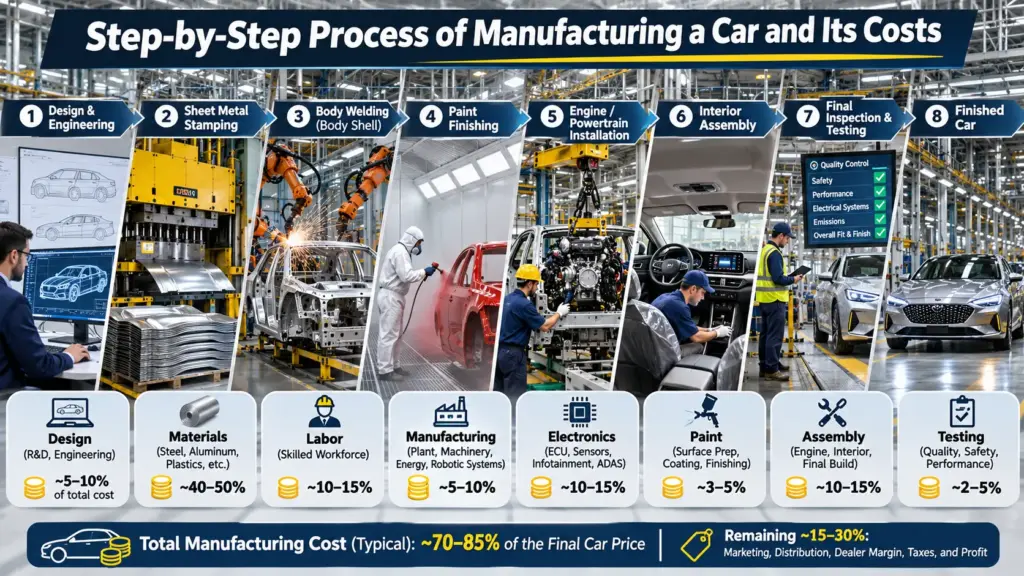
Automakers rarely publish per-stage costs, so the table says where each stage’s cost lands and gives a verified data point where one exists.
| Step | What happens | Cost notes |
|---|---|---|
| 1. Market research and planning | Target customer, price, specs and volume are set | Mostly salaries; fixes the cost target every later step must hit |
| 2. Design and engineering | Styling, CAD, structural and aerodynamic work | Booked as R&D. Company-wide: Volkswagen about $23.7B, Tesla about $6.4B in recent annual figures compiled by Lightsource AI |
| 3. Prototypes and testing | Crash, durability, emissions and safety validation | Part of R&D and certification; per-program figures aren’t published |
| 4. Sourcing and procurement | Supplier selection, contracts, parts qualification | The largest spend (purchased parts). Tariffs have cost automakers at least $35.4B since 2025, per Automotive News analysis |
| 5. Stamping | Presses form doors, hoods and body panels | Dies are one-time tooling, spread across lifetime volume (see the factory example) |
| 6. Body welding | Robots weld and bond the body-in-white | Capital-heavy and highly automated |
| 7. Paint | Cleaning, e-coat, primer, color, clear coat, curing | Energy-intensive and requires environmental controls |
| 8. Powertrain | Engine and transmission, or battery and motor | Gas powertrain about $11,000 in the reference car; EV battery about a third of production cost |
| 9. Final assembly | Interior, wiring, glass, wheels, fluids | The most labor-intensive stage |
| 10. Quality control | Electrical, brake, alignment, water-leak and road tests | Rework and defects add cost |
| 11. Shipping and distribution | Rail, truck, port, delivery to dealers | 2026 destination charges reached $2,795 on full-size GM and Ford trucks and SUVs |
How Much Does It Cost to Make Different Types of Cars?
The ICCT model gives the cleanest like-for-like comparison. Figures are total OEM cost (direct plus overhead, no markups), 2022 dollars.
| Class and segment | Gas (ICE) | Electric (BEV) |
|---|---|---|
| Passenger car, economy | $24,600 | $29,900 |
| Passenger car, midrange | $27,800 | $36,300 |
| Passenger car, luxury | $31,900 | $50,400 |
| Crossover, economy | $25,000 | $30,200 |
| Crossover, midrange | $27,700 | $38,600 |
| SUV, midrange | $29,800 | no comparable EV in dataset |
| SUV, luxury | $34,100 | $58,600 |
| Pickup/light truck, midrange | $33,800 | $55,600 |
| Pickup/light truck, luxury | $41,100 | $68,600 |
How Much Does It Cost to Make an Economy Car?
About $24,600 for a gas economy car in the model. Smaller engines, simpler interiors and high volume keep it low, since fixed costs are spread over more cars.
How Much Does It Cost to Make a Sedan?
A midrange gas sedan comes out around $27,800, about $3,200 above the economy car. Most of that gap is a larger interior, better materials and more electronics.
How Much Does It Cost to Manufacture an SUV?
Midrange gas SUVs land near $29,800. Larger bodies need more metal and glass, and AWD adds drivetrain parts. Luxury SUVs reach about $34,100 for gas and $58,600 for electric.
How Much Does It Cost to Make a Pickup Truck?
Pickups are among the costliest gas vehicles to build: about $30,100 for an economy truck and $33,800 midrange in the model. Frames, payload and towing hardware, and larger engines drive that.
How Much Does It Cost to Manufacture a Luxury Car?
The ICCT luxury sedan costs about $31,900 as a gas car and $50,400 as an EV, but its “luxury” segment is a mainstream premium tier, so brands like Mercedes or Porsche can spend far more. Their pricing power shows up in profit per car: Jaguar Land Rover about $6,022, Porsche about $5,762, Mercedes about $2,933 and BMW about $2,384, against about $706 across 34 automakers in the first half of 2025.
How Much Does It Cost to Manufacture a Sports Car?
Automakers don’t publish per-car costs for sports cars. What is public is how much they earn: Ferrari made about $138,764 in operating profit per car in the first half of 2025. Low volumes mean engineering and tooling are spread over few cars, which is why prices run high.
How Much Does It Cost to Make an Electric Car?
Electric Vehicle Battery Pack Cost
The battery is the single biggest difference. BloombergNEF’s December 2025 survey found the global average lithium-ion pack price fell 8% to a record $108/kWh. EV packs specifically averaged $99/kWh, LFP packs across all uses averaged $81/kWh and NMC packs $128/kWh. For EV packs, cells made up about $79/kWh, or roughly 80% of the pack price. China had the lowest average pack price at $84/kWh, with North America and Europe running 44% and 56% higher. BloombergNEF expects the all-segment average to dip about 3% to just under $105/kWh in 2026.
Do not read $108/kWh as an EV-only price: it blends EVs, buses, two-wheelers and stationary storage, which averaged just $70/kWh.
| Pack size | LFP at $81/kWh | EV average at $99/kWh | NMC at $128/kWh |
|---|---|---|---|
| 50 kWh | $4,050 | $4,950 | $6,400 |
| 75 kWh | $6,075 | $7,425 | $9,600 |
| 100 kWh | $8,100 | $9,900 | $12,800 |
Illustrative arithmetic on BloombergNEF averages. Actual automaker contracts, regions and pack designs vary.
Electric Motor and Power Electronics Cost
In ICCT’s model, non-battery EV electronics (inverter, onboard charger, DC-DC converter, thermal management, high-voltage cables and battery management) cost about C$4,392 (roughly US$3,500) in an economy car and up to about C$13,118 (roughly US$10,500) in a large luxury SUV. The reduction gearbox is cheap by comparison.
EV Platform, Electronics and Thermal Management
Bodies and chassis cost more on EVs because they must protect a heavy battery: in the Oliver Wyman split, body-in-white runs about 24% higher and chassis about 8% higher than in the gas equivalent. Assembly labor is slightly lower, about 6% less.
Electric Car vs Gasoline Car Manufacturing Cost
| Cost factor | Gasoline car | Electric car |
|---|---|---|
| Powertrain | Engine and transmission (about 47% of material cost) | Motor, reduction gear, inverter and charger |
| Energy storage | Fuel tank | Battery pack (about a third of production cost in ICCT’s recalculation) |
| Exhaust system | Required | Not required |
| Cooling | Engine cooling | Battery and motor thermal systems |
| Electronics | Standard plus optional driver assistance | High-voltage electronics plus driver assistance |
| Assembly | Conventional drivetrain work | High-voltage installation and testing; slightly less labor |
| Modeled total (mid-size sedan, 2022) | $27,800 | $36,300 (about 31% more) |
Why EV Manufacturing Costs Vary by Country
The IEA found battery-electric car production costs are over 30% lower in China than in advanced economies, with roughly a third of the gap due to the battery. Of the overall cost gap, about half comes from efficiency and automation and about 30% from access to low-cost critical minerals and battery components. A similar gap exists for gasoline cars, so it is not only a battery story.
How Much Does It Cost to Set Up a Car Manufacturing Factory?
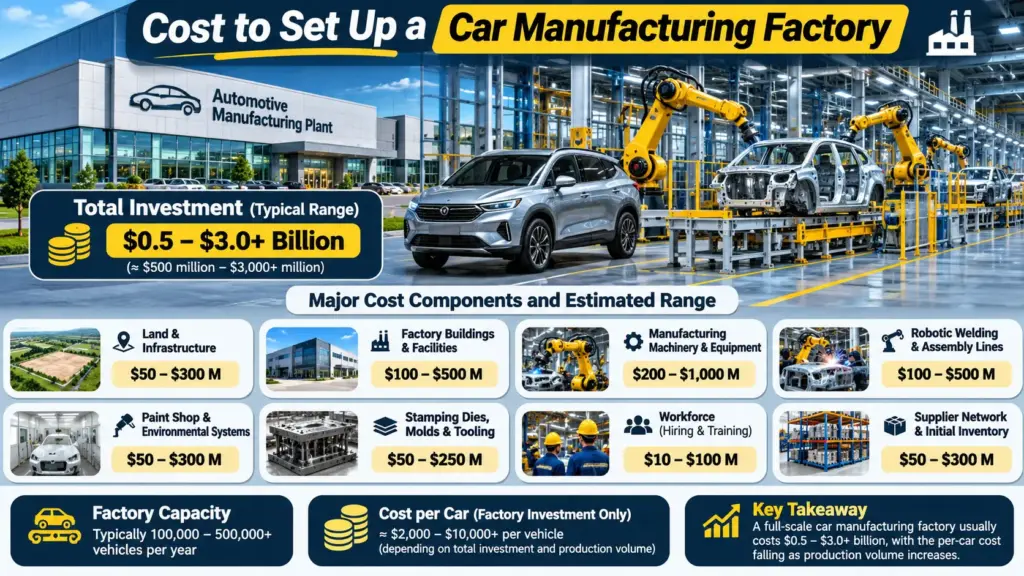
The best recent real-world anchor is Hyundai’s Metaplant America in Georgia: a $7.6 billion project (including a battery facility) with 300,000 vehicles a year of capacity, now being expanded to 500,000 in a further $2.7 billion effort. Hyundai is separately building a $5.8 billion steel plant in Louisiana to supply its U.S. factories. For scale, Tesla’s Fremont plant has about 560,000 vehicles of annual capacity. In round numbers, a new high-tech plant costs about $25,000 of capital per vehicle of annual capacity at Metaplant, though that figure includes battery production that a normal assembly plant would not.
| Cost area | What it covers | What drives the price |
|---|---|---|
| Land, buildings, infrastructure | Plant shell, roads, rail spurs, power and water | Location, site prep, incentives |
| Machinery and equipment | Stamping presses, conveyors, test equipment | Capacity and vehicle mix |
| Robotic welding and assembly lines | Body shop and final assembly | Level of automation |
| Paint shop and environmental systems | Pretreatment, ovens, air and waste handling | Emissions rules, energy use |
| Dies, molds and tooling | Vehicle-specific panels and fixtures | Number of models, redesign cycle |
| Workforce and training | Hiring, onboarding, line training | Wage level, ramp-up speed |
| Supplier network and inventory | Supplier parks, parts buffers | Local vs imported content |
How Factory Investment Affects Cost Per Car
The example below spreads a $1 billion investment over different lifetime volumes. Assumptions: straight-line allocation, no interest or inflation, covers buildings and production equipment only, and excludes vehicle R&D and program tooling (add those separately).
| Annual volume | Years in service | Lifetime volume | Investment per car |
|---|---|---|---|
| 20,000 | 10 | 200,000 | $5,000 |
| 100,000 | 10 | 1,000,000 | $1,000 |
| 250,000 | 10 | 2,500,000 | $400 |
| 400,000 | 10 | 4,000,000 | $250 |
Applied to Metaplant, and assuming a 15-year life: $7.6 billion over 4.5 million cars (300,000 a year at full utilization) is about $1,690 per car. At 60% utilization (180,000 a year) it rises to about $2,815. That is why automakers fight so hard to keep plants full.
What Factors Affect the Cost of Manufacturing a Car?
Raw material prices and supply chain. Steel, aluminum and copper tariffs were restructured into a tiered system effective April 6, 2026, and copper has grown pricier on demand from EV batteries and wiring.
Labor costs. Detroit Three all-in labor runs about $76–$78 an hour versus roughly $55 at foreign-owned U.S. plants (2023 estimates), and the UAW contract tops out near $42 an hour in base wages by 2028.
Production volume and scale. Fixed costs (the factory example above) fall per car as volume rises.
Automation and robotics. Hyundai says automation in its Metaplant assembly shop nearly doubles that of any other Hyundai plant, and the IEA attributes about half of China’s EV cost advantage to efficiency and automation.
Vehicle size, design and complexity. ICCT scales non-powertrain materials by footprint (a pickup is about 1.39 times a car’s) and by trim level (1.2 times for midrange, 1.5 times for luxury).
Regulations and safety standards. Emissions hardware, crash structures and airbags add content to every car, and certification adds engineering cost; these costs are real but rarely disclosed per vehicle.
Imported parts, tariffs and exchange rates. Toyota projected $9.1 billion in tariff costs for the fiscal year ending March 2026, and Detroit’s Big Three absorbed $6.5 billion in 2025. GM is still carrying about $2.5 billion in 2026, partly offset by refunds after a February 2026 Supreme Court ruling against emergency tariffs (Ford booked a $1.3 billion benefit in Q1). Imported vehicles saw price increases of roughly $5,000–$8,900.
Manufacturing defects and waste. Productivity differences turn into dollars: Harbour Consulting once valued Nissan’s labor-productivity lead at $300–$450 per vehicle.
Supplier pricing and outsourcing. Buying a module instead of building it moves cost from labor to materials; Harbour noted Toyota makes more parts in-house while Chrysler bought more modules.
Inflation, energy and logistics. Diesel hovered around $6.35 a gallon in October 2026, near an all-time high, and GM and Ford each flagged roughly $2 billion of commodity, memory and logistics pressure this year. Energy is still a small slice of factory cost, however: the IEA puts it at 1–4% of direct manufacturing cost.
How Do Car Manufacturers Calculate the Cost Per Vehicle?
Automakers build the number in layers: the bill of materials first, then direct labor and assembly, then allocated overhead (plant depreciation, tooling, utilities), then R&D spread over the program’s expected lifetime volume, then warranty reserves and distribution costs. The skill is allocating each cost once.
Manufacturing cost per car = direct materials + direct labor + factory overhead
Fully allocated cost = manufacturing cost + freight + warranty + R&D allocation + corporate SG&A and marketing
Example Calculation for One Car
Assumptions: fictional mid-size gas crossover, 2026 dollars, about 250,000 units a year. Component shares follow ICCT’s breakdown, labor is about 25 hours at $76 an hour, and plant depreciation and tooling sit inside factory overhead so nothing is counted twice. R&D is allocated once. Dealer costs and taxes are excluded.
| Line | Amount | Basis |
|---|---|---|
| Direct materials and purchased components | $23,500 | Powertrain $11,000, interior $4,500, electronics $3,050, body $2,900, chassis $2,050 |
| Direct labor | $1,900 | About 25 hours at $76 |
| Factory overhead | $2,700 | Plant depreciation, tooling, energy, maintenance, quality control |
| Manufacturing cost per car | $28,100 | |
| Freight and logistics | $1,100 | Plant to dealer |
| Warranty reserve | $800 | |
| Cost of goods sold | $30,000 | |
| R&D and engineering allocation | $2,300 | Program R&D divided by lifetime volume |
| Corporate SG&A and marketing | $2,700 | |
| Fully allocated cost per car | $35,000 | |
| Wholesale revenue (what the automaker nets) | $36,800 | After automaker-funded incentives |
| Operating profit per car | $1,800 | About 4.9% of wholesale |
The result sits in a believable range: a 4.9% margin falls between Ford’s roughly 3.4% and GM’s 6.86% EBIT margins for 2025, and $1,800 per car compares with $2,078 at Toyota and $2,140 at Tesla in 2025.
How Much Profit Does a Car Manufacturer Make on Each Car?
Manufacturing Cost vs Wholesale and Retail Price
A $40,000 MSRP does not mean the automaker receives $40,000, and it does not mean the automaker pockets the gap above parts cost. Here is the same reference vehicle traced from sticker to profit:
| Step | Amount |
|---|---|
| MSRP | $40,000 |
| Discounts and incentives (about 3.5%, in line with the gap between Kelley Blue Book’s September 2026 average transaction price and MSRP) | −$1,400 |
| Buyer pays (transaction price) | $38,600 |
| Dealer front-end gross profit | −$1,800 |
| Manufacturer wholesale revenue | $36,800 |
| Fully allocated manufacturer cost | −$35,000 |
| Manufacturer operating profit | $1,800 |
The automaker’s $1,800 is about 4.5% of the sticker price. Sales tax is paid by the buyer on top, and the automaker pays income tax on its profit.
Manufacturer Gross Profit vs Operating Profit
Gross profit is revenue minus cost of goods sold; operating profit also subtracts R&D and corporate expenses. Tesla’s 2025 automotive gross margin was 17.8%, yet its operating profit per vehicle was only about $2,140. Toyota posted a 9.1% operating margin for the six months through September 2025. Across 34 major automakers, operating profit averaged about $706 per vehicle sold in the first half of 2025, with total operating profit down 23%.
Dealer Markup and Dealership Expenses
Dealers earn less on new cars than most buyers assume. Gross profit per new vehicle retailed fell 13.5% to $1,840 in Q2 2026, while finance and insurance income hit a record $1,769 per vehicle. Service and parts generated 52.8% of total dealership gross profit. That gross still has to cover salaries, rent and advertising.
Shipping, Advertising, Warranty and Taxes
Destination charges are billed separately on the window sticker (up to $2,795 on 2026 full-size GM and Ford trucks and SUVs). Warranty, advertising and corporate costs are carried by the automaker, which is why they appear in the fully allocated cost above.
Why Expensive Cars Are Not Always More Profitable
Higher prices don’t guarantee higher margins. Tesla’s lead over Toyota in profit per vehicle shrank to just $62 in 2025 despite a price gap, and one review of annual filings put Porsche’s operating margin at just 0.3%, a collapse from about 17% previously. Meanwhile Toyota earned about a 10% margin selling far cheaper vehicles. What matters is the gap between price and fully allocated cost, not the sticker.
How Much Does It Cost to Build a Car Yourself?
Many people searching this question mean a personal project, not a factory. The honest answer: it usually costs more than buying, and the savings are in enjoyment, not dollars.
Building a Car From Scratch vs Using a Donor Vehicle
A true from-scratch build means designing a chassis and sourcing everything, which hobbyists generally find costlier than starting from a kit. Kits typically ask you to supply a donor or purchased drivetrain.
DIY Kit Car Costs
Factory Five Racing, the best-known U.S. Cobra-replica kit maker, lists its Mk5 Roadster complete kit at $24,990, and the kit excludes the engine, transmission, rear end, wheels and tires. Its 30th Anniversary Mk5 kits started at $42,990 and are sold out. Cheaper options exist: a Meyers Manx dune-buggy kit was cited around $6,000 and a Model A-style roadster kit near $17,000 in older price listings, so confirm current prices with each maker.
Engine, Transmission and Parts Expenses
Drivetrain cost swings the total widely, from about $2,600 for a pulled used Mustang engine and transmission (a builder-forum figure) to $20,000–$25,000 for a new crate V8 and transmission (Motor Biscuit). That puts a finished Mk5 at roughly $45,000–$50,000 before shipping, options and finishing work. For reference, the average pre-built Cobra replica on Bring a Trailer sits around $50,000.
Tools, Garage Equipment and Labor
Factory Five estimates about 300 hours to complete its Mk4 and 600 hours for its 818. At even $25 an hour, 300 hours is $7,500 of your time. You also need lifting gear, welding or specialty tools for some builds, and workshop space; taking unpaid time off adds lost income to the true cost.
Registration, Inspections and Road-Legal Requirements
Rules vary by state. Kit and replica cars are typically registered through a specially constructed or replica-vehicle process involving inspections and paperwork, so check your state DMV before buying.
Hidden Costs and Unexpected Repairs
Builders on the Factory Five forum describe options and substitutions that pile up, and nonstandard parts mean there is no dealer to fix mistakes. Budget a contingency of at least 10–20% (a rule of thumb, not a published figure).
Is Building Your Own Car Cheaper Than Buying One?
Usually not. The average new car cost $50,562 in September 2026 and comes with a warranty, while a Cobra-style kit build lands in the same range and takes hundreds of hours. Build for the experience.
Can Automakers Reduce the Cost of Manufacturing Cars?
- Shared platforms: one underbody and component set across several models spreads engineering and tooling over more cars.
- Automation and smart factories: the IEA credits efficiency and automation with about half of China’s EV cost advantage.
- Less waste: scrap, rework and defects feed straight into cost of goods sold.
- Localizing suppliers: shorter supply chains cut freight and tariff exposure; domestic production rose to 54.4% of U.S. new-vehicle sales as automakers added U.S. capacity.
- Standardized components: fewer unique parts reduce purchasing and inventory costs.
- Better efficiency: small labor gains add up, as Harbour’s $300–$450 per vehicle productivity gap showed.
- Simpler designs and modular parts: fewer parts and welds mean less assembly time.
- Volume without sacrificing quality: the factory example shows how volume dilutes fixed costs, but only if the cars sell.
What Will Affect Car Manufacturing Costs in 2026 and Beyond?
Verified now
- Battery pack prices hit a record low in 2025 even as lithium and cobalt prices rose, driven by cell overcapacity, competition and a shift to LFP chemistry.
- Tariffs have cost automakers at least $35.4 billion since 2025, and 2026 brought new cost pressure from memory chips, copper and diesel.
- The $7,500 federal EV tax credit expired at the end of September 2025, and automakers have booked more than $70 billion in EV-related restructuring costs.
- Average new-vehicle prices are near records: $50,562 in September 2026, with the average new EV at $55,879.
Forecasts (not facts)
- BloombergNEF expects average pack prices to slip about 3% to just under $105/kWh in 2026.
- ICCT’s 2023 model projected EV production-cost parity with gas cars around 2028–2029 for economy cars and about 2035 for midrange cars; Gartner (2024) predicted EV production would be cheaper than gasoline cars by 2027. Both depend on battery costs, tariffs and volumes.
- Software-defined vehicles and AI-driven manufacturing could lower costs or raise them (electronics and software spending). Neither effect is yet measurable in published per-car costs.
Frequently Asked Questions About Car Manufacturing Costs
1. How much does it cost to make a car from scratch?
A mass-market gas car costs automakers roughly $25,000–$35,000 fully loaded. A hobbyist building one car from a kit spends about $45,000–$50,000 for a Cobra replica with drivetrain, plus hundreds of hours. One-off builds cost more per car because there is no volume to spread costs.
2. How much does it cost to manufacture a Toyota?
Toyota doesn’t publish per-car cost. What is public: operating profit of about $2,078 per vehicle in 2025, an operating margin around 9–10%, and projected tariff costs of $9.1 billion for the fiscal year ending March 2026.
3. How much does it cost to manufacture a Ford car?
Ford doesn’t disclose per-vehicle cost either. Its 2025 EBIT margin was about 3.4%, its UAW contract adds roughly $850–$900 of labor cost per vehicle by 2028, and it cited about $2 billion of commodity, memory-chip and logistics headwinds in 2026.
4. How much does it cost to make a Tesla?
Tesla’s 2025 10-K shows $56.3 billion of cost of automotive sales against 1.636 million deliveries, about $34,400 per car, excluding R&D and corporate expenses. Its automotive gross margin was 17.8% and operating profit was about $2,140 per vehicle.
5. What is the cheapest type of car to manufacture?
In the ICCT model, a gas economy passenger car is cheapest at about $24,600, followed by a gas economy crossover at about $25,000. The cheapest EV in the model costs about $29,900. Small size, simple content and high volume keep costs down.
6. What is the most expensive part of manufacturing a car?
In a gas car, the powertrain, about 47% of material cost (about $11,000 in the reference vehicle). In an EV, the battery, about a third of production cost: roughly $4,950–$9,900 for a 50–100 kWh pack at BloombergNEF’s $99/kWh EV average.
7. How much does an engine cost to manufacture?
Automakers don’t publish engine-only costs. ICCT’s model, built on NHTSA cost data by cylinder count, puts a complete gas powertrain (engine, emissions equipment, transmission) at about US$9,600–$10,200 for sedans and SUVs in 2022.
8. How much does it cost to assemble a car?
Industry sources cite 18–35 hours of line time per mass-market vehicle. At the $76–$78 an hour all-in labor estimated for Detroit automakers, that works out to roughly $1,400–$2,700 per car in direct assembly labor (our arithmetic).
9. How long does it take to manufacture a car?
About 18–35 hours on the assembly line, but the full path from concept to showroom typically takes two to five years. Parts, stamping and logistics add time before and after line hours.
10. How much does it cost to manufacture an electric car?
ICCT’s model puts EVs at about $29,900–$36,300 for economy to midrange passenger cars (2022 dollars), and more for luxury and trucks. Tesla’s implied cost is about $34,400. Cheaper batteries since 2022 trim some of that, while tariffs and inflation add to it.
11. Do car companies make a profit on every vehicle?
Not necessarily. GM and Ford said their gas businesses stayed profitable in 2025 while their EV businesses lost money. Across 34 automakers, average operating profit was about $706 per vehicle in the first half of 2025, and some models earn far less.
12. Why is the manufacturing cost lower than the retail price?
Retail price also pays for dealer margin, destination freight, marketing, R&D, warranty reserves and automaker profit. In the reference example, a $40,000 MSRP covers $28,100 of direct factory cost, $35,000 of fully allocated cost and $1,800 of operating profit.
13. Is it cheaper to build or buy a car?
Buying is usually cheaper. The average new car cost $50,562 in September 2026 with a warranty, while a Cobra-replica kit with drivetrain runs about $45,000–$50,000 and about 300 hours of labor. Build for the experience, not the savings.
14. How many parts are used to manufacture a car?
The commonly cited figure is about 30,000 parts counting every nut and bolt. A 1998 MEMA estimate counted roughly 3,800 unique part numbers (about 35,000 items), and a rougher count of major pieces is about 1,800. EVs have fewer mechanical parts.
Final Thoughts: How Much Does It Really Cost to Make a Car?
A mainstream gas car costs an automaker about $20,000–$27,000 to build in the factory and $25,000–$34,000 fully loaded; an EV runs roughly 20–30% higher in the same modeling, with the battery as the main gap and Tesla’s reported cost near $34,400. Parts and materials are the biggest line, then powertrain or battery, then labor, equipment and engineering. In today’s market, tariffs, memory chips and metals matter as much as wages.
The sticker price is a different thing. On a $40,000 car, the factory spends about $28,100, the automaker’s full cost is about $35,000, and it keeps roughly $1,800 after dealers, freight, R&D and overhead are paid. The takeaway: the gap between manufacturing cost and showroom price is not mostly profit, it is the cost of everything around the factory.
You May Aslo Like It:
AC Evacuation and Recharge: Complete Process, Cost, and Maintenance Guide
Top Electric Vehicle Manufacturers: Leading Companies and Industry Overview
CNC Machining in Automotive Industry: Parts & Process
Sources
- BloombergNEF, Lithium-Ion Battery Pack Prices Fall to $108/kWh (Dec. 9, 2025): about.bnef.com; coverage at energy-storage.news and evinfrastructurenews.com
- Kelley Blue Book / Cox Automotive, September 2026 ATP report: coxautoinc.com/insights/sept-2026-atp-report
- Tesla, Form 10-K for fiscal 2025: sec.gov (cost of revenues and gross margin tables); Tesla Q4 2025 production and deliveries
- ICCT Working Paper 2023-29, Assessment of light-duty electric vehicle costs in Canada: theicct.org (cost build, Tables 4 and 8)
- IEA, What Next for the Global Car Industry (2025): iea.org/reports/what-next-for-the-global-car-industry
- Hyundai Metaplant America: AP; Atlanta Journal-Constitution; Business Insider
- Dealer data: Digital Dealer (Q2 2026 gross profit and F&I); NADA Data 2025
- Tariffs: CBT News/Kelley Blue Book; Carscoops/Automotive News; NPR (Oct. 2026); Reuters
- Per-vehicle profit: Nikkei Asia via Yahoo Finance; Gasgoo; Caixin (margins)
- Labor: Fortune, Inquirer/AP (UAW contract); Wells Fargo estimates via KCTV5; Harbour Report 2006 and 2008 summaries
- Kit cars: factoryfive.com; Hagerty; Motor Authority; Motor Biscuit; SlashGear
Hypothetical vehicle figures in this article are illustrative and labeled as such. Everything else is attributed to the source above and reflects data available as of November 4, 2026.