
Is a Lithium Ion Solar Battery Worth It for Off-Grid Use?
Yes, for most off-grid homes, cabins and workshops. A lithium ion solar battery, almost always the lithium iron phosphate (LiFePO4) type, gives you 80% to 100% usable capacity, 3,000 to 10,000 charge cycles, around 95% round-trip efficiency and no routine maintenance. Lead-acid batteries cost less upfront but usually give you only 50% usable capacity and 300 to 1,000 cycles, so you replace them far sooner.
To size a lithium bank, use this simple formula:
Battery capacity (kWh) = Daily energy use (kWh) x Days of backup ÷ (Usable depth of discharge x Efficiency)
For example, a home using 10 kWh a day that wants 2 days of backup, with 90% usable capacity and 95% efficiency, needs about 23.4 kWh of battery. At 48V, that is roughly 457 Ah.
Most off-grid systems above 3 kW should run at 48V, and every lithium bank needs a built-in battery management system (BMS) and a charge setup that matches lithium chemistry. If you live somewhere that freezes, choose a battery with built-in heating or install it indoors.
What Is a Lithium Ion Solar Battery?
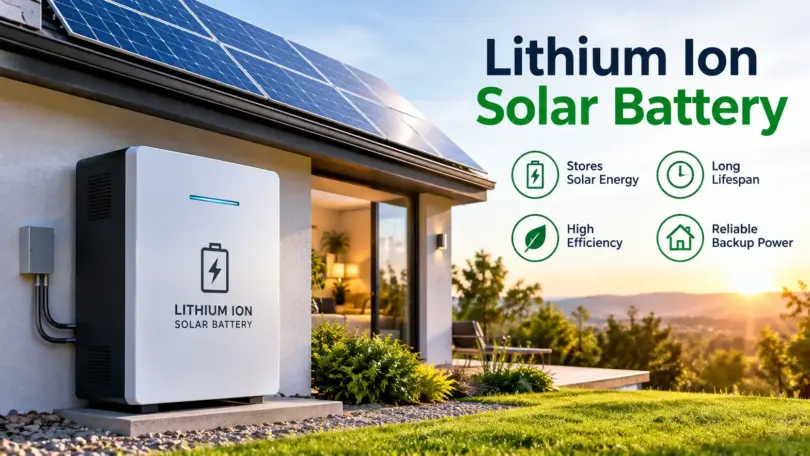
A lithium ion solar battery is a rechargeable energy storage unit that holds the electricity your solar panels make during the day so you can use it at night, on cloudy days or during a power cut. In an off-grid setup it is the heart of the whole system, because there is no utility line to fall back on.
The term “lithium ion” covers several chemistries. Phone batteries and many electric vehicles use nickel manganese cobalt (NMC). Most modern solar storage uses lithium iron phosphate (LiFePO4 or LFP), which trades a little energy density for much better thermal stability and a far longer life. When people shop for a lithium solar battery for home or cabin use, LiFePO4 is almost always what they end up with, and it is what this guide focuses on.
A complete lithium battery for solar includes:
- Individual cells, grouped to reach 12V, 24V or 48V
- A battery management system that watches voltage, current, temperature and cell balance
- A casing, often with terminals, communication ports and sometimes a heater
- A communication link to the inverter, so the two can agree on charge and discharge limits
How Off-Grid Solar Battery Storage Works
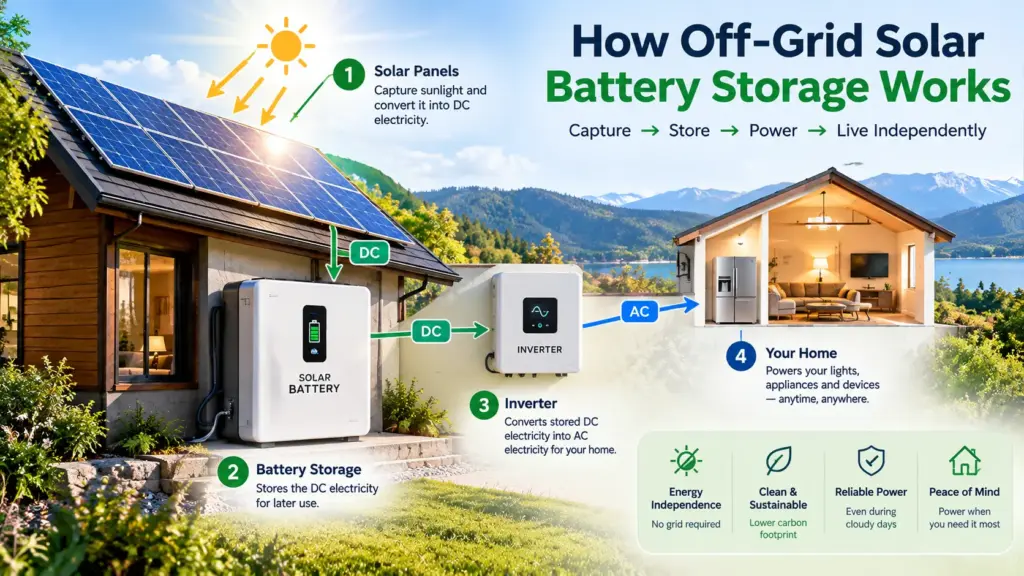
An off-grid solar power system has four main parts that work as a loop.
- Solar panels turn sunlight into direct current (DC) electricity.
- A charge controller (often built into a hybrid or off-grid inverter) regulates that power so it charges the battery safely.
- The battery bank stores the energy until you need it.
- An inverter converts DC power from the battery into the alternating current (AC) your appliances use.
During the day, panels power your loads first and send any extra to the battery. After sunset, the battery covers the load. If the weather turns bad for several days, the bank is what keeps your fridge, lights, pump and internet running. If it runs low, many people add a small generator that restarts automatically as a last line of defense.
This is the main difference between off-grid and grid-tied solar. A grid-tied system can sell extra power back and pull from the grid whenever needed. An off-grid system must produce and store everything it uses, so the battery bank has to be sized with care.
Why Lithium Beats Lead-Acid for Most Off-Grid Systems
For years, flooded lead-acid batteries were the default for remote power. They still work, but the numbers now favor lithium in nearly every long-term comparison.
| Feature | LiFePO4 lithium | AGM / gel lead-acid | Flooded lead-acid |
|---|---|---|---|
| Usable depth of discharge | 80% to 100% | About 50% | About 50% |
| Typical cycle life | 3,000 to 10,000 | 300 to 1,000 | 500 to 1,500 |
| Round-trip efficiency | About 95% | 80% to 85% | 75% to 85% |
| Maintenance | None | Very low | Regular watering |
| Weight per usable kWh | Light | Heavy | Very heavy |
| Charging speed | Fast | Slow at the end | Slow at the end |
| Upfront cost | Higher | Lower | Lowest |
The upfront price is the only column where lead-acid wins. Once you count replacement cycles, wasted energy and the time spent on upkeep, the cost per kWh delivered over the battery’s life usually favors lithium. A bank that gives you 8,000 cycles can outlast two or three sets of lead-acid batteries.
There is one honest exception. If you run a very small system that is used only a few weekends a year, such as a hunting cabin, a cheap AGM battery can still make sense. The savings are real and the cycle life barely matters when you rarely cycle the battery.
AGM and Gel Batteries: When They Still Make Sense
Absorbent glass mat (AGM) and gel batteries are sealed, spill-proof lead-acid types. They need no watering and handle vibration well, which is why they remain popular in boats, RVs and backup setups. Gel batteries tolerate heat a little better and prefer slower charging. Both are sensitive to being left partly charged, and both lose lifespan quickly if you drain them below 50% often. If you want to compare them properly, look at cost per cycle rather than sticker price.
Lithium Solar Battery Types and Specs You Should Understand
Before you buy, learn the handful of specifications that actually decide whether a battery will suit your system.
Capacity: kWh and Ah
Capacity tells you how much energy the battery stores. Kilowatt-hours (kWh) is the clearest number because it works across any voltage. Amp-hours (Ah) only makes sense alongside voltage. To convert, multiply Ah by volts and divide by 1,000. A 100 Ah battery at 51.2V stores about 5.12 kWh.
Voltage: 12V, 24V or 48V
Higher voltage means lower current for the same power, which means thinner cables, less heat and less energy lost in wiring.
- 12V suits small loads such as a camper, shed lighting or a small workshop. Keep inverters at or under about 2 kW.
- 24V works for small cabins and loads up to roughly 3 to 4 kW.
- 48V is the standard for homes and anything above 3 kW. It also gives you access to the widest range of modern inverters and server-rack batteries.
If you think your system might grow, start at 48V. Changing voltage later means replacing the inverter and the batteries.
Depth of Discharge (DoD)
Depth of discharge is the share of the battery’s capacity you can use before recharging. A battery with 100% DoD can in theory be emptied fully, but real manufacturers usually limit it through the BMS. Look for the DoD figure used in the cycle life rating. A claim of 6,000 cycles at 80% DoD is more honest than 10,000 cycles at 50% DoD.
Continuous and Peak Power
Capacity is how long the battery lasts. Power is how much it can deliver at once. A battery with a 5 kW continuous rating cannot run a 7 kW load, no matter how many kWh it holds. Check both the continuous and surge ratings, especially if you run well pumps, air conditioners or power tools.
Round-Trip Efficiency
Round-trip efficiency is the share of stored energy you get back. Good lithium batteries reach about 95%. That 10 to 15 point gap over lead-acid is free extra energy from every panel you already own.
Cycle Life and Warranty
Cycle life is the number of full charge and discharge cycles before capacity falls to about 70% to 80% of its original level. Warranties of 10 years are common, and some brands offer 12. Read the fine print for throughput limits, operating temperature requirements and whether the warranty requires a specific inverter.
How to Size an Off-Grid Solar Battery Bank
Sizing is where most off-grid projects go right or wrong. Oversize and you waste money. Undersize and you run out of power at 2 a.m. in the middle of a cloudy week.
Step 1: Add Up Your Daily Energy Use
List every appliance, its wattage and the hours you use it each day. Multiply watts by hours and divide by 1,000 to get kWh. A fridge at 150 W running about 8 hours of actual compressor time uses roughly 1.2 kWh. Add everything and you have your daily total.
If you already live in the property, your old electricity bills or a plug-in energy meter will give more accurate numbers than guesses. Build in a 10% to 20% margin for things you forget.
Step 2: Decide on Days of Autonomy
Days of autonomy is how long you want the system to run with little or no solar input. In sunny, stable climates, one day is often enough, especially with a generator as backup. In regions with long cloudy winters, two or three days gives much more comfort.
Step 3: Account for Usable Capacity and Efficiency
No battery gives you every watt-hour it holds. Divide by your usable DoD and your round-trip efficiency.
Required battery (kWh) = Daily kWh x Days of autonomy ÷ (DoD x Efficiency)
Worked Example
A small off-grid home uses 10 kWh a day. The owner wants 2 days of autonomy and buys LiFePO4 batteries rated for 90% usable capacity with 95% efficiency.
- 10 kWh x 2 days = 20 kWh needed
- 0.90 x 0.95 = 0.855
- 20 ÷ 0.855 = about 23.4 kWh
At 51.2V nominal, that is about 457 Ah, or roughly two 314 Ah batteries or five 100 Ah rack batteries.
How Much Battery Capacity Does an Off-Grid Home Need?
These ranges give a starting point, not a final design.
| Property type | Typical daily use | Suggested battery size |
|---|---|---|
| Weekend cabin or shed | 1 to 3 kWh | 3 to 6 kWh |
| Small off-grid cabin, full time | 4 to 8 kWh | 10 to 15 kWh |
| Average off-grid home | 10 to 20 kWh | 20 to 40 kWh |
| Large home with heavy loads | 25 kWh and up | 40 kWh and up |
Heating, cooling and water heating are the biggest swing factors. Heat with wood or propane and your battery needs shrink dramatically.
Step 4: Match the Solar Array to the Battery
A large battery is useless if your panels cannot refill it. As a rough guide, the array should be able to produce your daily energy use plus the battery’s recharge needs within your local peak sun hours. If your location gets 4 peak sun hours in winter and you use 10 kWh a day, you need roughly 2.5 to 3.5 kW of panels, and more once you include losses and cloudy days.
Step 5: Size the Inverter for Peak Loads
Add up the loads that might run at the same time, then allow for startup surges from motors and compressors. Pick an inverter with a continuous rating above that total and a surge rating above the highest motor start. Also confirm the inverter supports the battery’s voltage and communication protocol.
Lithium Battery and Inverter Compatibility
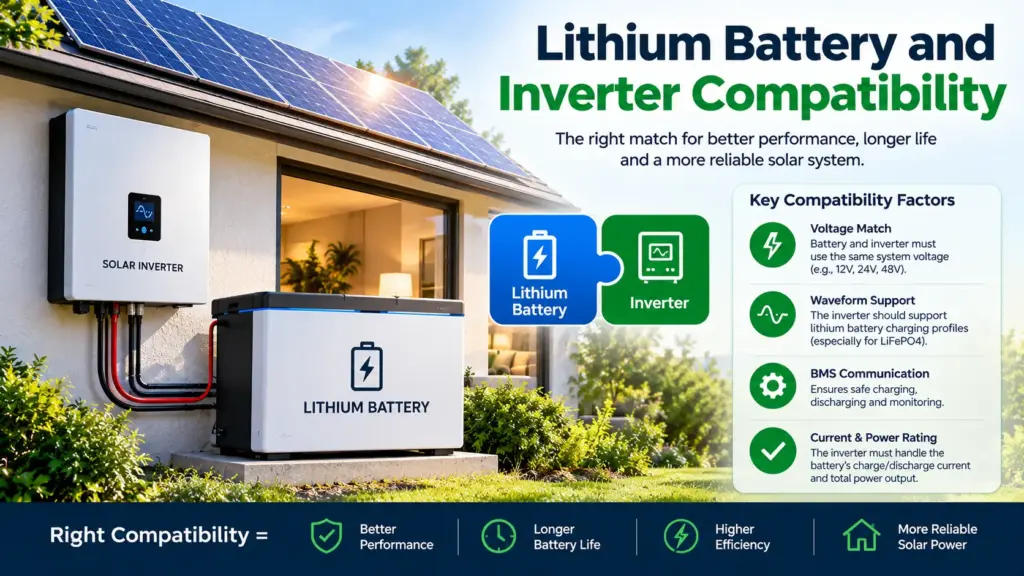
This is the most common source of expensive mistakes. A lithium battery and an inverter must agree on charging voltages, current limits and shutdown behavior.
- Closed-loop communication lets the BMS tell the inverter exactly how much to charge or discharge. It is the safest option when your inverter and battery list each other as compatible.
- Open-loop systems rely on voltage settings you configure manually. They work with many combinations, but every setting must be correct.
- Check the maximum charge current. Charging a small battery with a large inverter can trip the BMS or shorten life.
- Check that your charge controller has a lithium profile. Lead-acid presets can overcharge or undercharge LiFePO4.
When possible, buy the battery and inverter from the same supplier or from a combination that is documented as compatible. It saves you hours of troubleshooting.
Understanding the Battery Management System
The BMS is the brain inside a lithium battery. It protects the cells from overcharge, over-discharge, over-current, short circuits and extreme temperatures. It also balances cells so none drift out of sync.
A good BMS will:
- Disconnect the battery if cell voltage goes out of safe limits
- Block charging when the battery is too cold or too hot
- Report state of charge, voltage and temperature to your inverter or an app
- Support parallel expansion with other batteries of the same model
The BMS is also why you should not mix old and new batteries or different brands in the same bank. Different internal resistance and BMS logic can cause imbalance and early failures.
Lithium Batteries in Cold and Hot Weather
LiFePO4 batteries discharge well in cold weather, but charging below freezing (0°C or 32°F) can damage the cells through lithium plating. Quality batteries solve this in one of two ways.
- Self-heating batteries warm the cells using a small amount of stored energy before allowing charge current.
- Low-temperature cutoffs simply stop charging until the cells warm up.
If you live where winters are hard, pick a battery with a heater, or install the bank inside an insulated space. In very hot regions, shade the battery and give it ventilation, because high temperatures speed up aging. Look for an operating range of about -20°C to 55°C on the data sheet, and remember that the battery lasts longest when kept near room temperature.
Off-Grid Lithium Battery Cost
Prices change often, so treat these as broad ranges rather than quotes.
- Server-rack and wall-mounted LiFePO4 batteries often fall in the range of roughly $300 to $700 per kWh, depending on brand, warranty and certifications.
- A complete small off-grid kit with battery, inverter and charge controller can start near a few thousand dollars.
- A full-home system with panels, battery bank, inverter, wiring and installation can reach well into five figures.
The sticker price is only part of the story. Cost per delivered kWh over the battery’s life is the better measure. A bank that costs twice as much but lasts five times longer and wastes less energy is the cheaper choice over time.
Also budget for the parts people forget: busbars, breakers and fuses, cabling, battery racks or enclosures, monitoring, grounding and, where required, permits or professional inspection.
How to Choose the Best Batteries for Off-Grid Solar
Use this checklist before you commit.
- Chemistry: choose LiFePO4 for safety and cycle life.
- Certifications: look for UL 1973, UL 9540A or equivalent safety testing, especially if insurance or inspection matters.
- Usable capacity: compare usable kWh, not just the label.
- Continuous power: make sure it meets your peak load without constant stress.
- Cold-weather capability: heating or a suitable indoor spot.
- Scalability: confirm how many units you can connect in parallel and whether future batteries must match.
- Communication: closed-loop compatibility with your inverter.
- Warranty and support: read the terms and confirm that real people answer the phone.
- Installation environment: indoor or outdoor rating (IP rating).
- Monitoring: a clear app or display helps you spot problems early.
Installation Basics
A lithium ion solar battery is safe when installed correctly, and much less forgiving when installed carelessly. Follow these basics.
- Use cables rated for the maximum current, and keep runs short.
- Fuse or breaker every battery on the positive side, sized to the battery and cable ratings.
- Torque terminals to the manufacturer’s value, since loose connections cause heat.
- Keep the bank away from direct sun, moisture and flammable materials.
- Provide a clear disconnect switch for emergencies.
- Follow local electrical codes, and use a licensed electrician for high-voltage or whole-home systems.
If you are building a DIY system, take extra care with 48V DC. It carries enough current to cause serious burns and fires even though the voltage seems low.
Solar Battery Charging, Discharging and Maintenance
Lithium batteries ask for very little, but a few habits keep them healthy.
- Charging: use the lithium profile recommended by the manufacturer. Avoid holding the battery at 100% for long periods if you can avoid it, since slightly lower top-of-charge voltage can extend life.
- Discharging: do not routinely run the battery to empty. Many owners set a low cutoff near 10% to 20% to protect the cells and keep an emergency reserve.
- Cycling: daily cycling is what these batteries are built for, so do not worry about using them.
- Inspection: every few months, check connections for heat marks, corrosion or looseness, and make sure vents and fans are clear.
- Firmware and settings: update inverter firmware when the manufacturer recommends it, and recheck settings after any system change.
- Storage: if you leave a property for months, store the battery at roughly 40% to 60% charge in a cool, dry place.
How Long Do Off-Grid Lithium Batteries Last?
With moderate temperatures and sensible discharge limits, a good LiFePO4 battery can last 10 to 15 years or more. Cycle ratings of 6,000 to 8,000 cycles at 80% DoD translate to well over 15 years of daily use on paper. Real life is shorter than lab numbers because of heat, high charge rates and time itself, so plan on a 10 to 15 year range and treat the warranty as the minimum.
Signs that a battery is aging include falling runtime, frequent BMS shutdowns and cells that drift out of balance. Catching these early lets you replace a single module instead of the whole bank.
Can Solar Batteries Work Without Sunlight?
Yes, for a limited time. A battery does not need sunlight to deliver power. It only needs sunlight, or another source, to recharge. How long a bank lasts without sun depends on its usable capacity and your load.
A 20 kWh usable bank running a 10 kWh a day household lasts about two days. If you cut non-essential loads, it can last much longer. Many off-grid owners add a backup generator that starts automatically when the battery falls to a set level, which protects the battery from deep discharge during long stretches of bad weather.
How Long Can a Solar Battery Power a House?
Divide usable battery energy by average load.
- A 10 kWh usable battery running a 500 W average load lasts about 20 hours.
- The same battery running a 1 kW average load lasts about 10 hours.
- Add an electric oven or water heater and it may last only a few hours.
The lesson is that appliance choices matter as much as battery size. Efficient refrigeration, LED lighting, DC well pumps and gas or wood for heating can cut your battery needs by half or more.
Common Off-Grid Solar Battery Problems and Fixes
| Problem | Likely cause | What to do |
|---|---|---|
| Battery shuts off at night | Low cutoff reached or undersized bank | Reduce loads, add storage, review inverter settings |
| Battery will not charge in winter | Low-temperature protection | Use a self-heating battery or insulate the space |
| Inverter cannot see the battery | Wrong communication cable or protocol | Check compatibility and settings |
| Bank will not reach 100% | Weak solar input or cell imbalance | Check array output, shading and balance cycle |
| One battery works harder than others | Uneven cabling or mixed batteries | Use equal cable lengths and matching batteries |
| Frequent overload trips | Surge loads exceed inverter or battery limits | Add soft starters or upgrade inverter |
How to Prepare an Off-Grid System for Winter
Winter is when off-grid systems get tested. Shorter days, lower sun angles and snow on panels all reduce production while heating loads rise.
- Tilt panels steeper to catch the low sun and shed snow.
- Clear snow when safe, since even partial coverage cuts output sharply.
- Check that batteries can charge in cold, using heaters or an insulated enclosure.
- Test your backup generator before the cold season.
- Reduce nonessential loads and shift heavy use to midday.
- Review your battery’s low-temperature settings and charge current limits.
How to Expand an Existing Battery Bank
Expanding a lithium bank is easy only when you plan for it.
- Check how many units your inverter and BMS support in parallel.
- Prefer the same brand, model and capacity. Mixing is risky.
- Avoid mixing very old and brand new batteries, since resistance differences cause imbalance.
- Bring the new battery to a similar state of charge before connecting it.
- Update cabling, fusing and busbars so they can handle the higher current.
- Review inverter settings for the larger bank.
If your original system did not allow expansion, consider building a second independent bank with its own inverter instead of forcing compatibility.
How to Store Excess Solar Energy
A lithium battery is the main answer, but not the only one. Once the battery is full, extra solar energy can go to useful loads instead of being wasted.
- Run a water heater with a diversion controller.
- Charge tools, e-bikes and power stations.
- Pump water into a storage tank.
- Run laundry, pumps or other flexible loads in the middle of the day.
This is called load shifting, and it makes a smaller battery feel much larger.
Hybrid vs Off-Grid Solar Systems
A hybrid system connects to the grid and has a battery. It uses solar first, stores extra in the battery and falls back on the grid when needed. An off-grid system has no utility connection at all, so it needs more battery, more panels and usually a generator.
If grid power is available at a fair cost, hybrid is often cheaper and simpler. If the grid is unreliable, far away or very expensive to connect, off-grid can be the better answer. In places with frequent outages, a hybrid system with a strong lithium battery gives many of the benefits of off-grid living without the full cost.
Where Lithium Ion Solar Batteries Fit Best
- Remote cabins and rural homes: reliable daily power without a utility line.
- Sheds and workshops: quiet power for tools, lights and pumps.
- Farms and ranches: water pumping, fencing and outbuildings.
- Backup power for grid-connected homes: protection from outages.
- Tiny homes, RVs and boats: compact, light storage with fast charging.
Common Mistakes to Avoid
- Sizing from the home’s square footage instead of real energy use.
- Ignoring surge loads from pumps and compressors.
- Buying cheap batteries with no certification or support.
- Mixing batteries of different brands or ages.
- Using lead-acid charging settings on lithium batteries.
- Installing a battery in a freezing space without heating.
- Skipping fuses and disconnects.
- Forgetting to plan for future expansion.
Frequently Asked Questions
What is the best lithium ion solar battery for off-grid use?
There is no single best model. For most off-grid homes, a 48V LiFePO4 battery with a built-in BMS, a cold-weather heating option, UL certification and a 10 year warranty is a strong choice. Match the capacity to your daily use and the power rating to your peak loads.
How many solar batteries do I need?
That depends on your daily energy use and how many days of backup you want. Use the formula in this guide. As a rough example, a home using 10 kWh a day with two days of backup needs about 23 kWh of lithium storage.
Are lithium batteries better than AGM for solar?
For frequent cycling, yes. Lithium gives more usable capacity, more cycles and better efficiency. AGM can still make sense for small, rarely used systems where low upfront cost matters most.
Can I use a lithium battery with any solar inverter?
No. The inverter must support lithium charging profiles and ideally communicate with the battery’s BMS. Always confirm compatibility before buying.
Is a lithium ion solar battery safe?
LiFePO4 is the safest common lithium chemistry and is far more resistant to thermal runaway than other lithium types. Safety still depends on quality cells, a good BMS, correct fusing and proper installation.
Can lithium solar batteries be installed outdoors?
Only if they are rated for it. Look for a suitable IP rating and a temperature range that matches your climate. Many owners still prefer a shaded, insulated enclosure.
How long do off-grid solar batteries last?
A quality LiFePO4 battery typically lasts 10 to 15 years under normal conditions, and lead-acid batteries often last 3 to 8 years depending on use.
Can I add more batteries later?
Usually yes, but only if your battery and inverter support parallel expansion. Buy matching units and plan the wiring for growth from the start.
Do lithium batteries need maintenance?
They need no watering or equalizing. A quick inspection of connections, ventilation and settings a few times a year is enough.
Can solar batteries power a whole house?
Yes, if the battery capacity and inverter size match your energy use and peak loads. Heavy loads such as electric heating, air conditioning and water heating drive the size more than the house itself.
Final Thoughts
A lithium ion solar battery is the most practical storage choice for the majority of off-grid systems today. It costs more at the start, but it delivers more usable energy, lasts much longer, charges faster and asks for almost nothing in return. The key to a good result is not chasing the biggest battery, but sizing the system around your real energy use, matching the battery to a compatible inverter, protecting it from extreme temperatures and installing it with proper safety gear.
Start with an honest energy audit, pick a voltage that leaves room to grow, and choose a battery with solid certifications and a clear warranty. Do that, and your off-grid system will keep the lights on for many years to come.
You May Also Like It:
Solar Hot Water System: What It Really Delivers, Costs and Needs
Power Generation Equipment: What It Is, How to Choose It, and What Actually Fails in the Field
Power Distribution System: How It Works, What Fails, and How to Size It Right
Power Outage Safety Guide: How to Prepare for Outages and Emergencies