

Who owns the plants, how each company earns its money, and what to check before you trust a ranking.
Updated October 6, 2026
Power generation companies own and operate the plants that produce electricity, then sell that power to utilities, retailers, grid markets or large buyers. In the US, the biggest names by fleet size include Constellation Energy, NextEra Energy, Vistra, NRG Energy and Southern Company. Each earns money in a different way, which is why no single ranking tells the full story.
What Are Power Generation Companies?
Most “biggest power generation companies” lists hand you a ranking and nothing else. They mix oil majors, turbine makers and utilities in one table, then sort by whatever number looked impressive that year.
We took a different approach. This guide covers ten companies worth knowing, shows what makes each one different, and explains how to check any list before you rely on it.
Why Every Ranking Looks Different
The Yahoo Finance list we reviewed, published in March 2023, ranked companies by a blend of trailing revenue and market cap, with 60% weight on revenue and 40% on market value. That method rewards companies with large retail or trading arms, not necessarily those with the most plants. It also predates every major deal in this article.
Four Numbers, Four Different Winners
- Installed capacity: measured in gigawatts (GW), this shows how much power a fleet can produce at peak.
- Actual generation: measured in megawatt-hours (MWh), this shows what the plants really delivered.
- Revenue: inflated by fuel pass-through costs and retail sales.
- Market cap: reflects investor expectations, not plant ownership.
A coal-heavy fleet with a low capacity factor can sit high on the GW list and low on the MWh list. When we compare filings, we start with generation by fuel type and work outward.
Top 10 Power Generation Companies at a Glance
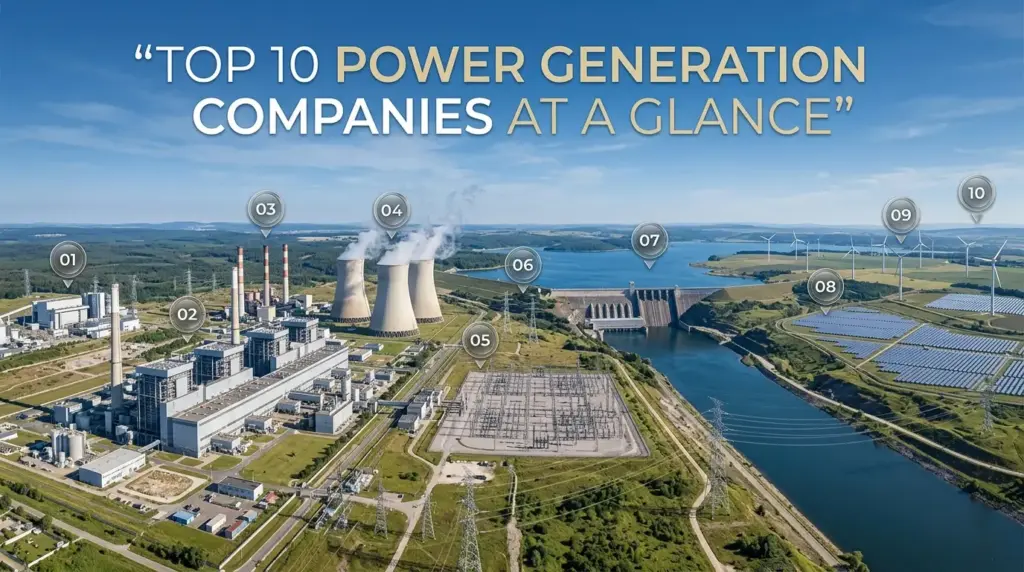
This is not a strict ranking. We picked ten companies that matter most to the US generation story and ordered them by how central generation is to their business, using the latest figures we could verify. Dates differ by source, so read the footnotes at the bottom.
| Company | Model | Scale snapshot | Best known for |
|---|---|---|---|
| 1. NextEra Energy | Regulated utility plus renewables developer | About $185.7B market cap; 110 GW combined with Dominion if the deal closes | Wind, solar and storage at national scale |
| 2. Constellation Energy | Independent power producer | About 55 to 60 GW | Largest US nuclear fleet, roughly 10% of US clean energy |
| 3. Southern Company | Regulated utility | 9M customers; about $105.6B market cap | Southeast utility with big tech power deals |
| 4. Duke Energy | Regulated utility | About 55.1 GW; 8.6M customers | Record $103B five-year capital plan |
| 5. Vistra | Independent producer plus retail | 44 GW; 5M retail customers | Texas retail reach and a diverse fleet |
| 6. American Electric Power | Regulated utility and transmission owner | 5.6M customers; 11 states | Transmission network and data center load |
| 7. Dominion Energy | Regulated utility plus contracted energy | Millstone at 2,098 MW; 2.6 GW offshore wind build | Nuclear and the largest US offshore wind project |
| 8. NRG Energy | Independent producer plus retail | About 25 GW (analyst estimate) | Gas-heavy fleet aimed at Texas data centers |
| 9. Talen Energy | Independent power producer | About 10.7 GW (estimates vary) | Susquehanna nuclear stake |
| 10. GE Vernova | Equipment maker | About $162.2B market cap (December 2025) | Turbines that run inside other companies’ plants |
Generation Capacity Snapshot (Gigawatts)
A quick side-by-side of fleet size for the companies where we found a comparable figure.
| Company | Capacity | Note |
|---|---|---|
| NextEra + Dominion (deal pending) | 110 GW | Estimate / pending combination |
| Constellation Energy | 55 to 60 GW | |
| Duke Energy | 55.1 GW | |
| Vistra | 44 GW | |
| NRG Energy | ~25 GW | Analyst estimate |
| Talen Energy | ~10.7 GW | Estimate |
Southern Company, AEP and GE Vernova are left out because we could not find a comparable fleet-capacity figure.
What Sets Each One Apart
1. NextEra Energy
ModelUtility plus renewables developer FootprintFlorida, plus wind, solar and storage across the US and parts of Canada HeadquartersJuno Beach, Florida
What sets it apart: NextEra runs two businesses under one roof. Florida Power & Light serves Florida customers, while NextEra Energy Resources builds and sells renewable power elsewhere.
Energy Digital reports FPL’s energy mix at 73% natural gas and NextEra Energy Resources’ output at 66% wind. The company operates seven nuclear units at four sites, and in January it said it could add up to 6 GW of small modular reactor capacity at existing or new sites. Its stated goal is to reach zero Scope 1 and 2 emissions by 2045 at the latest.
2. Constellation Energy
ModelIndependent power producer CapacityAbout 55 to 60 GW HeadquartersBaltimore, Maryland
What sets it apart: Constellation is the largest independent power company in the US and the biggest producer of carbon-free electricity in the country. It supplies about 10% of US clean energy.
Its nuclear fleet is the anchor. A Microsoft agreement helps restart the 835 MW Three Mile Island unit, and a 20-year Meta agreement covers 1,121 MW of nuclear power from the Clinton, Illinois plant. The Calpine acquisition added gas and geothermal generation to a fleet that was previously close to all nuclear.
3. Southern Company
ModelRegulated utility CustomersAbout 9 million HeadquartersAtlanta, Georgia
What sets it apart: Southern pairs three regulated electric companies (Alabama Power, Georgia Power and Mississippi Power) with gas distribution businesses in several states. That mix gives it steady regulated returns plus gas customers.
It holds power supply deals with Meta and Microsoft and plans $81 billion in capital spending between 2026 and 2030. Its stated target is net zero emissions by 2050, backed by research and development spending and water and waste reduction work.
4. Duke Energy
ModelRegulated utility CapacityAbout 55,100 MW FootprintCarolinas, Florida, Indiana, Ohio, Kentucky
What sets it apart: Duke has the biggest spending plan among the pure utilities here: a record $103 billion over five years through 2030. Its electric utilities serve about 8.6 million customers.
Power supply deals with Amazon, Google and Microsoft sit behind that plan. The company is also building a smarter grid, which it says should improve reliability and make room for cleaner energy.
5. Vistra
ModelIndependent producer plus retail Capacity44 GW HeadquartersIrving, Texas
What sets it apart: Vistra owns both the plants and a large retail business serving 5 million customers in 20 states, including almost a third of Texas electricity consumers.
The fleet is 27 GW of gas, 8.7 GW of coal, 6.5 GW of nuclear and 1.3 GW of solar and storage. It holds the second-largest competitive nuclear fleet in the US, behind Constellation, and has power purchase agreements with Amazon and Microsoft. Reported revenue swings from quarter to quarter because Vistra books hedging gains and losses in revenue, so the headline number can mislead.
6. American Electric Power (AEP)
ModelRegulated utility and transmission owner CustomersAbout 5.6 million Footprint11 states, over 200,000 square miles
What sets it apart: AEP is a major transmission owner, so it moves power as well as makes it. Its territory runs from Ohio and Texas through Virginia, West Virginia and Louisiana.
The company signed 7 GW of new large energy project agreements in a single quarter, mostly in Ohio and Texas. Nearly 90% of the 63 GW of incremental contracted load it expects by 2030 comes from data centers, and its five-year capital plan is $78 billion.
7. Dominion Energy
ModelRegulated utility plus contracted energy FootprintVirginia, North Carolina, South Carolina Nuclear shareOver 40% of generation
What sets it apart: Dominion pairs a heavy nuclear base with the largest offshore wind project under construction in the US. Its reactors are Millstone in Connecticut, North Anna and Surry in Virginia, and V.C. Summer in South Carolina.
The Coastal Virginia Offshore Wind project is 2.6 GW and 81% complete, but final turbine installation slipped to the end of 2027 and the cost estimate rose to about $11.65 billion. Millstone alone is 2,098 MW, and Dominion has signaled it will seek approval to run it until 2065.
8. NRG Energy
ModelIndependent producer plus retail CapacityAbout 25 GW (analyst estimate) HeadquartersHouston, Texas
What sets it apart: NRG leans on natural gas and aims at Texas data centers that want to bring their own power. Analyst research credits a January 2026 LS Power deal with roughly doubling its size, and with adding a virtual power plant business.
Because that capacity figure comes from third-party research, check it against NRG’s own filings before you quote it. NRG and Vistra compete head to head, since both pair gas-heavy generation with Texas retail.
9. Talen Energy
ModelIndependent power producer CapacityAbout 10.7 GW (estimates run higher) Nuclear stake90% of Susquehanna
What sets it apart: Talen is the smallest independent producer in this group, but about half of its output is carbon-free thanks to its stake in the two-unit Susquehanna nuclear plant (roughly 2.25 GW).
The rest is mostly gas, around 7 GW, plus about 1.4 GW of coal. Analyst sources disagree on its total size, with some placing it between 13 and 15 GW, so treat any single number with care.
10. GE Vernova
ModelEquipment maker Workforce75,000 people, 100+ countries HeadquartersCambridge, Massachusetts
What sets it apart: GE Vernova does not run a power fleet. It builds the gas turbines and grid technology that other companies install, and its technology helps generate about a quarter of the world’s electricity.
We include it because many “top power generation companies” lists do, and readers search for it. Its market cap was about $162.2 billion in December 2025, which is why it rubs shoulders with the generators on ranking pages even though its income comes from selling equipment.
Three Business Models Behind the Names

The company type matters more than the logo. It decides who carries price risk.
- Regulated utilities: NextEra’s FPL, Southern, Duke, AEP and Dominion earn a regulator-approved return on plants they build. Customers carry most of the price risk.
- Merchant power producers: Constellation, Vistra, NRG and Talen sell into open markets. Their earnings swing with power and gas prices unless they hedge.
- Equipment makers and developers: GE Vernova sells turbines, while NextEra Energy Resources develops and sells renewable projects.
Most utilities in the top 10 also have a competitive arm, so one company can sit in two categories at once. Dominion’s contracted energy segment is a good example.
What Data Center Contracts Really Tell You
Tech companies now sign directly with plant owners, often for 20 years. Nuclear plants and gas plants near data center hubs command a premium, while aging coal units are valued mainly by how soon they retire.
The part we watch closely is conversion. A “pipeline” of inquiries is not revenue, and the gap between pipeline and signed contracts is wide.
- Southern: over 11 GW contracted across 28 projects against a 75 GW pipeline of inquiries, roughly 15% by our arithmetic.
- Dominion: about 12 GW under electric service agreements out of more than 53 GW in various contracting stages, roughly 23% by our arithmetic.
- Definitions: companies define “pipeline” and “contracted” differently, so treat these ratios as a rough guide, not a scoreboard.
When a company quotes a big pipeline, ask how much is under a signed agreement and how much is only an inquiry.
Why Everyone Is Buying Everyone
Three deals in one year tell us scale is now a survival strategy. Large buyers want one counterparty that can promise gigawatts on a fixed schedule.
- Constellation and Calpine: a $16.4 billion deal in early 2026 that lifted the combined fleet to nearly 60 GW and 2.5 million customers.
- Vistra and Cogentrix: a $4 billion agreement adding 5.5 GW of gas across PJM, New England and ERCOT.
- NextEra and Dominion: a $66.8 billion plan that would create a combined company with an enterprise value near $420 billion. The new entity would be 74.5% owned by NextEra shareholders and 25.5% by Dominion shareholders.
The NextEra and Dominion deal still needs FERC, NRC and antitrust clearance, and the parties expect it to close in 12 to 18 months. Because NextEra owns Seabrook and Dominion owns Millstone, it also matters to New England nuclear contracts. Connecticut officials said existing negotiations continue until the deal closes.
Bigger balance sheets matter for a practical reason. New gas turbines and grid connections take years and cost heavily, so a company that can fund both gets the contract.
The Texas Angle Most Lists Ignore
Texas runs its own grid, ERCOT, with its own registration rules. The Public Utility Commission of Texas publishes an alphabetical directory of registered power generation companies, which is a useful first check if you are vetting a counterparty.
A company name on a big national list does not tell you which Texas entity actually owns a given plant. Subsidiaries and project companies are common, so match the legal entity, not the brand.
How to Evaluate a Power Generation Company
This is the checklist we use when comparing two fleets. It takes about an hour with public filings.
- Fuel mix: list gigawatts by gas, nuclear, coal and renewables. Check retirement dates for coal units.
- Contracted share: find how much output is sold under long-term contracts versus the open market.
- Hedge position: read the hedging disclosure to see how much of next year’s power is already locked in.
- Market exposure: note which grids the plants sit in, such as PJM, ERCOT or ISO-NE. One analyst report put the jump in PJM capacity prices at more than 800% in the 2025/26 auction and questioned whether it will last.
- Balance sheet: compare debt against the cost of announced acquisitions.
Common Mistakes When Comparing Companies
- Market cap ranking: a high valuation can reflect growth hopes, not plants.
- Oil majors: ExxonMobil and Chevron appear on many “energy” lists but are not generators.
- Old tables: the 2023 list we reviewed predates every major deal above.
- Pending deals: Cogentrix and Dominion figures depend on closing.
- Global lists: state-owned companies dominate worldwide revenue rankings, so revenue-led tables favor state utilities in Asia and Europe over US investor-owned firms.
FAQ
How do I find out who owns a specific power plant near me?
The US Energy Information Administration publishes plant-level data, including owner and operator names. Search its generator inventory by state and county.
Do power generation companies set my electricity bill?
Only part of it. Generation is one component, alongside delivery charges and taxes. In deregulated markets such as Texas, you can choose your retail provider, which changes the energy portion.
Are power generation stocks a good investment?
That depends on contracts, hedging and debt, not on size alone. We are not financial advisors, so read the filings or speak with a licensed professional.
How much does it cost to start a power generation company?
It varies widely by fuel and scale. Costs include land, equipment, grid interconnection studies, permits and market registration, and approval timelines often outlast construction.
Which fuel produces the most electricity in the US?
Natural gas is the largest single source, followed by nuclear, coal and wind. The mix shifts by region and season.
Do generation companies own the power lines?
Usually not. Merchant producers sell into the grid, while transmission and local distribution belong to utilities or grid operators.
How long does it take to build a new gas plant today?
Plan for several years from planning to operation. Turbine delivery slots and interconnection queues are common bottlenecks.
Outages and Emergencies: The Complete Guide to NV Energy Power Outages in Nevada
Top Renewable Energy Companies in 2026
Solar Panel Maintenance: The Complete Guide
Industrial Generators: The Complete Buying Guide for U.S. Businesses



[…] Power Generation Companies: Top 10 Players and How to Compare […]