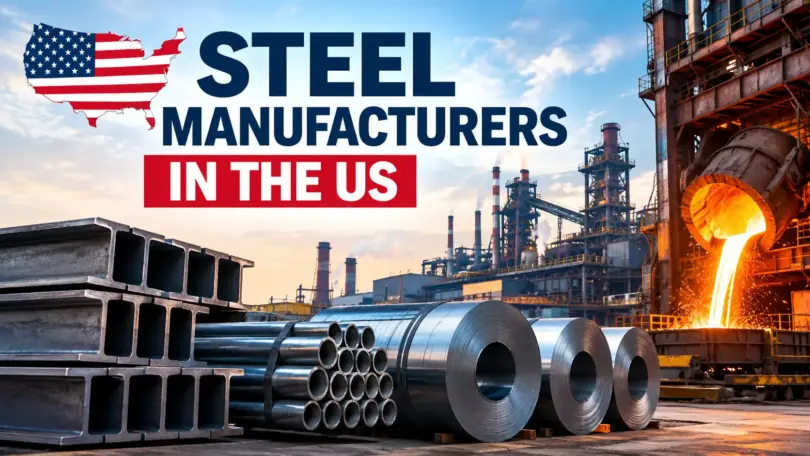

The largest US steel manufacturers by production include Nucor, Cleveland-Cliffs, Steel Dynamics, and Commercial Metals, with Nucor posting the highest steel-mill shipment volumes of any US producer through the first half of 2026. Nucor is also the largest publicly traded US steelmaker by market capitalization, though market values shift daily and shouldn’t be treated as fixed figures.
One important distinction worth flagging up front: ownership. U.S. Steel is no longer an independently traded public company following Nippon Steel’s 2025 acquisition, so current lists should treat it differently from companies such as Nucor and Steel Dynamics that still trade on their own.
What Actually Separates Steel Manufacturers From Steel-Related Companies
Most lists of “steel companies” mix true manufacturers in with distributors, pipe fabricators, and diversified holding companies. That’s not wrong exactly, but it blurs an important distinction for anyone doing real research: who actually melts and shapes steel, versus who processes, distributes, or owns steel-adjacent businesses.
Production method is the first real dividing line among the manufacturers themselves. There are two models running the US market:
- Integrated mills start from raw iron ore and coke, running it through blast furnaces. This is capital-heavy, slower to adjust output, and increasingly rare in the US.
- Electric-arc-furnace (EAF) mini-mills melt down recycled scrap steel instead of starting from ore. They’re generally cheaper to run and quicker to adjust output.
Electric-arc furnaces now account for a major share of US steel production, with Nucor and Steel Dynamics both operating almost entirely on this model. Cleveland-Cliffs runs a more vertically integrated business that includes iron ore mining, iron ore pellets, direct reduced iron, scrap processing, and primary steelmaking. Its business mix is therefore structurally different from the predominantly EAF-based model used by Nucor, which is worth knowing before comparing the two companies directly on any single metric.
For buyers sourcing steel rather than researching companies, production method alone doesn’t tell you much. The more useful question is whether a given mill produces the required grade, dimensions, certifications, and volume within your required lead time. That depends on the specific mill’s product mix and current order book, not just whether it runs an EAF or a blast furnace.
Major Steel Manufacturers and Steel-Related Companies in the US
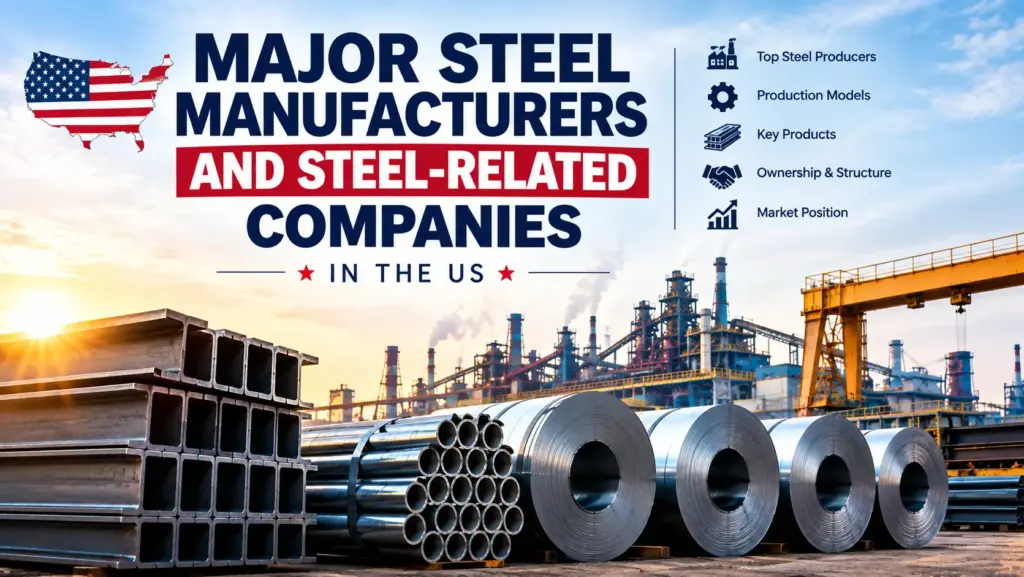
Revenue ranking shifts year to year depending on steel prices and tariff conditions, but the companies below represent the core of the US industry. The table separates true manufacturers from distributors and holding companies, since several commonly cited “biggest steel company” lists blur that line.
| Company | Headquarters | Business Type | Main Products | Public? |
|---|---|---|---|---|
| Nucor | Charlotte, NC | Steel manufacturer (EAF) | Sheet, bar, plate | Yes – NYSE: NUE |
| Cleveland-Cliffs | Cleveland, OH | Integrated steel producer | Flat-rolled, plate | Yes – NYSE: CLF |
| Steel Dynamics | Fort Wayne, IN | Steel manufacturer (EAF) | Sheet, long products | Yes – NASDAQ: STLD |
| Commercial Metals (CMC) | Irving, TX | Steel manufacturer (EAF) | Rebar, merchant bar | Yes – NYSE: CMC |
| U.S. Steel | Pittsburgh, PA | Integrated + EAF steel producer | Flat-rolled, tubular | No – subsidiary of Nippon Steel |
| SSAB Americas | Mobile, AL (Swedish parent) | Steel manufacturer | Plate steel | Parent company publicly traded in Sweden |
| ATI Inc. | Dallas, TX | Specialty metals manufacturer | Aerospace and specialty alloys | Yes – NYSE: ATI |
| Worthington Steel | Columbus, OH | Steel processor | Value-added flat steel | Yes – NYSE: WS |
| Metallus Inc. | Canton, OH | Specialty steel manufacturer | Bar, tubular products | Yes – NYSE: MTUS |
| Reliance, Inc. | Scottsdale, AZ | Metals service center / distributor | Processed and distributed metals | Yes – NYSE: RS |
| NWPX Infrastructure | Portland, OR | Steel pipe / infrastructure manufacturer | Water infrastructure pipe | Yes – NASDAQ: NWPX |
| Friedman Industries | Longview, TX | Steel manufacturer | Pipe, plate | Yes – NYSE American: FRD |
| The Renco Group | New York, NY | Diversified private industrial holding company | Various, including legacy steel-related assets | No – private |
A quick note on why this table matters: names like Reliance, NWPX, and The Renco Group show up on many “biggest steel companies” lists because of their size or industry association, but they’re distributors, infrastructure specialists, or diversified holding companies rather than primary steel manufacturers. Separating “Business Type” out this way gives a clearer picture than a flat ranked list.
How 2026 Steel Prices, Tariffs and Demand Are Affecting US Steelmakers
Coverage of the US steel sector in 2026 tends to get flattened into a single headline about strong performance, but the reality has been more mixed across companies.
According to the American Iron and Steel Institute, US domestic raw steel production came in just under 90 million net tons for 2025, with weekly capacity utilization running mostly in the 75 to 79 percent range through the year.
Nucor’s first half of 2026 was genuinely strong. First-quarter net sales reached $9.50 billion with net earnings attributable to Nucor stockholders of $743 million, or $3.23 per diluted share, on record steel-mill shipments of 7.028 million tons. Second-quarter results improved further: net sales of $10.40 billion, net earnings of $1.16 billion, or $5.04 per diluted share, and a second consecutive quarterly shipment record at 7.1 million tons. Nucor’s leadership specifically pointed to investment across key sectors of the economy combined with supportive federal trade policy as drivers of the shipment records.
Cleveland-Cliffs told a different story in the same period. The company posted a first-quarter 2026 GAAP net loss of $229 million, or $0.42 per diluted share, on revenue of $4.92 billion, with results weighed down by a cold-weather-driven energy price spike. Its second quarter showed improvement, with adjusted EBITDA nearly tripling from the first quarter and the company returning to positive free cash flow, but it remained in a recovery position rather than posting the kind of record results Nucor reported.
The practical takeaway: tariff policy and demand trends have generally supported US steelmakers in 2026, but company-specific factors, such as production mix, input costs, and prior debt levels, mean performance has varied significantly between producers. Treating “steel stocks” as a single unified trend misses that.
Publicly Traded US Steel Companies
For readers who specifically want to know which US steel manufacturers are exchange-listed, here’s a factual rundown without ranking or recommendation:
- Nucor (NYSE: NUE) – steelmaking and steel products
- Steel Dynamics (NASDAQ: STLD) – steel, metals recycling, and fabrication
- Cleveland-Cliffs (NYSE: CLF) – vertically integrated steel producer
- Commercial Metals (NYSE: CMC) – rebar and merchant steel
- Worthington Steel (NYSE: WS) – value-added steel processing
- ATI Inc. (NYSE: ATI) – specialty and aerospace-grade alloys
- Metallus Inc. (NYSE: MTUS) – specialty bar and tubular steel
- Friedman Industries (NYSE American: FRD) – pipe and plate steel
- Reliance, Inc. (NYSE: RS) – metals service center and distributor, not a primary steelmaker
Together, these companies make up a large share of the exchange-listed US steel sector by market value, though the exact composition shifts daily with share prices and isn’t something a static article can report precisely. One point worth repeating: U.S. Steel traded on the NYSE under ticker X from 1901 until 2025 and is not part of this list anymore, since it now operates as a subsidiary of Nippon Steel rather than an independent public company.
Global Context: Where US Manufacturers Rank Worldwide
US steel manufacturers dominate domestic headlines, but it’s worth knowing where they sit globally, since that context explains some of the pricing pressure US mills face from imports.
China Baowu Steel Group, the state-owned Chinese producer, reported revenue north of $157 billion, dwarfing every US producer combined. ArcelorMittal, the Luxembourg-based multinational that also trades on the NYSE under ticker MT, posted around $61.4 billion in revenue. Even mid-tier Chinese producers outsize most American names: Delong Steel, based in Hebei province, was ranked 12th globally with production of 27.9 million tonnes in a recent year.
The practical implication: no US steel manufacturer, including Nucor, competes with Chinese state-backed producers on raw scale. US mills compete more on delivery speed, quality consistency, and proximity to American buyers, which is part of why tariff policy carries so much weight for this specific sector.
What to Check Before Choosing a US Steel Manufacturer
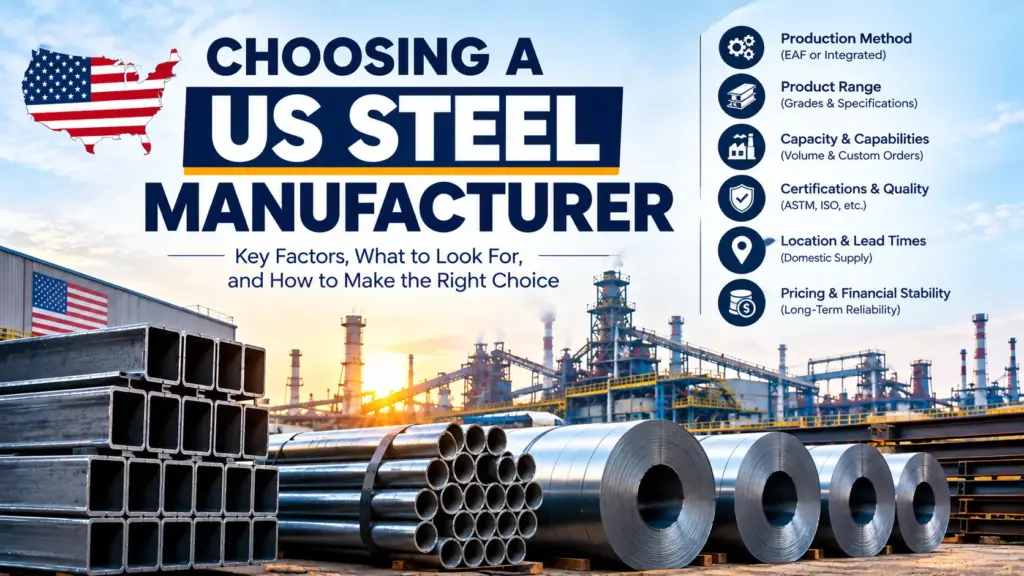
Whether you’re sourcing steel for a project or researching the industry, these are the details that actually separate a good fit from a bad one:
- Product range – does the mill make the form (sheet, bar, plate, tube) you actually need?
- Steel grade and specifications – confirm the exact grade, not just the general product category.
- Production method – EAF versus integrated affects available grades and typical lead time flexibility.
- Annual capacity – a mill’s total capacity affects how easily it can absorb a large or urgent order.
- Mill location – freight cost and delivery time both scale with distance from the mill.
- Lead times – ask for current lead times directly, since published averages lag real conditions.
- Certifications – check for the specific industry certifications your project or buyer requires.
- Domestic vs. imported feedstock – this affects both pricing stability and tariff exposure.
- Pricing structure – index-based, fixed-contract, and spot pricing all carry different risk profiles.
- Financial stability – a supplier’s balance sheet affects their ability to deliver on long lead-time orders.
- Recent shipment volumes – a good proxy for whether a mill is running near capacity or has room for new orders.
- Customer industries served – mills that already serve your industry are more likely to understand its specs and standards.
FAQ
Is Nucor the largest steel manufacturer in the US?
By steel-mill shipment volume, yes: Nucor posted record shipments in both the first and second quarters of 2026. It’s also the largest publicly traded US steelmaker by market capitalization, though that figure moves daily with share prices.
Is U.S. Steel still a public company?
No. U.S. Steel traded on the NYSE under ticker X from 1901 until 2025, when Nippon Steel completed its acquisition. It now operates as a subsidiary rather than an independent public stock.
What’s the difference between a steel manufacturer and a metals distributor?
A manufacturer melts or smelts raw material into steel products. A distributor like Reliance buys finished steel and resells or lightly processes it. Both show up on “steel company” lists, but they play very different roles in the supply chain.
Did all US steel companies perform well in 2026?
No. Nucor posted record shipments and strong earnings in both the first and second quarters of 2026, while Cleveland-Cliffs reported a first-quarter GAAP net loss before improving in the second quarter. Performance has varied by company, not moved as a single trend.
What are electric-arc-furnace (EAF) mini-mills?
EAF mini-mills melt recycled scrap steel using electric arc furnaces instead of starting from raw iron ore in a blast furnace. They account for a major share of current US steel production.
Which publicly traded steel companies are smaller producers?
Names like Friedman Industries, Metallus, and Worthington Steel are considerably smaller than Nucor or Steel Dynamics by market value and production volume, and each serves more specialized product niches.
Do US steel manufacturers compete with Chinese producers on price?
Not directly on scale. Chinese state-backed producers like China Baowu operate at a size no US company matches. US manufacturers compete more on delivery speed, consistency, and domestic market access.
Is Reliance, Inc. considered a steel manufacturer?
Not technically. Reliance is a metals service center and distributor. It’s often included on “biggest steel companies” lists because of its size, but it doesn’t produce steel from raw materials or scrap the way Nucor or Steel Dynamics does.
You May Also Like It:
Powder Metallurgy Steel: The Complete Guide to Process, Properties, and Uses
The Sintering Process: A Complete, Practical Guide
Metallurgy Technology: Definition, Types, Processes, and Applications
Metallurgy Testing Laboratory: The Complete Guide to Metallurgical Testing Services
Metallurgy Expert Witness: A Practical Guide for Attorneys Hiring One