
Commercial solar systems can significantly reduce a building’s electricity costs while improving energy efficiency and property value. In 2026, businesses are increasingly using solar systems for commercial buildings to lower monthly utility bills, reduce their carbon footprint, and protect against rising energy rates. The total cost and ROI depend on system size, installation costs, financing, location, and equipment selected.
This guide explains how commercial solar energy works, the average commercial solar installation cost in 2026, how to calculate ROI, leading commercial solar companies and equipment brands, and how to choose reliable commercial solar contractors for your building.
What Is a Solar System for Commercial Building Projects
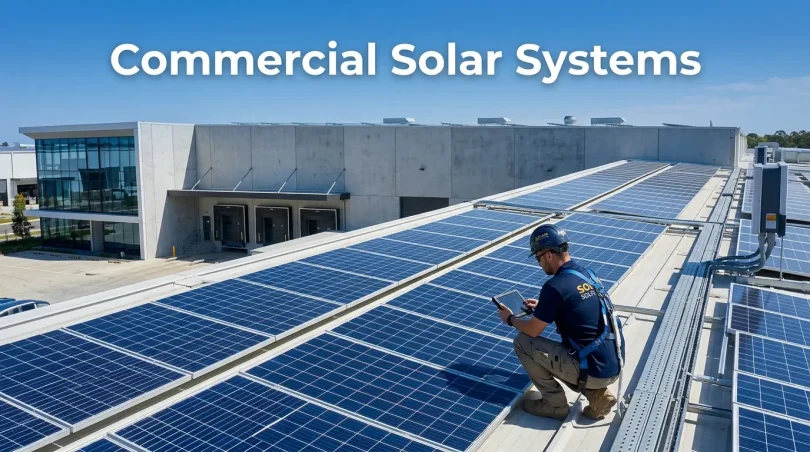
A solar system for commercial building use is a photovoltaic (PV) installation designed to power offices, warehouses, retail stores, manufacturing plants, and other business properties. Unlike a small residential array, a commercial PV system is engineered around the building’s actual load profile, its demand charges, and its roof or land structure.
Commercial solar power systems typically fall into three categories:
- Commercial rooftop solar. Installed on flat, metal, or shingle roofs using ballasted or penetrating mounts.
- Ground mounted solar power systems. Built on open land next to the facility, common for warehouses and industrial sites with limited roof space.
- Solar carports. Installed over parking lots, providing shade for vehicles while generating power for the building.
Commercial PV systems are usually sized between 25 kW for a small office and several megawatts for a large distribution center. The larger the system, the lower the cost per watt, since fixed costs like design, permitting, and engineering get spread across more capacity.
How Commercial Solar Panels Work
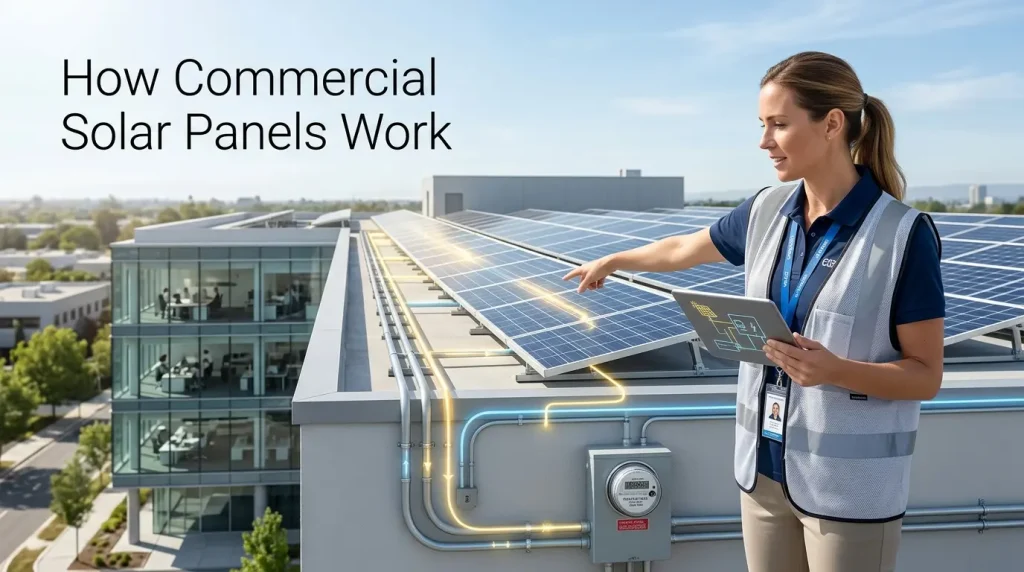
A commercial solar energy system converts sunlight into direct current (DC) electricity through solar modules. An inverter, commonly from manufacturers such as SolarEdge, SMA, or Enphase, then converts that DC power into alternating current (AC) that the building uses to run lighting, HVAC, machinery, and other equipment.
Any electricity the panels generate but the building does not use is sent back to the grid through net metering, which credits the business for the excess. This is what makes a grid connected solar system so practical for most commercial properties: it does not require a full off-grid setup to deliver meaningful energy independence.
At night or on cloudy days, the building draws power from the grid as usual. Utility bills reflect only the net difference between what the building consumed and what the solar system produced, which is why many businesses see their commercial electricity bill drop by 50 percent or more.
Benefits of Commercial Solar Panels
Beyond the headline savings, commercial solar panels deliver a range of business advantages:
- Lower and more predictable electricity costs, protecting the business from utility rate hikes for decades.
- Improved cash flow, since the money once spent on electricity consumption can be redirected into operations.
- Higher property value. Commercial buildings with an installed solar power system are frequently more attractive to buyers and tenants.
- Energy independence and resilience, especially when paired with battery storage for backup power.
- Stronger sustainability credentials, which matter for corporate ESG reporting, tenant expectations, and public image.
- Tax savings, through federal and state solar incentives described later in this guide.
Commercial Solar Installation Cost in 2026
Cost is the first question every business owner asks, and it depends heavily on system size, roof type, and location. According to Department of Energy and NREL benchmarking data, installed commercial solar pricing has fallen sharply over the past decade as both hardware and soft costs (permitting, labor, interconnection) have come down. Based on current industry pricing, here is what businesses can expect per watt in 2026:
| System Size | Typical Cost Range | Approx. Total Cost |
|---|---|---|
| Small business (25 to 100 kW) | $1.80 to $2.55 per watt | $45,000 to $255,000 |
| Mid-size (100 to 500 kW) | $1.40 to $1.90 per watt | $140,000 to $950,000 |
| Large scale (500 kW to 2 MW) | $1.10 to $1.50 per watt | $550,000 to $3,000,000 |
Larger commercial solar installations achieve better cost efficiency because engineering, permitting, and mobilization costs do not scale linearly with system size. A 500 kW system can cost 20 to 30 percent less per watt than a 50 kW system on the same roof type. Industry benchmark reporting from SEIA and Wood Mackenzie has placed typical commercial pricing near $1.71 per watt DC, broadly consistent with the ranges above.
Site conditions also affect final pricing. Roof age, structural load capacity, shading, switchgear capacity, and interconnection requirements can all push costs higher or lower than the averages shown. Getting a site-specific quote from a licensed commercial solar contractor is the only way to know your exact commercial solar panels cost.
Roof Requirements for Commercial Solar
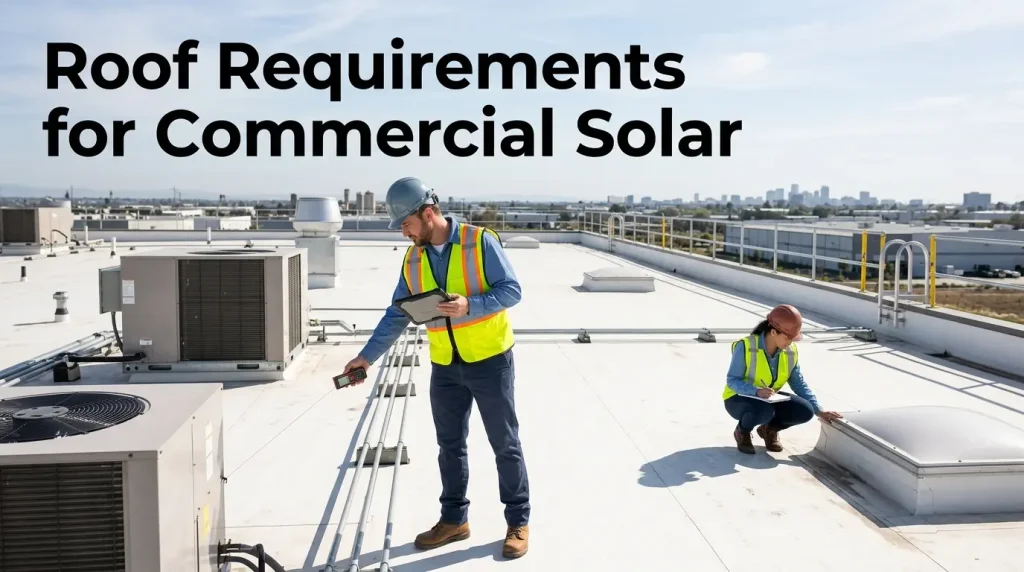
Before committing to a project, most commercial solar companies will assess whether your roof can support the system:
- Structural load capacity. The roof must safely support the added weight of panels, racking, and ballast.
- Roof age and remaining life. Installers generally recommend at least 10 to 15 years of remaining roof life before mounting a system, since removing and reinstalling panels for a roof replacement adds cost.
- Roof type. Flat rubber roofs typically use a ballasted, non-penetrating mount, while metal and shingle roofs use specialized attachment points.
- Available square footage and shading. A rough planning rule is that 100 kW of commercial solar panels requires approximately 8,000 to 10,000 square feet of usable, unshaded roof or ground area, though actual figures depend on panel efficiency and layout.
- Access to switchgear. The building’s electrical service and switchgear must have enough capacity, or be upgraded, to safely interconnect the new system.
If the roof cannot support a rooftop array, a ground mount or solar carport is usually the next option, particularly for warehouses and industrial sites with open land or large parking areas.
ROI and Payback Period for Commercial Solar Energy
Return on investment is what ultimately drives the decision to go solar. Most commercial solar installation projects pay for themselves within 4 to 8 years, and the panels themselves are warranted for 25 to 30 years, meaning decades of low-cost electricity after payback.
Here is a simplified example:
A business installs a 100 kW commercial PV system for $200,000. After the 30 percent federal tax credit and other incentives, the net cost drops to around $140,000. If the system saves the business $30,000 a year on electricity consumption, the payback period is roughly 4.7 years. Over the remaining life of the system, that same business could save well over $1 million in avoided utility costs.
To calculate ROI for your own building, you need three numbers: the net installed cost after incentives, the annual electricity savings, and the expected maintenance cost over the system’s life. Businesses with high daytime energy use, such as manufacturing plants, cold storage, and retail stores with long operating hours, generally see the fastest payback because their electricity demand lines up closely with solar production hours.
Commercial Solar Case Study
Consider a mid-size distribution warehouse in the southern United States with an average monthly electricity bill of $9,000. The facility installed a 250 kW rooftop commercial solar system at a gross cost of $400,000. After applying the 30 percent federal ITC and state depreciation benefits, the net cost fell to roughly $250,000. The system offset around 70 percent of the warehouse’s annual electricity consumption, cutting the monthly bill to about $2,700. With annual savings of roughly $75,000, the warehouse reached full payback in just under 3.5 years, and it is now projected to save more than $1.8 million over the remaining life of the system. Cases like this are common across the commercial solar industry and are one reason warehouses and manufacturing plants are among the fastest-growing segments for commercial solar adoption.
Commercial Solar Tax Incentives and Financing
Federal Tax Incentives
Commercial solar in the United States benefits from incentives that are not available to homeowners in the same way:
- Investment Tax Credit (ITC). Businesses can claim a 30 percent tax credit on the total cost of the solar installation, directly reducing federal tax liability.
- Modified Accelerated Cost Recovery System (MACRS). Commercial solar assets qualify for accelerated depreciation, often over five years, which further reduces the effective cost of the system.
- State and utility incentives. Many states offer additional rebates, grants, or performance-based incentives that stack on top of the federal credit.
When combined, these incentives can offset 45 to 80 percent of the total project cost, which is why so many businesses move forward with solar even when the upfront number looks large.
Commercial Solar Financing Options
Not every business wants to pay the full cost upfront, and several financing structures exist to make commercial solar accessible regardless of capital position:
- Cash purchase. The business owns the system outright and claims the full ITC and depreciation benefits directly.
- Solar loan. The business finances the purchase and pays it down using the energy savings generated each month, while still owning the system and claiming incentives.
- Power Purchase Agreement (PPA). A third-party developer owns and maintains the system, and the business simply buys the electricity it produces, usually at a rate below the utility’s price.
- Operating lease. Similar to a PPA but with fixed monthly payments instead of per-kWh pricing.
PPAs and leases work particularly well for nonprofits and businesses without enough tax liability to use the ITC directly, since the developer captures those benefits and prices them into the contract instead.
Solar Plus Battery Storage for Commercial Buildings
Adding battery storage to a commercial solar system unlocks savings that panels alone cannot deliver. Many commercial utility bills include demand charges, a separate fee based on the building’s highest 15-minute spike in peak demand, which can account for up to half of the total bill.
A commercial battery energy storage system (BESS), similar in concept to a Tesla Powerwall but scaled up for business use, paired with solar allows a company to:
- Reduce demand charges through peak shaving, using stored energy during high-demand periods instead of pulling more from the grid.
- Keep critical operations running during a grid outage, supporting overall energy management.
- Shift stored solar energy to evening hours when utility rates are highest.
Commercial battery systems typically range from 20 kWh for a small office to several hundred kWh for larger industrial facilities, and they are increasingly bundled into new commercial solar installation packages rather than added later.
Commercial Solar Maintenance
One advantage of a commercial photovoltaic system is that it requires relatively little upkeep compared to most mechanical building equipment. Typical maintenance includes:
- Periodic panel cleaning, especially in dusty or high-pollen environments, to maintain peak energy efficiency.
- Annual inspections of wiring, connectors, and racking for wear or corrosion.
- Inverter monitoring, since inverters (from brands such as SMA, SolarEdge, or Enphase) typically need replacement or servicing around year 10 to 15, well before the panels themselves degrade.
- Remote performance monitoring software that flags underperformance early, often included by the installer.
- Vegetation and debris management for ground mounted systems to prevent shading.
Well-maintained commercial solar panels typically retain 80 to 90 percent of their original output after 25 years, which is why manufacturer warranties are such an important factor when selecting equipment.
Commercial vs Industrial Solar Power Systems
The terms are often used interchangeably, but there is a practical difference. Commercial solar systems generally serve offices, retail spaces, and small to mid-size businesses. Industrial solar installations tend to be larger-scale systems built for manufacturing facilities, warehouses, and distribution centers with higher, more consistent electricity demand. The core technology is the same, but industrial projects usually involve more complex switchgear work, longer conductor runs, and stronger structural engineering to support the larger array.
Solar for Specific Business Types
- Solar system for office building. Office buildings typically have moderate, business-hours energy consumption, making a rooftop or carport system a strong fit, often in the 50 to 250 kW range.
- Solar system for warehouse. Warehouses often have large, unobstructed roofs and high daytime loads from refrigeration, lighting, or material handling equipment, making them ideal candidates for larger rooftop or ground mounted arrays.
- Solar for manufacturing plant. Manufacturing facilities usually run heavy equipment continuously, so systems here are frequently paired with battery storage to manage peak demand and reduce demand charges.
Best Commercial Solar Companies: How to Choose Commercial Solar Contractors
The commercial solar contractors you choose have as much impact on your outcome as the equipment itself. When comparing commercial solar companies, look for:
- Experience with commercial-scale projects, not just residential rooftops. Ask for case studies or references from similar-sized buildings.
- In-house engineering and licensing. A true EPC (Engineering, Procurement, and Construction) firm manages design, permitting, and installation without outsourcing critical steps.
- Premium component sourcing. Reputable installers use commercial solar panels, inverters, and racking from established manufacturers such as First Solar, Canadian Solar, and Jinko Solar, along with inverter brands like SolarEdge, SMA, and Enphase, since a 25-year system is only as reliable as the company standing behind it decades from now.
- Financing and incentive support. A good contractor helps you navigate the ITC, MACRS, and any state or utility rebates rather than leaving that work to your accountant alone.
- Post-installation service. Ask how monitoring, maintenance, and warranty claims are handled after the system goes live.
Environmental Benefits of Commercial Solar Energy
Beyond the financial case, commercial solar energy directly supports a company’s environmental goals. A single 100 kW commercial solar power system can offset roughly 100 to 140 metric tons of carbon emissions per year, comparable to taking around 25 to 30 gasoline-powered cars off the road annually, depending on the local grid’s fuel mix. Choosing renewable energy over grid electricity generated from fossil fuels reduces a company’s Scope 2 emissions, supports corporate sustainability reporting, and appeals to environmentally conscious customers, employees, and investors. As more businesses adopt clean energy, the demand for renewable power continues to reduce strain on regional electricity grids during peak demand periods.
Common Mistakes to Avoid
Many businesses lose money on solar not because of the technology, but because of avoidable planning errors:
- Sizing the system based on rooftop space alone instead of actual electricity consumption.
- Skipping a structural and electrical assessment before signing a contract.
- Choosing the lowest bid without checking the installer’s warranty and financial stability.
- Ignoring demand charges when calculating expected savings.
- Missing incentive deadlines, since federal and state solar incentives can change with new legislation.
Frequently Asked Questions
How much does a solar system for a commercial building cost?
Most commercial systems cost between $1.10 and $2.55 per watt depending on size, with small systems costing more per watt than large ones due to fixed engineering and permitting costs.
How long does it take for commercial solar to pay for itself?
Typical payback periods range from 4 to 8 years, after which the business benefits from decades of reduced electricity costs.
Can a business get tax credits for solar?
Yes. Businesses can claim a 30 percent federal Investment Tax Credit along with accelerated depreciation under MACRS, and many states add further incentives on top.
Is battery storage necessary for a commercial solar system?
Battery storage is not required, but it significantly improves ROI for buildings with high demand charges or a need for backup power during outages.
What is the difference between commercial and industrial solar?
Commercial solar generally serves offices and retail buildings, while industrial solar is built for larger facilities like warehouses and manufacturing plants with higher energy loads.
How many solar panels does a commercial building need?
It depends on the building’s energy consumption and panel wattage, but as a general guide, a 100 kW system typically requires 200 to 250 commercial-grade panels rated around 400 to 500 watts each.
Can commercial buildings run completely on solar?
It is possible with a large enough system and sufficient battery storage, but most grid connected commercial buildings use solar to offset 50 to 100 percent of consumption while remaining connected to the grid for reliability.
How much roof space is needed for commercial solar?
As a planning estimate, every 10 kW of commercial solar panels requires roughly 800 to 1,000 square feet of usable, unshaded roof or ground space.
What maintenance do commercial solar systems require?
Routine maintenance includes periodic cleaning, annual inspections, inverter servicing around year 10 to 15, and ongoing performance monitoring.
How long do commercial solar panels last?
Most commercial solar panels are warranted for 25 to 30 years and often continue producing electricity, at a reduced output, well beyond that period.
Can warehouses use commercial solar?
Yes. Warehouses are one of the strongest candidates for commercial solar because of their large roof area and high daytime electricity demand.
Do commercial solar systems increase property value?
Yes. Buildings with an installed solar power system are generally more attractive to buyers and tenants due to lower operating costs and stronger sustainability credentials.
Final Thoughts
A solar system for commercial building projects is no longer a niche upgrade. It is a mainstream financial decision that reduces operating costs, protects against rising utility rates, and strengthens a company’s sustainability profile. With federal incentives currently in place, businesses that act now lock in the most favorable economics before any future policy changes take effect. The right first step is a site-specific assessment from a licensed commercial solar contractor who can size the system to your building’s actual energy use and walk you through financing options that fit your budget.
Sources and Industry References
- U.S. Department of Energy, Solar Photovoltaic System Cost Benchmarks
- National Renewable Energy Laboratory (NREL), Solar Market Research and Analysis
- Solar Energy Industries Association (SEIA) and Wood Mackenzie, U.S. Solar Market Insight
- Paradise Energy, GreenLancer, and other commercial solar industry cost guides referenced for 2026 pricing trends
You May Also Like It:
Power Outage Safety Guide: How to Prepare for Outages and Emergencies
Power to Choose in Texas: The Complete Guide to Comparing Electricity Plans
CenterPoint Outage Map Houston: How to Report and Track Power Outages
Consumers Outage Map: Complete Guide to Tracking Power Outages in Michigan