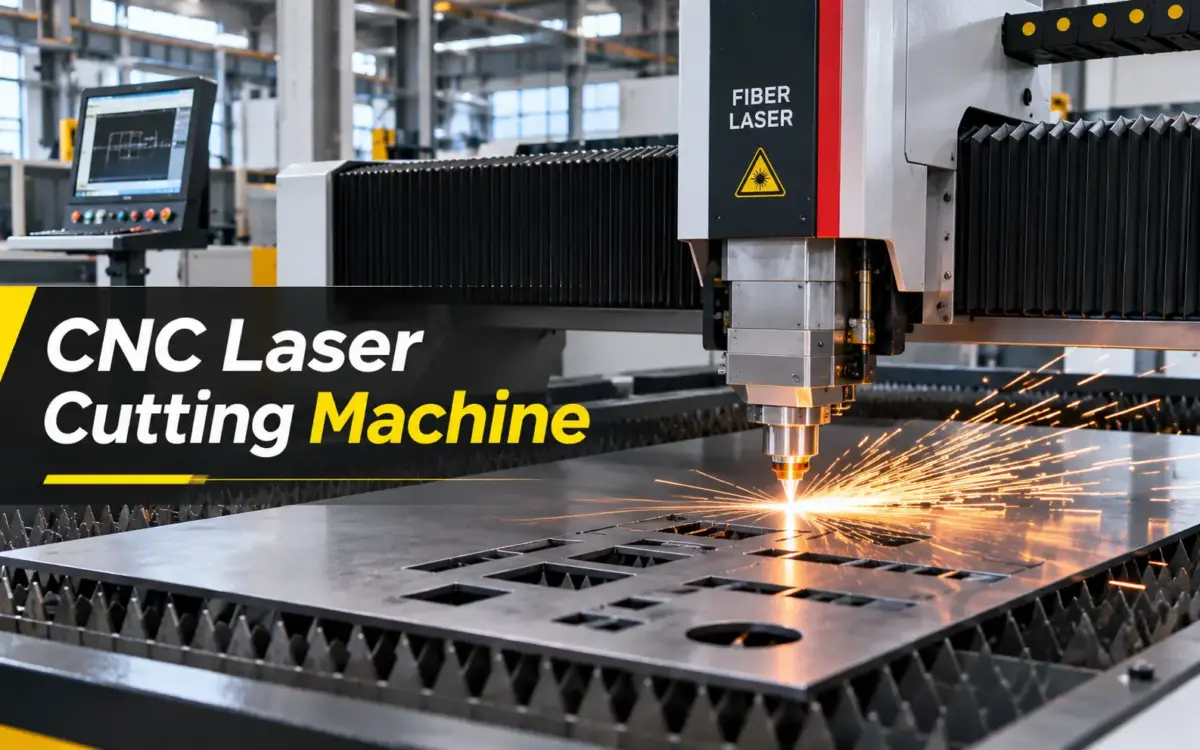
A CNC laser cutting machine is a computer-controlled machine that directs a focused laser beam along a programmed path to melt, burn, or vaporize material. It cuts sheet metal, tubes, and non-metals with high precision and without any physical tool touching the workpiece.
How It Works
A part is drawn in CAD (usually saved as DXF), arranged on the sheet by nesting software to waste as little material as possible, and converted into G-code. The CNC controller then moves the cutting head along that path while the laser, focused to a spot of roughly 0.1–0.3 mm, melts the material. A jet of assist gas blows the molten metal out of the cut.
The assist gas matters more than most beginners expect:
- Oxygen (carbon steel): reacts with the hot steel and adds heat, so cutting is faster and works on thicker plate, but the edge gets a thin oxide layer.
- Nitrogen (stainless steel, aluminum): gives a clean, oxide-free, bright edge, but uses high pressure and is the biggest running cost.
- Compressed air: cheap and good enough for thin sheet where edge colour does not matter.
Main Parts
Laser source, cutting head with focusing lens and nozzle, CNC controller, motion system (rack-and-pinion or linear motors), assist gas supply, water chiller, and fume extraction. The cutting head and the protective window in front of the lens are the parts that wear and fail most often.
Fiber vs CO2 Laser
| Fiber laser | CO2 laser | |
|---|---|---|
| Wavelength | ~1.06 µm | ~10.6 µm |
| Best for | Steel, stainless, aluminum, copper, brass | Wood, acrylic, leather, fabric, paper |
| Energy efficiency | About 30–40% | About 10% |
| Reflective metals | Handles well (with back-reflection protection) | Struggles |
| Maintenance | Low, no mirrors or gas resonator | Higher |
Rule of thumb: cutting metal means fiber; cutting non-metals means CO2. A fiber laser passes straight through clear acrylic, so it is the wrong tool for that job.
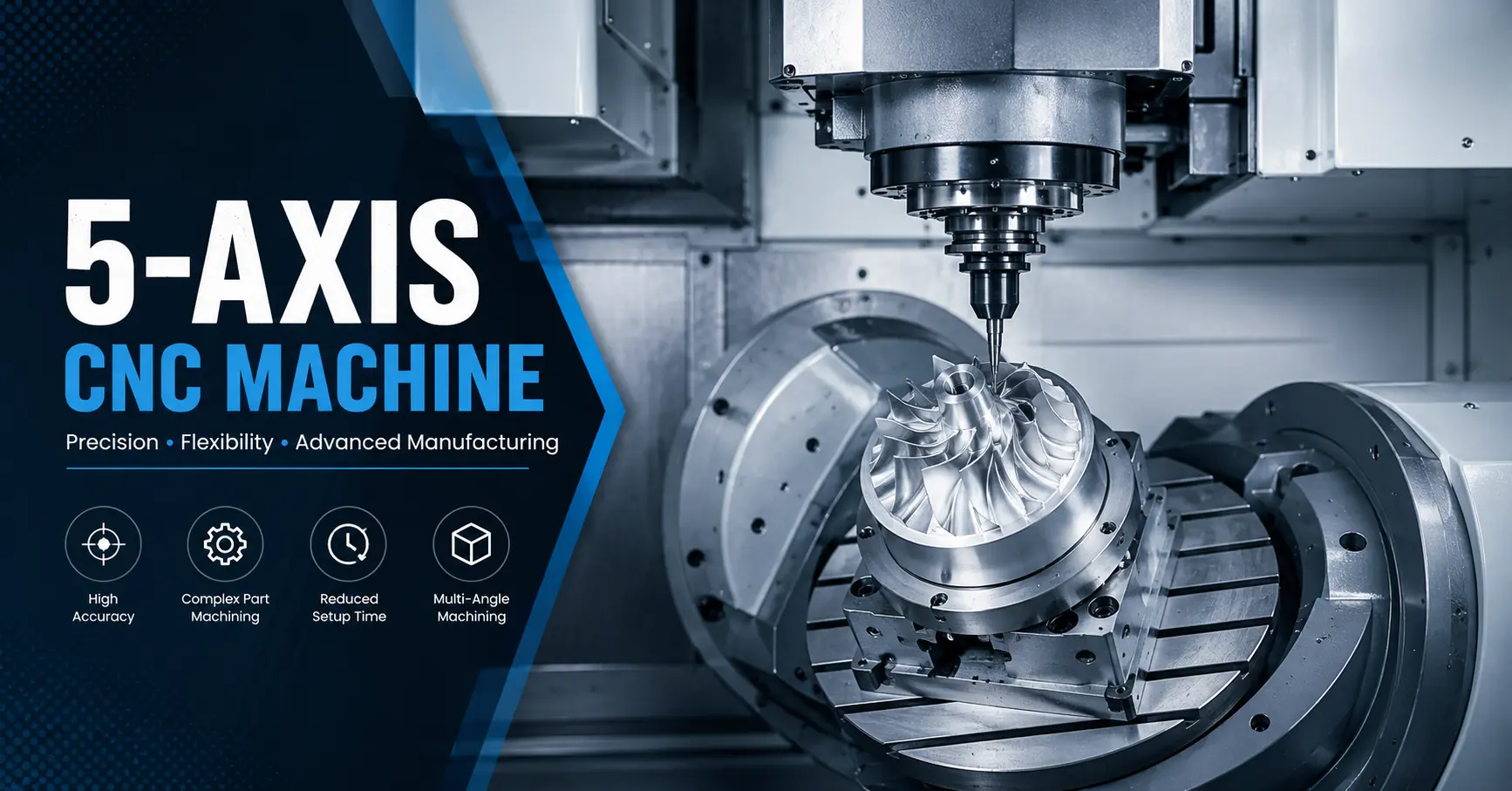
By format, machines are 2D flatbed (sheet), tube/pipe cutters, and 3D (5-axis) heads for formed parts.
What Power Can Cut (Approximate, Fiber Laser)
| Power | Mild steel | Stainless | Aluminum |
|---|---|---|---|
| 1–1.5 kW | up to ~8 mm | up to ~4 mm | up to ~3 mm |
| 3 kW | up to ~16 mm | up to ~10 mm | up to ~8 mm |
| 6 kW | up to ~25 mm | up to ~20 mm | up to ~16 mm |
Exact limits vary by brand, gas, and acceptable edge quality. Higher power mainly increases speed on thin sheet, so a 12 kW machine is not automatically better for a shop that cuts 2 mm sheet.
Materials to avoid: PVC (releases corrosive, toxic chlorine gas that also damages the machine), ABS, polycarbonate, fiberglass, and carbon fiber.
Accuracy
Industrial machines typically position within about ±0.03–0.05 mm, with a kerf (cut width) of roughly 0.1–0.4 mm. Real part accuracy also depends on material flatness and heat distortion, not just the machine.
Laser Cutting vs Plasma vs Waterjet
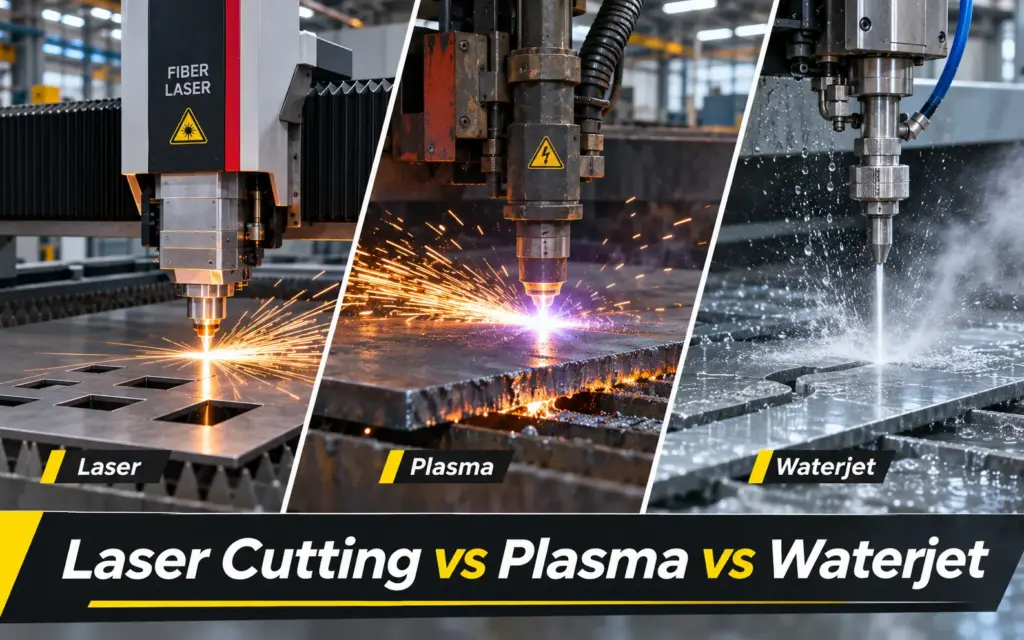
| Laser | Plasma | Waterjet | |
|---|---|---|---|
| Precision | Very high | Moderate | High |
| Thick plate | Good up to ~25 mm | Excellent (50 mm+) | Excellent |
| Heat effect | Small | Larger | None |
| Speed on thin sheet | Fastest | Fast | Slow |
| Running cost | Medium | Low | High |
Choose laser for thin-to-medium sheet needing clean edges, plasma for thick steel where tolerance is loose, and waterjet for heat-sensitive or non-conductive materials.
Advantages and Limits
Advantages: tight tolerances, small holes and complex shapes, no tooling changes, less material waste through nesting, and easy repeat production.
Limits: high initial cost, limited thickness compared with plasma or waterjet, a heat-affected zone, and fume and fire risk with some materials.
Cost
Prices vary widely by brand, country, and automation, so treat these as rough ranges:
- CO2 hobby/small-business machines: about $2,000–$15,000
- Entry fiber sheet cutters (1–3 kW): about $25,000–$70,000
- Industrial fiber (6–12 kW): about $80,000–$250,000+
- With automatic loading/unloading: $300,000 and above
Look at total cost of ownership: assist gas (especially nitrogen), electricity, lenses and nozzles, chiller upkeep, and operator training often decide profitability more than the purchase price.
How to Choose
- List your materials and the thickest cut you do regularly. Buy power for that, not for the occasional job (outsource the rare thick cut).
- Check production volume. Low volume rarely justifies automation.
- Verify local after-sales support and spare parts, which are more important than small price differences.
Maintenance Essentials
- Inspect and clean the protective window and nozzle daily; a dirty lens is the most common cause of poor cuts and lens damage.
- Keep chiller water clean and at the correct temperature.
- Check gas pressure and purity (moisture or oil in air ruins cuts).
- Never leave a running machine unattended: thin or dusty material can catch fire.
Common Problems and Fixes
| Problem | Likely cause | Fix |
|---|---|---|
| Incomplete cut | Speed too high, power too low, dirty lens | Slow down, clean optics, check power |
| Dross/burrs on bottom edge | Wrong focus, low gas pressure, worn nozzle | Adjust focus, raise pressure, replace nozzle |
| Burn marks, rough edge | Too much oxygen or speed too slow | Lower pressure, speed up |
| Inconsistent accuracy | Loose motion parts, uneven sheet | Check rails and drives, flatten material |
FAQ
Can it cut aluminum?
Yes, with a fiber laser and nitrogen. Aluminum is reflective, so older CO2 machines struggle.
Difference between CNC cutting and laser cutting?
CNC describes how the machine is controlled (by computer). Laser describes the cutting tool. A CNC laser cutter uses both.
Which is better, fiber or CO2?
Neither universally. Fiber wins for metal; CO2 wins for wood, acrylic, and fabric.
Is it expensive?
The machine is, but per-part cost is low at volume, which is why it dominates sheet metal fabrication.
Conclusion
A CNC laser cutting machine pairs computer control with a focused beam for fast, precise, repeatable cutting. The right choice depends on what you cut, how thick, and how many parts: fiber for metal, CO2 for non-metals, and power matched to your real daily work rather than the maximum you might need.
You May Also Like It:
Prototype CNC Machining: The Complete Expert Guide
Aerospace CNC Machining: Costs, Tolerances, Quality
CNC Machining Centers: The Complete Buyer’s and Operator’s Guide