
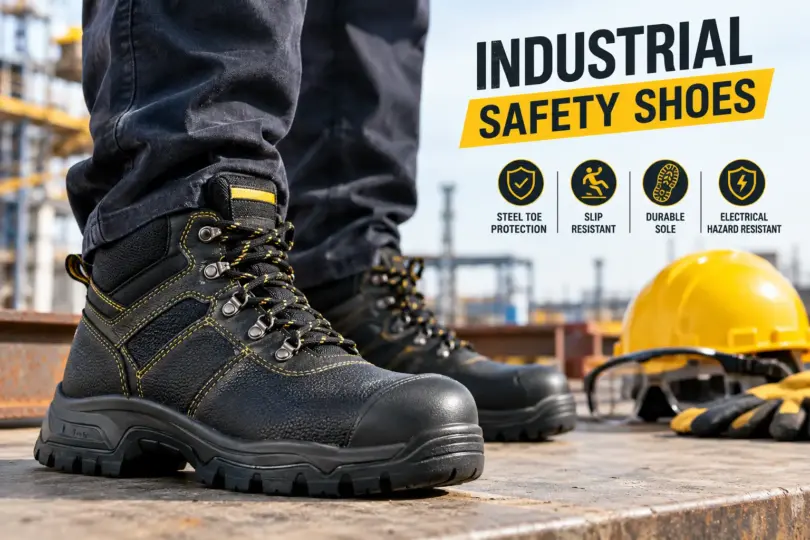

Most people shop for safety footwear by brand, price or looks. That’s how you end up with a pair that passes inspection but fails you at 2 p.m. on a wet concrete floor.
Industrial safety shoes are protective footwear built with a reinforced toe cap, and often a puncture-resistant plate and slip-resistant outsole, tested to standards such as ASTM F2413 (US) or EN ISO 20345 (Europe and many other regions). The best pair is the one whose ratings match your actual workplace hazards and whose fit holds up for a full shift. A pair with the wrong rating can be worse than a plain shoe, because it gives you confidence it hasn’t earned.
Start With the Hazard, Not the Shoe
Walk your work area before you open a shopping tab. Write down what could actually hurt your feet.
- Falling or rolling objects: pallets, tools, pipes, drums.
- Sharp debris underfoot: nails, rebar tie wire, metal shavings, glass.
- Slick surfaces: oily concrete, wet tile, ice, fresh-mopped floors.
- Heat: hot asphalt, welding spatter, molten metal splash.
- Electricity: live circuits, or static that can ruin sensitive electronics.
- Water and chemicals: washdown areas, wet trenches, caustic spills.
A typical warehouse picker and a roofing crew have almost nothing in common on this list. Same category of shoe, completely different buying decision.
How to Read the Label Inside the Tongue
Real safety footwear carries a permanent tag, usually stitched inside the tongue or collar. If it’s missing, the shoe is not certified, however tough it looks.
| Marking | What it tells you |
|---|---|
| I/75, C/75 | Toe cap passed impact (75 ft-lbs) and compression (2,500 lbs) tests |
| Mt/75 | Metatarsal guard protects the top of the foot |
| PR | Puncture-resistant plate in the sole |
| EH | Electrical hazard protection (tested at 18,000 volts) |
| SD | Static dissipative, for electronics and explosive-risk areas |
| CD | Conductive, for environments where static buildup itself is the danger |
Two cautions here. SD and CD are opposites in purpose, so never wear one in a zone that requires the other. And EH protection is secondary: it weakens when the sole is worn through or soaked, so it is not a license to touch live wires.
Steel, Composite or Alloy: What Matters on Shift
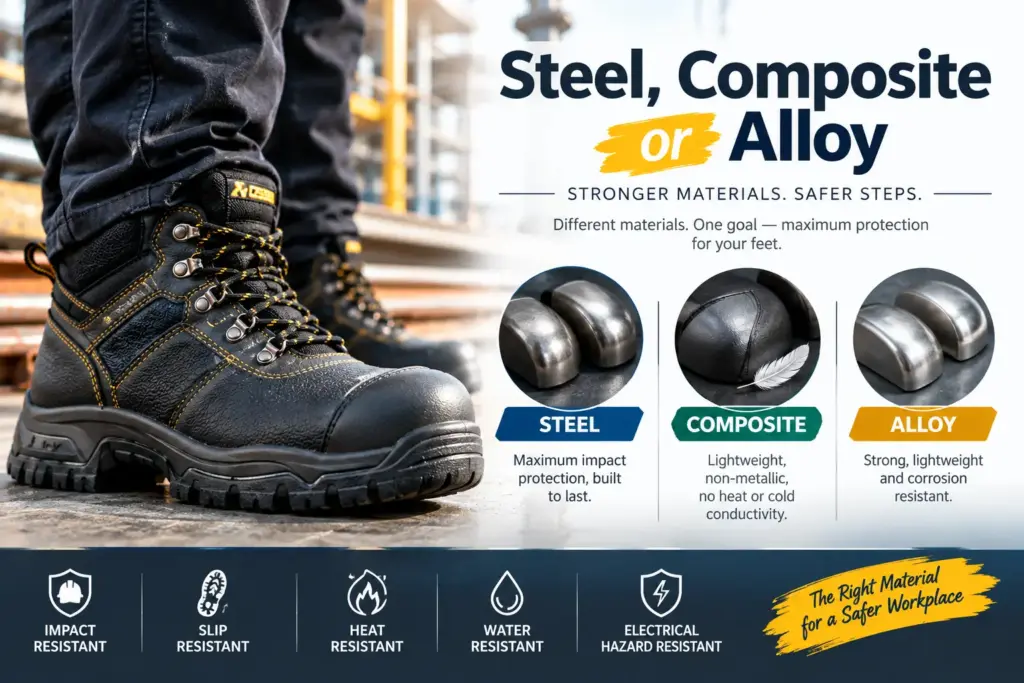
The toe cap material matters less than people argue online. All three can meet the same impact and compression ratings. What changes is how they feel after eight hours.
- Steel: thinnest profile and usually the lowest price, but heaviest.
- Composite: non-metallic, so no metal detector alarms and less heat transfer, though the cap is bulkier.
- Alloy (aluminum or titanium): near-steel protection at lower weight, at a higher price.
Weight is the sleeper issue. An extra half pound per foot adds up over thousands of steps, and tired legs trip more often.
Slip Resistance Is Not One Rating
“Slip resistant” on a product page can mean very little. Outsoles are tested on specific surfaces and contaminants, and the result only holds for those conditions.
In the EN system, SRA covers ceramic tile with soapy water, SRB covers steel with glycerol, and SRC means both. In the US, many brands cite ASTM F2913 results or their own testing, so ask which surface and liquid were used.
Match the tread to your floor:
- Oily concrete: softer rubber compounds with shallow, closely spaced tread.
- Wet tile or kitchens: wide channels that move liquid away.
- Mud and gravel: deeper lugs, which can actually skid on smooth floors.
Tread also wears. Once the pattern goes shallow, the rating on the box no longer describes your shoe.
Work Zone Boots: What Roadwork and Construction Change
Work zone boots face conditions that office-side safety footwear guides rarely cover. You’re on uneven ground, in weather, often near heat and heavy traffic.
- Heat-resistant outsoles (HRO): rated for brief contact with surfaces around 300°C. Useful when you’re walking over freshly laid asphalt.
- Ankle height: a 6 to 8 inch shaft helps on loose gravel, ladders and trench edges.
- Waterproofing with breathability: a sealed boot that traps sweat will blister you faster than rain will.
- Lug depth: deep tread grips mud, but pack-in clay and gravel can lodge in it. Pick a pattern you can clean quickly.
- Puncture protection: worth the weight wherever nails and rebar stubs lie around.
High-visibility colors on the upper are optional. Reflective strips are only a supplement to proper vest gear, not a substitute.
Industrial Work Shoes vs. Boots: Choosing the Height
Low-cut safety work shoes make sense indoors on flat floors: warehouses, assembly lines, light manufacturing. They’re lighter, cooler and easier to get on, and they cost less to replace.
Switch to boots when you face uneven terrain, standing water, or anything that could hit above the ankle. Welders have a special case: choose pull-on or covered-lace designs, so spatter can’t lodge in laces or tongue gaps.
| Your environment | Prioritize |
|---|---|
| Warehouse, logistics | Light alloy or composite toe, slip-resistant sole, cushioned insole |
| Construction site | PR plate, ankle support, waterproofing |
| Roadwork and paving | HRO outsole, mud-clearing tread, breathable waterproofing |
| Welding, foundry | Metatarsal guard, covered laces, heat-resistant leather |
| Electronics, cleanrooms | SD rating, no metal exposure |
| Electrical trades | EH rating, non-conductive sole, dry condition checks |
Getting the Fit Right
A rigid toe cap won’t stretch. Break-in applies to the leather, not to the cap, so any pinch at the front stays pinched.
- Shop late in the day. Feet swell by evening, and that’s the size you wear on shift.
- Wear your work socks. Thin dress socks give a false fit.
- Check the toe box. You should wiggle your toes freely, with about a thumb’s width ahead of the longest toe.
- Test the heel. Walk up an incline. A heel that lifts more than slightly will blister.
- Try both feet. Most people have one larger foot, so size to the bigger one.
- Walk for ten minutes in the store. Pressure points show up fast on hard floors.
If you use orthotics, bring them. Removable insoles let you swap in your own without changing the fit.
When to Replace Your Shoes
Safety shoes do not wear out evenly. The toe cap can be compromised while the outside looks fine.
- After any serious impact: replace the pair even if you can’t see damage.
- Tread worn flat or uneven: grip is gone.
- Midsole creased or squashed: cushioning and shock absorption have failed.
- Cap visible through the leather: the protection layer is exposed.
- Cracks at the flex point: water and debris now enter easily.
- Puncture by a nail: the plate can’t be trusted again.
For heavy daily use, plan on 6 to 12 months. Rotating two pairs lets each dry fully and often extends the life of both.
Mistakes That Cost People Money (or Toes)
- Buying “steel toe” fashion boots with no ASTM or EN tag. Look for the label, not the marketing.
- Choosing by sneaker size. Safety footwear often runs differently, and the toe cap eats interior room.
- Ignoring weight until the first long day.
- Wearing EH-rated shoes wet and assuming protection still applies.
- Using worn insoles inside new shoes. Cheap insoles collapse long before the shoe does.
Buying for a Team: What Employers Should Know
In the US, OSHA requires protective footwear where foot injury hazards exist, and it must meet recognized standards such as ASTM F2413. Under OSHA’s PPE payment rule, employers generally aren’t required to pay for ordinary safety-toe shoes that workers can also wear off the job, though many do anyway, and specialty footwear is treated differently. Check current rules for your region and any union agreements.
Good programs offer an allowance, fitting help by size and width, and a replacement schedule. Mobile fitting trucks are one example some suppliers use to get workers properly sized on site.
FAQ
What do S1, S1P and S3 mean?
These are EN ISO 20345 categories. S1 is a basic safety shoe with a toe cap, antistatic and energy-absorbing heel. S1P adds puncture resistance. S3 adds water resistance and a cleated sole on top of that.
Can I wear steel toe shoes through airport security?
Often yes, but they may trigger additional screening or need to come off. Composite toes usually pass more easily.
Can a steel toe cap really cut off toes?
This is mostly a myth. Rated caps are tested to resist crushing, and an unprotected toe in the same incident would fare much worse.
Do steel toe boots make my feet colder in winter?
They can conduct cold somewhat more than composite. Insulated liners and thicker wool socks handle most of the difference.
How should I dry soaked safety shoes?
Remove insoles, loosen laces, and let them air dry at room temperature. Direct heat can crack leather and weaken adhesives.
Can safety shoes be resoled?
Some welted boots can be resoled by a cobbler, but cemented soles generally cannot. Check that the replacement keeps the original ratings.
Can I wear custom orthotics in safety shoes?
Yes, in most cases. Choose a shoe with a removable footbed and enough depth to avoid crowding your toes.
How long does it take to break in new safety shoes?
Plan on one to two weeks of gradually longer wear. Persistent pain at the toe cap means the size or shape is wrong, not that the shoe needs more time.
You May Also Like It:
Industrial Robot Safety: The Complete 2026 Guide for Facilities, Engineers & Safety Managers
Safety Topics: Guide to OSHA Safety Topics, Toolbox Talks, and Meeting Ideas
Industrial Safety Signs: The Complete Guide to Types, Meanings, Colors, and Standards




[…] Industrial Safety Shoes: How to Pick a Pair That Fits Your Hazards […]