
Every year, approximately 2.3 million workers around the world die from work-related accidents or diseases. Millions more suffer injuries that change their lives permanently. Behind every one of those numbers is a real person, a family, and a team that relied on them.
Industrial safety is not just about following rules. It is about building a culture, choosing the right systems, and caring enough about people to act before an accident happens. Whether you run a manufacturing plant, a construction site, a warehouse, or an energy facility, this guide gives you a clear, practical roadmap for keeping your people safe.
This guide goes beyond the basics most competitors cover. You will find everything from the latest AI-powered safety technology to the often-ignored topic of worker mental health, all in plain, easy-to-understand language.
What Is Industrial Safety and Why Does It Matter?
Industrial safety refers to the policies, practices, equipment, and culture that protect workers from harm in industrial environments. It covers physical hazards like heavy machinery and toxic chemicals, but also ergonomic risks, mental health pressures, and emergency preparedness.
The business case is just as strong as the ethical one. Companies with strong safety programs experience:
- Lower insurance premiums and workers compensation costs
- Less unplanned downtime from accidents and investigations
- Higher employee morale, retention, and productivity
- Fewer OSHA fines and legal liabilities
- A stronger reputation that attracts quality talent and clients
In short, investing in industrial safety pays for itself many times over.
The Most Common Industrial Hazards
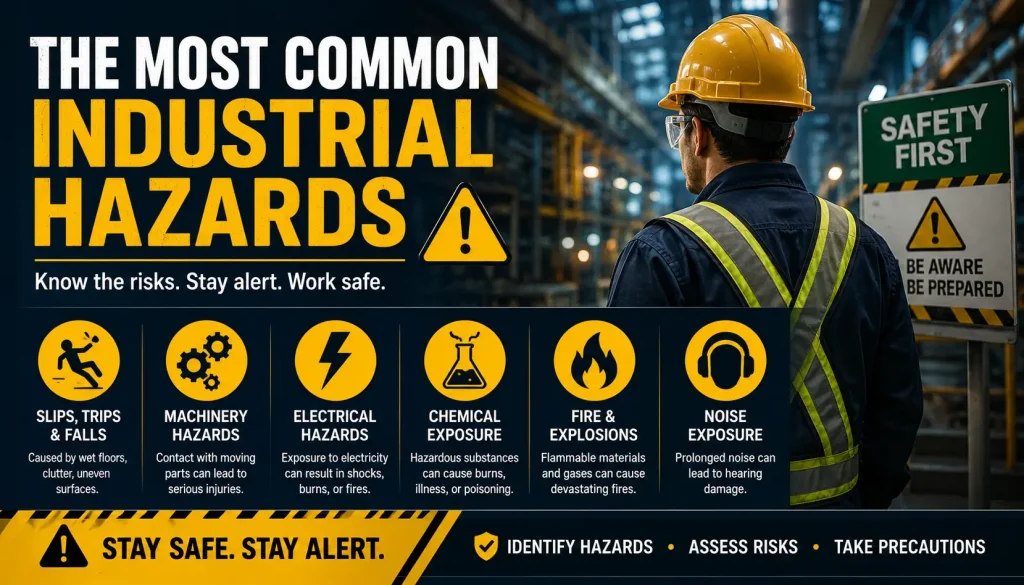
Before you can prevent hazards, you need to know what you are dealing with. Industrial workplaces typically face six major categories of risk.
Physical Hazards
- Moving machinery and unguarded parts
- Slips, trips, and falls on wet or cluttered floors
- Working at heights without proper fall protection
- Noise exposure leading to permanent hearing damage
- Extreme heat or cold environments
Chemical Hazards
- Exposure to toxic substances, solvents, or fumes
- Improper labeling or storage of hazardous materials
- Skin and respiratory contact with corrosive agents
Electrical Hazards
- Working on energized equipment without lockout/tagout procedures
- Damaged wiring or overloaded circuits
- Arc flash and electrocution risks
Ergonomic Hazards
- Repetitive strain from the same motion performed hundreds of times a day
- Poor workstation design that forces awkward postures
- Heavy manual lifting without proper technique or equipment
Biological Hazards
- Exposure to bacteria, mold, or viruses in certain industrial settings
- Contact with contaminated water, soil, or animal products
Psychological Hazards (Often Overlooked)
This category rarely appears in competitor guides, but it is increasingly recognized as a major workplace safety issue. High stress, burnout, and poor mental health directly lead to more accidents. A 2024 Mind the Workplace report by Mental Health America found that 75% of U.S. employees report work stress seriously affecting their sleep, and 60% say it damages their personal relationships.
In high-risk industries like manufacturing, construction, and oil and gas, the consequences of a distracted or mentally exhausted worker can be catastrophic. Mental health deserves a place in every industrial safety program.
Building a Strong Safety Culture: Where It Really Starts
Rules and equipment matter, but they only work inside a culture that takes safety seriously. A safety culture is the shared set of beliefs and behaviors that determines how people actually act when no one is watching.
Leadership Must Lead by Example
Managers who skip PPE, rush procedures, or treat safety as a checkbox send a loud message to the whole team. When leaders prioritize safety in planning, budgeting, and daily behavior, employees follow. Research consistently shows that inclusive, transformational leadership is the single strongest predictor of psychological safety in high-risk workplaces.
Encourage Open Reporting Without Fear
Workers closest to the hazards know them best. Create an environment where anyone can report unsafe conditions, near-misses, or concerns without fear of blame or retaliation. Programs that reward near-miss reporting catch problems before they become fatalities.
Peer-to-Peer Responsibility
Encourage team members to look out for one another. When a coworker spots someone about to make an unsafe choice, they should feel empowered to speak up. This is not about policing. It is about genuine care for each other’s wellbeing.
Recognize Safe Behavior
Reward employees who demonstrate proactive safety behavior, such as completing training, reporting hazards, or suggesting improvements. Avoid programs that simply reward a low number of incident reports. That approach discourages reporting rather than improving safety.
Hazard Identification and Risk Assessment
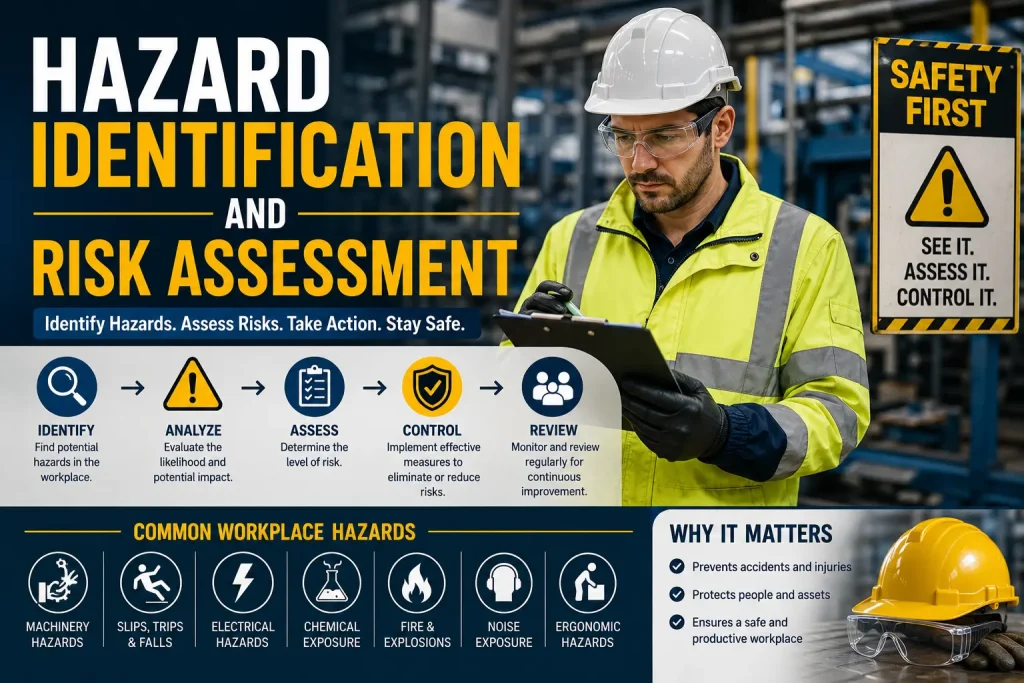
You cannot manage a risk you have not identified. A thorough risk assessment is the foundation of any effective industrial safety program.
The Core Steps of a Risk Assessment
- Identify hazards: Walk the worksite, review incident reports, and consult with workers. Use job hazard analyses (JHAs) to examine each task step by step.
- Evaluate the risk: Consider both the likelihood of an incident and the severity of potential harm. A small risk with catastrophic consequences demands urgent action.
- Control the risk: Apply controls in order of effectiveness, starting with elimination and ending with PPE.
- Document and review: Record your findings, implement controls, and revisit the assessment regularly or whenever conditions change.
The Hierarchy of Controls
This framework, endorsed by OSHA and safety professionals worldwide, prioritizes controls from most to least effective:
- Elimination: Remove the hazard entirely. The safest option of all.
- Substitution: Replace a dangerous material or process with a safer alternative.
- Engineering controls: Physically redesign the workplace to reduce exposure, such as adding machine guards or ventilation systems.
- Administrative controls: Change how work is done, including job rotation, shift limits, and standard operating procedures.
- PPE: The last line of defense, used when other controls are not sufficient on their own.
Personal Protective Equipment (PPE): What You Need and How to Use It Right
PPE is critical, but only when workers have the right equipment, it fits properly, and they know how to use it. Here is a quick reference by hazard type.
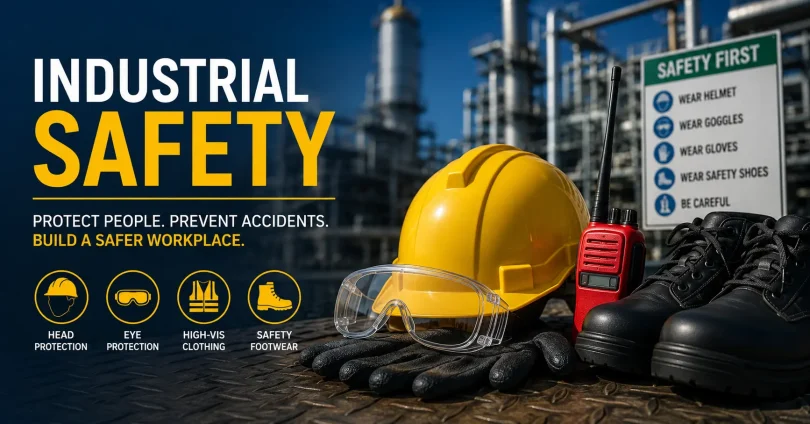
Head Protection
- Hard hats protect against falling objects and head strikes
- Choose the right class: Class E for electrical work, Class G for general use
Eye and Face Protection
- Safety glasses for flying debris and dust
- Face shields when working with chemicals or performing grinding operations
- Indirect-vent goggles for chemical splash risk
Hearing Protection
- Earplugs for high-noise environments above 85 decibels
- Earmuffs for continuous exposure or particularly loud equipment
Hand Protection
- Cut-resistant gloves for sharp materials
- Chemical-resistant gloves when handling solvents or acids
- Heat-resistant gloves for welding or high-temperature tasks
Foot Protection
- Steel-toe or composite-toe boots for impact and compression protection
- Slip-resistant soles in wet or oily environments
Respiratory Protection
- Dust masks (N95) for airborne particulates
- Half-face or full-face respirators for chemical fumes
- Self-contained breathing apparatus (SCBA) for oxygen-deficient spaces
Fall Protection
- Full-body harnesses connected to anchor points when working at heights
- Guardrails, safety nets, and personal fall arrest systems as layered protection
Important: PPE must be inspected before each use, properly maintained, and replaced when worn or damaged. Train every worker on correct fitting and why it matters. A hard hat worn backwards offers no protection.
6. Safety Training: Building Knowledge That Sticks
A safety program is only as strong as the knowledge of the people following it. Effective training goes far beyond reading a manual on day one.
Onboarding Training
Every new hire should receive a thorough safety orientation before they touch any equipment. Cover the specific hazards of their role, emergency procedures, and who to contact with concerns.
Ongoing and Refresher Training
Safety training is never a one-time event. Run regular refresher sessions to reinforce good habits, introduce new procedures, and correct any drift from safe practices. Monthly toolbox talks and annual recertification programs are proven approaches.
Specialized Training for High-Risk Tasks
Workers operating forklifts, handling hazardous materials, or working at heights need task-specific qualifications beyond general safety knowledge. Track certifications and ensure only certified personnel perform those tasks.
Mentorship Programs
Pair new hires with experienced workers who model safe behavior in real conditions. This transfers tacit knowledge that no classroom session can replicate.
Make Training Engaging
Passive training produces passive learners. Use scenarios, simulations, hands-on practice, and where available, virtual reality (VR) to make safety training immersive and memorable. The newer workforce entering industrial environments expects interactive, technology-driven learning experiences.
7. Critical Safety Procedures Every Industrial Facility Needs
Lockout/Tagout (LOTO)
Never work on energized equipment. Lockout/tagout procedures de-energize and physically lock machines before maintenance or repair begins. This prevents accidental startup that can cause severe injury or death. Every worker who performs maintenance must be trained and authorized to apply LOTO procedures.
Confined Space Entry
Confined spaces like tanks, silos, and tunnels present risks of toxic atmospheres, oxygen deficiency, and engulfment. A permit-required confined space program includes atmospheric testing, ventilation, a trained attendant stationed outside, and a rescue plan.
Working at Heights
Falls are one of the leading causes of industrial fatalities. Any work above four feet in general industry or six feet in construction requires a fall protection plan. This includes guardrails, personal fall arrest systems, and training specific to the conditions workers will face.
Hazard Communication (HazCom)
Every chemical in your facility should have a Safety Data Sheet (SDS) readily accessible to workers. Chemical containers must be clearly labeled with their contents and hazards. Workers must be trained to read and understand these materials before they work with any substance.
Powered Industrial Trucks (Forklifts)
OSHA issued over 2,400 forklift citations in fiscal year 2024, totaling more than eight million dollars in fines. Only certified operators should drive forklifts, pre-shift inspections should be documented, and pedestrian/vehicle separation must be enforced with floor markings and physical barriers.
Emergency Response Planning
Every facility needs a written emergency action plan that covers fires, chemical spills, medical emergencies, and natural disasters. The plan must include:
- Clearly marked and unobstructed emergency exits
- Posted evacuation routes throughout the facility
- Regular drills so workers know exactly what to do without having to think
- Assigned roles for emergency coordinators and first aiders
- Communication procedures for notifying emergency services
8. The Role of Technology in Modern Industrial Safety
Technology is transforming what is possible in industrial safety. Companies are moving from reactive responses to genuinely predictive systems that catch risks before accidents occur.
AI-Powered Predictive Analytics
Traditional safety programs investigate incidents after they happen. AI flips this model. By analyzing data from sensors, connected devices, wearables, and historical incident records, AI systems identify patterns that signal elevated risk, often before any human observer would notice. This allows safety managers to intervene proactively rather than reactively.
Wearable Safety Technology
Wearables are among the fastest-growing tools in industrial safety. Modern devices can monitor:
- Worker vital signs, including heart rate and body temperature
- Fatigue levels and alertness
- Ergonomic posture and movement patterns
- Environmental conditions such as air quality, noise, and temperature
- Proximity to moving vehicles or machinery
When a wearable detects dangerous fatigue levels or a toxic gas reading, it can alert both the worker and their supervisor in real time. Companies like SlateSafety, Rombit, and StrongArm are leading this space with devices that integrate directly with centralized safety management platforms.
Predictive Maintenance
Equipment failures cause some of the most dangerous industrial incidents. AI-driven predictive maintenance monitors equipment health continuously through sensors and machine learning. Instead of waiting for a breakdown, facilities can schedule repairs before failures occur, eliminating unsafe conditions caused by malfunctioning machinery.
Virtual and Augmented Reality Training
VR allows workers to train in realistic simulations of hazardous situations without any actual risk. Augmented reality (AR) glasses overlay safety information directly onto a worker’s field of view, providing real-time guidance on machine operation or hazard alerts on the factory floor.
Drones for Safety Inspections
Drones can inspect hard-to-reach areas like rooftops, towers, and confined spaces, reducing the need to put humans in danger just to assess a risk. They can capture visual data, thermal readings, and even gas concentration measurements.
Safety Management Software
Digital platforms consolidate incident reporting, inspection schedules, training records, and compliance documentation in one place. This makes it far easier to identify trends, act on leading indicators, and demonstrate compliance to regulators.
9. Mental Health as a Safety Issue (What Most Guides Miss)
This topic is almost entirely absent from competitor articles on industrial safety, yet the evidence is undeniable. Mental health directly affects physical safety.
According to the National Safety Council, manufacturing ranks among the worst industries for workplace mental health. A 2021 report found that 8.6% of manufacturing workers experience anxiety or insomnia. In high-stress sectors like construction, oil and gas, and mining, suicide rates are significantly higher than the national average.
When a worker is exhausted, anxious, or mentally struggling, their reaction time slows, their concentration drops, and their risk of making an error rises sharply. NIOSH research shows that chronic occupational stress measurably worsens mental health over time, and the impact managers have on worker wellbeing rivals that of doctors and therapists.
What Organizations Can Do
- Treat mental health like any other safety hazard: Identify the stressors, assess their impact, and put controls in place.
- Train managers to recognize signs of distress: Fatigue, withdrawal, irritability, and decreased performance are all warning signs.
- Create psychological safety: Workers must feel safe enough to speak up about pressure, mistakes, or concerns without fear of punishment or embarrassment. Research from Harvard and the NIH consistently links psychological safety to better team performance and fewer incidents.
- Offer accessible mental health resources: Employee assistance programs (EAPs), on-site counselors, and peer support programs all reduce the stigma of seeking help.
- Address workload and working conditions: Sustainable workloads, realistic deadlines, and rest breaks are not luxuries. They are risk controls.
10. Housekeeping and Workplace Organization
A cluttered, disorganized workplace is a dangerous one. Slips, trips, and falls remain among the most common industrial injuries, and most of them are preventable through basic housekeeping.
The 5S Methodology
Originally developed in manufacturing, 5S is one of the most effective organizational frameworks for industrial safety:
- Sort: Remove everything from the workspace that is not needed.
- Set in order: Organize remaining items so the most-used ones are easiest to reach.
- Shine: Clean the workspace regularly and address the root causes of dirt and clutter.
- Standardize: Create consistent routines so good organization is not dependent on individual effort.
- Sustain: Build habits and accountability to maintain the first four steps over time.
Practical Housekeeping Rules
- Clean up spills immediately, using the correct materials for the substance involved
- Keep walkways and emergency exits completely clear at all times
- Route cables and hoses properly so they do not create tripping hazards
- Return tools to their designated storage location after every use
- Use shadow boards and labeled tool chests to make missing items immediately visible
- Stack materials securely and store them in designated zones away from pathways
11. OSHA Compliance: Understanding Your Legal Obligations
For most industrial employers in the United States, OSHA compliance is not optional. It is the legal floor, and true safety leaders build far above it.
Key OSHA Standards for Industrial Workplaces
- 29 CFR 1910: General industry standards covering everything from machine guarding to electrical safety
- Hazard Communication Standard (HCS): Requires SDS sheets, proper labeling, and worker training on chemical hazards
- Personal Protective Equipment standard: Mandates employer-provided PPE that meets ANSI specifications
- Lockout/Tagout standard: Governs the control of hazardous energy during maintenance
- Respiratory Protection standard: Requires fit testing, medical evaluation, and training
State-Level Plans
Twenty-two U.S. states operate their own OSHA-approved plans and can impose stricter requirements than the federal standard. California, for example, requires a written Injury and Illness Prevention Program (IIPP) with no federal equivalent. If you operate across multiple states, follow the strictest applicable rule at every location.
Documentation That Protects You
Maintain OSHA 300 injury and illness logs, incident investigation reports, inspection records, and training documentation. Good records are not just a compliance requirement. They are the data you need to identify trends, measure progress, and demonstrate due diligence.
12. Continuous Improvement: Safety Is Never Finished
The most dangerous words in industrial safety are: we have always done it this way. A truly effective safety program is always evolving.
Regular Audits and Inspections
Schedule routine safety audits of high-risk areas, equipment, and procedures. Use a mix of announced audits, unannounced spot checks, and worker-led inspections. Document findings and track corrective actions to completion.
Incident Investigation
Every incident, including near-misses, deserves a thorough investigation. The goal is not to assign blame but to identify root causes and prevent recurrence. A near-miss is a free lesson. Treat it as one.
Safety Metrics That Actually Matter
Track leading indicators, not just lagging ones. Total recordable incident rate (TRIR) tells you what went wrong. Near-miss reporting rates, training completion, and audit scores tell you where you are headed. Leading indicators give you the chance to change course before an injury occurs.
Benchmark Against Your Industry
Compare your safety performance against industry standards from OSHA, the Bureau of Labor Statistics, and peer organizations. Know where you stand and set realistic targets for improvement each year.
Final Thoughts
Industrial safety is one of the most important responsibilities any organization has. It protects the people who show up every day to build things, move things, and make things. It protects families. And done right, it strengthens the business from the inside out.
The companies that lead on safety do not see it as a burden. They see it as a value. From the CEO to the newest hire, everyone plays a role. And when every person at every level treats safety as non-negotiable, the results speak for themselves: fewer injuries, higher productivity, stronger culture, and a workplace where people genuinely want to be.
You May Also Like It:
CNC Machining Tolerances: The Complete Expert Guide
MIG vs TIG Welding: Complete Guide to Differences and Procedures