
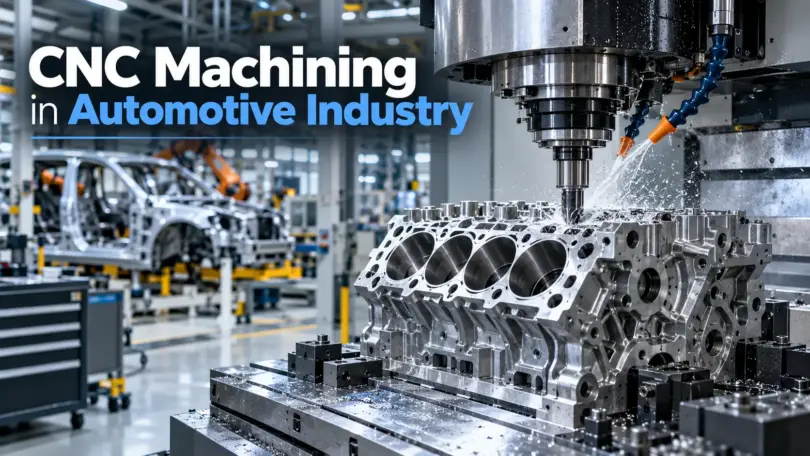

CNC machining in automotive industry is the computer-controlled cutting of cast, forged, or bar-stock metal into finished engine, transmission, brake, steering, and EV components. It delivers tolerances measured in microns, and it repeats them across thousands of parts.
Automotive CNC machining matters because a raw casting never fits, seals, or wears correctly on its own. Bearing bores, sealing faces, and gear seats need exact geometry before a vehicle can run reliably for 200,000 kilometres or more. This guide covers how the work flows, which machines do what, and where we see projects succeed or fail with precision automotive parts.
What Is CNC Machining in the Automotive Industry?
Think of CNC as the finishing stage in a longer chain. Foundries cast engine blocks, forges shape crankshaft blanks, and mills roll bar stock. Machining comes after, and it touches only the features that carry load, seal fluids, or locate other parts.
That distinction explains why a casting can look nearly complete and still be unusable. Cast surfaces vary by a few tenths of a millimetre. Machined datums bring that variation down to a controlled, measurable range.
In our experience, buyers often underestimate this split. They compare a casting price to a finished part price and wonder about the gap. The gap is the machining, inspection, and scrap risk packed into those critical features.
This is also where automotive CNC machining separates from general job-shop work. Automotive programs run on fixed cycle times, validated processes, and part-to-part consistency that must hold across years of production.
How CNC Machining Works in Automotive Manufacturing
A good workflow is mostly decisions made before the spindle turns. Most scrap we see traces back to setup and planning, not cutting.
CAD Design and CAM Programming
Engineers start with a 3D model and a drawing that flags critical characteristics: bores, flatness, positional tolerances. Programmers then build toolpaths in CAM software and simulate them for collisions.
One habit that pays off: choose the datum strategy first. If the first operation machines the wrong reference surface, every later feature inherits the error.
Material Selection and Machine Setup
Material choice drives tooling, coolant, and speeds. Setup then covers workholding, tool offsets, and probing routines.
Workholding deserves more attention than it gets. Thin-walled housings can distort by several microns if clamping force is uneven, and the part springs back after release.
CNC Machining and Cutting Operations
Roughing removes bulk material fast. Semi-finishing evens out the stock, and finishing hits the final size and surface.
For high-volume work, we separate these stages across machines. That way, finishing tools stay sharp and thermal drift from heavy roughing does not leak into final dimensions.
Inspection and Quality Control
Inspection happens at three points: in-process probing, first-article checks, and periodic CMM sampling. Probing catches tool wear before it produces a bad part.
If you only inspect at the end of a shift, you find problems after hundreds of parts have already been made.
Types of CNC Machining Used in the Automotive Industry
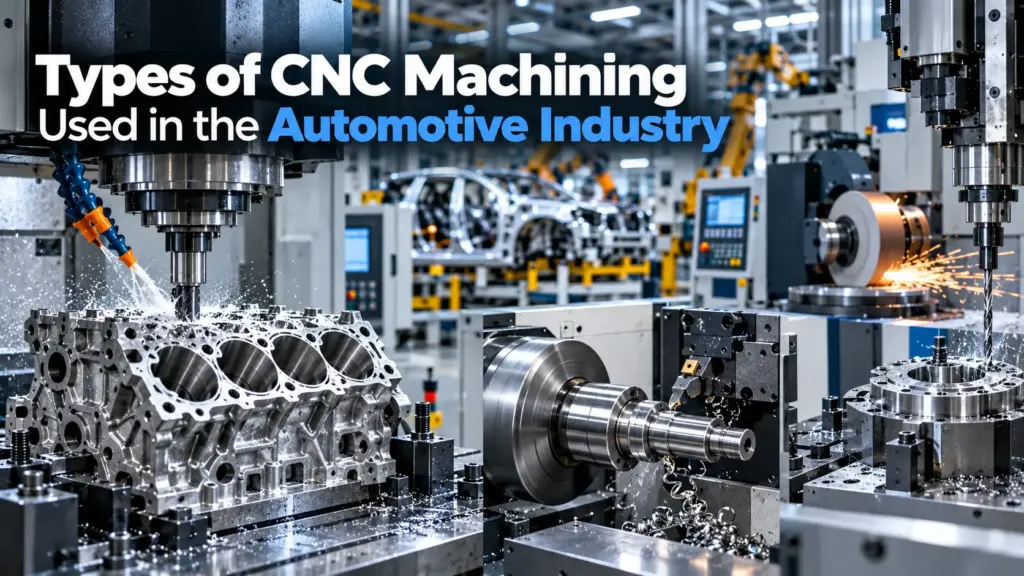
Each method solves a different geometry problem. Choosing the wrong one adds cycle time, tooling cost, or both.
CNC Milling
CNC milling automotive parts is the workhorse for prismatic shapes: engine blocks, cylinder heads, transmission cases, and valve bodies. A horizontal machining centre with a tombstone fixture can machine several faces in one clamping.
That matters because every re-clamp adds positional error. Fewer setups mean tighter relationships between bores and faces.
CNC Turning
CNC turning automotive components covers anything round: axle shafts, pistons, wheel hubs, and fasteners. Twin-spindle lathes pass a part from one chuck to another so both ends finish without manual handling.
Live tooling adds milling and cross-drilling in the same cycle. That removes a whole secondary operation on parts like valve bodies.
CNC Drilling and Boring
Deep-hole drilling creates oil galleries in crankshafts and engine blocks, where holes can run 20 times their diameter or more. Chip evacuation is the real challenge. Poor chip control breaks drills and scratches bore walls.
Boring then sets final diameter and position. Cylinder bores, bearing seats, and hydraulic ports rely on it for roundness and alignment.
CNC Grinding
Grinding comes last on hardened parts. Crankshaft journals, camshaft lobes, gear teeth, and bearing races are ground after heat treatment because hardened steel resists conventional cutting.
Typical surface finish targets sit around Ra 0.2 to 0.4 µm on journals. A rougher surface wears bearings fast, while an overly polished one can struggle to hold an oil film.
5-Axis CNC Machining
5-axis CNC machining reaches complex surfaces in one setup: turbocharger housings, intake ports, performance cylinder heads, and EV housings with angled features. Fewer setups mean less accumulated error.
It costs more per hour, so we reserve it for parts where setup reduction or geometry justifies it. For simple prismatic parts, a 3-axis or 4-axis machine usually wins on cost.
Applications of CNC Machining in Automotive Parts
Most CNC machined automotive parts share one logic: machine the surfaces that move, seal, or locate. Here is how that plays out across the vehicle.
Engine Blocks and Cylinder Heads
CNC engine components start as aluminium or cast iron castings. Machining produces deck faces, cylinder bores, main bearing bores, and valve seats.
Deck flatness protects the head gasket. Bore roundness and cylindricity, often held within a few microns, control oil consumption and ring wear.
One edge case we see often: casting porosity exposed during machining. A pore that hides beneath the skin can open up at a sealing face, so porosity checks and part rejection rules need agreement with the foundry upfront.
Crankshafts and Camshafts
Crankshafts are turned, drilled, milled, then ground. Journal diameters typically hold to around ±0.005 to 0.01 mm, and balance must stay within strict limits to avoid vibration.
Camshaft lobes are ground to precise profiles because lobe shape controls valve timing and lift. A small profile error changes engine behaviour, not just wear.
Transmission Gears and Shafts
Transmission machining combines turning, hobbing, shaving, and grinding. Gear tooth accuracy drives noise, so a gearbox that whines at 80 km/h is often a machining and heat-treat distortion story.
Shafts need tight runout, often around 0.01 mm, at bearing seats. Misalignment there shortens bearing life and raises temperature.
Brake Discs and Calipers
Brake components manufacturing focuses on disc thickness variation and lateral runout. Even a thickness variation of a few hundredths of a millimetre can cause pedal pulsation that customers notice as “warped rotors.”
Calipers are machined from cast iron or aluminium. Piston bores need a smooth, precise finish so seals hold pressure without dragging.
Steering and Suspension Components
Steering knuckles, control arms, tie rod ends, and ball joint housings carry load and safety responsibility. Machined holes must hold position relative to each other, because alignment angles depend on them.
Forged aluminium knuckles add a wrinkle. Material is lighter, but hardness and chip behaviour differ from steel, so tool choice changes.
Electric Vehicle Motor and Battery Components
EV CNC machining differs from combustion work in what matters most. Motor housings need concentric bores for stator fit and cooling-jacket sealing. Rotor shafts, often hollow, demand tight runout at high rpm.
Battery trays and cold plates need flatness for sealing and leak-free coolant paths. Large structural castings add another challenge: huge parts must be clamped without distortion, and probing becomes essential.
Common Materials Used for Automotive CNC Machining
Material determines tools, speeds, and cost. Our rule: pick for function first, then optimise machinability.
Aluminum Alloys
Aluminum CNC machining dominates weight-sensitive parts. Alloys like 6061 and 7075 suit wrought parts, while A356 and A380 suit castings.
Watch for built-up edge on cutting tools. Sharp, polished carbide and generous coolant keep surfaces clean.
Steel and Alloy Steel
Steel automotive components such as gears, shafts, and crankshafts use alloys like 4140, 4340, and 8620. Many get case-hardened after rough machining, then finish-ground.
Heat treatment changes dimensions slightly, so we leave grinding stock to correct it.
Cast Iron
Gray and ductile iron remain common in blocks, brake discs, and calipers. The graphite structure damps vibration and machines well, but it produces abrasive dust that wears tools and machine ways.
Engineering Plastics
Nylon, PEEK, and acetal appear in bushings, sensor housings, and EV insulators. They need sharp tools and low heat, because plastics expand and soften when cut hot.
Benefits of CNC Machining in Automotive Manufacturing
- Precision: Micron-level control keeps bores, seats, and faces within spec.
- Repeatability: Once validated, a process produces near-identical parts across shifts and years.
- Complex geometry: Multi-axis machines produce shapes that manual methods struggle to reach.
- Less waste: Near-net-shape blanks plus optimised toolpaths cut scrap and rework.
- Prototype speed: A design change becomes a program edit, not new tooling, which helps development teams test several versions in days.
CNC Machining vs. Traditional Machining in Automotive Production
| Factor | CNC Machining | Traditional/Manual Machining |
|---|---|---|
| Accuracy | Micron-level, program-controlled | Depends on operator skill |
| Repeatability | High across large batches | Varies part to part |
| Setup | Longer upfront, fast changeover after | Shorter setup, slower per part |
| Labor | Fewer operators, more programmers | Skilled operator on each machine |
| Flexibility | Fast design changes via software | Slow to modify |
| Production fit | Prototypes to mass production | Repair, one-offs, simple parts |
Manual machines still earn a place in tool rooms and repair shops. For production, the repeatability gap decides the matter.
Quality Standards and Precision Requirements
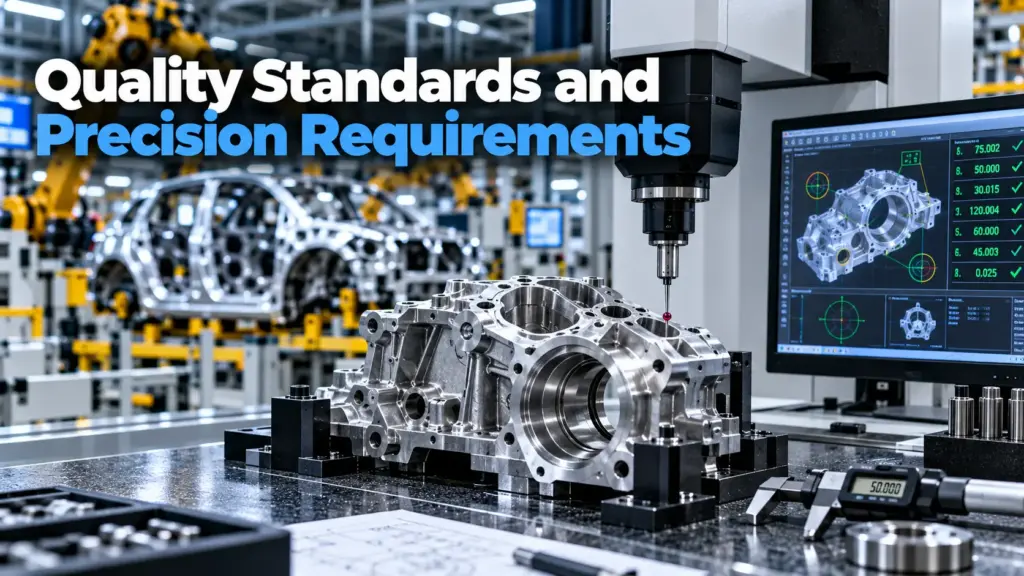
Machining Tolerances and Surface Finish
Tolerance depends on function. A sealing face and a cosmetic cover do not need the same control.
| Feature | Typical Tolerance/Finish |
|---|---|
| Engine bore diameter | ±0.01 mm, cylindricity within a few µm |
| Crankshaft journal | ±0.005 to 0.01 mm, Ra 0.2 to 0.4 µm |
| Transmission bearing seat | IT6, runout around 0.01 mm |
| Brake disc thickness variation | Often under 0.015 mm |
Use these as reference points, not universal rules. Always follow the drawing.
Automotive Quality Control and IATF 16949
IATF 16949 sets the quality management expectations for automotive suppliers. It works alongside APQP and PPAP, which document how a part will be made and proven.
On the floor, this means CMM measurement, gauge studies, and SPC charts. A common capability target is Cpk of 1.33 for general features and 1.67 for critical ones. A part can be inside tolerance and still fail a Cpk review if the process drifts.
Challenges of CNC Machining in the Automotive Industry
- Machine investment: Multi-axis centres and automation cost heavily, so utilisation planning matters.
- Tooling costs: Carbide inserts and custom cutters add up fast in high-volume lines.
- Programming skill: Good CAM programmers and setters are hard to hire and train.
- Tool wear: Wear shifts dimensions gradually, so tool-life management and offsets need discipline.
- Thermal drift: Machines warm up during shifts, and a morning-perfect part can drift by afternoon without compensation.
- High-volume consistency: Holding Cpk over millions of parts requires monitoring, not just good setup.
Future of CNC Machining in Automotive Manufacturing
Automation is moving from nice-to-have to standard. Robotic machine tending and pallet systems keep spindles running through lights-out shifts.
Smart monitoring comes next. Spindle load, vibration, and tool-life data flow into dashboards that predict failures before they cause scrap. CNC automation also feeds data back into process planning.
EV growth shifts demand toward motor housings, cold plates, and large structural castings. Multi-axis machining and in-process probing become more valuable as parts get larger and thinner.
Conclusion
CNC machining turns rough castings and forgings into the accurate, repeatable parts that modern vehicles depend on. From engine bores and gear shafts to EV motor housings, it controls the fit, sealing, and wear that determine real-world reliability. Strong results come from planning datums, managing tool wear and heat, and proving capability through inspection. As electric vehicles grow, CNC machining in the automotive industry will keep pushing toward tighter tolerances, larger parts, and more automation.
Frequently Asked Questions
How much does an automotive CNC machined part typically cost?
Cost depends on material, cycle time, tolerance, and volume. Tighter tolerances and extra operations like grinding raise price quickly, while higher volumes spread setup cost across more parts.
How long does it take to machine an engine block?
Cycle times vary with machine setup and process split. In mass production, blocks move through several machines in sequence, with each station running a few minutes to keep the line balanced.
Why do machined parts sometimes pass inspection but fail in assembly?
Usually it is a relationship issue. Individual dimensions can be in tolerance while positional or geometric tolerances between features drift, which only shows up in stack-up or functional testing.
Can CNC machining be used for both prototypes and mass production?
Yes. Prototypes use flexible setups, while production lines use dedicated fixtures and validated programs. The same CAD data often carries across both stages.
What causes surface chatter on automotive parts?
Chatter usually comes from vibration between tool, part, and machine. Weak workholding, long tool overhang, or wrong speeds and feeds are common culprits.
How do manufacturers control tool wear in high-volume CNC production?
They track tool life by part count or spindle load, use probing to adjust offsets, and replace tools on a schedule before wear affects dimensions.
Is aluminium or steel better for CNC machined car parts?
Neither is better overall. Aluminium reduces weight and machines fast, while steel handles higher loads and wear. The part’s function decides.
