
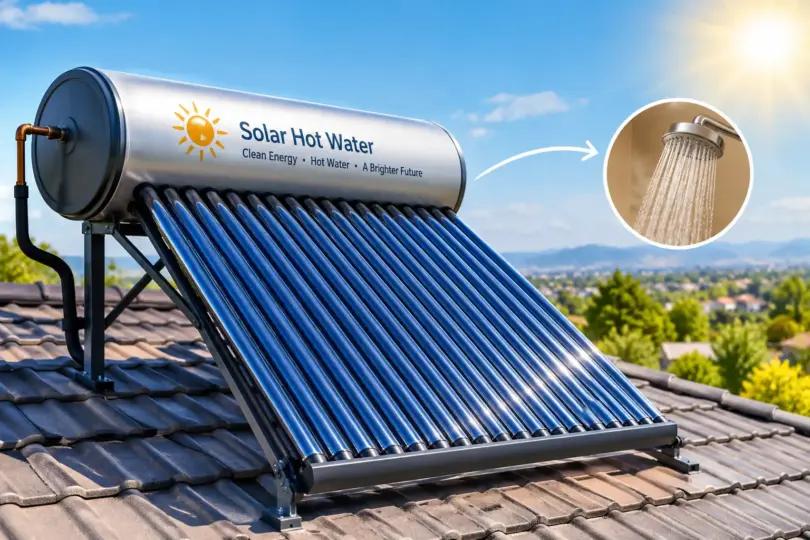

Most guides tell you a solar hot water system “saves money” and stop there. This one gives you the numbers and edge cases that decide whether it pays off in your home.
A solar hot water system uses roof collectors to capture sunlight as heat and store it in an insulated tank, so your boiler or electric element works less. Expect the sun to cover roughly half to 70% of your annual hot water: near 90% in summer and closer to 25% in winter. It suits homes with about 5 m² of unshaded roof facing south, or anywhere from east to west, and a steady daily hot water draw.
The Number That Decides Everything: Your Winter Share
Summer figures sell systems. Winter figures decide whether you are happy with one.
When we assess a home, we ask how much hot water the household uses in January, not July. A system covering 90% of a small summer load looks great on paper. But if your biggest bills come from cold months, the sun is contributing 20 to 30% exactly when you pay most.
Your boiler or immersion element remains the main supplier for several months a year. Plan for that, and the rest of the decision gets easier.
Size It by Litres, Not by Guesswork
Sizing errors are the most common mistake we see. Undersize and you lean on backup heat all year. Oversize and you invite the summer problem described below.
Here is the working method:
- Daily draw: Estimate around 50 litres of hot water per person per day. A family of four is therefore near 200 litres.
- Collector area: Screwfix puts roughly 1 m² of collector against 50 litres of daily use, so that family lands near 4 m². Two typical panels cover it.
- Storage volume: A common design rule is about 50 to 80 litres of tank per m² of collector. For 4 m², that is a 200 to 320 litre cylinder.
- Reality check: Add one adult who showers twice, or a bath habit, and your numbers move. Count real habits, not heads.
If your household is out all day, storage matters more than collector size. Heat gathered at noon has to survive until the evening shower.
Passive or Pumped: The Choice That Shapes Your Roof
Beyond collectors and tanks, the layout is a decision in its own right.
A passive (thermosiphon) system puts the tank above the collector, and hot water rises on its own. It has no pump and no controller, so there is less to fail. The tank sits on the roof, which means a heavier roof load and a visible profile.
A pumped (active) system keeps the tank indoors or at ground level, with a pump and controller moving fluid. It looks tidier and works in colder climates, but it adds electrical parts that eventually wear out.
In frost-prone areas, we lean toward pumped systems with antifreeze fluid. In warm, frost-free regions, passive units are hard to beat for simplicity.
The Summer Problem Nobody Warns You About
Solar collectors can get dangerously hot when nobody uses the water. This is called stagnation. Once the tank is full and hot, the fluid in the collectors has nowhere to send its heat, and temperatures inside can climb well beyond 100°C.
Left unmanaged, stagnation degrades the antifreeze fluid, stresses seals and shortens the life of the system. It most often happens when a family goes on holiday or a house is empty for a week or two in summer.
What helps:
- Holiday mode: Many controllers can cool the tank overnight through the collectors. Ask your installer how yours works.
- Right sizing: A modest collector area keeps stagnation rare.
- Expansion vessel: It must be correctly sized for the loop, or pressure spikes will stress joints.
- Evacuated tubes in hot climates: They tend to overheat more readily, so match the collector type to your climate.
Flat Plate or Evacuated Tube: Pick by Conditions
Both work. The better one depends on where you live and how much roof you have.
| Factor | Flat plate | Evacuated tube |
|---|---|---|
| Cold, cloudy climates | Adequate, loses more heat | Stronger, vacuum limits heat loss |
| Hot climates | Safer against overheating | Higher stagnation risk |
| Roof space | Needs more area | Smaller footprint for the same output |
| Cost | Usually lower | Usually a little higher |
| Repairs | Replace a whole panel | Replace a single tube |
Solar Thermal vs PV With an Immersion Diverter vs Heat Pump
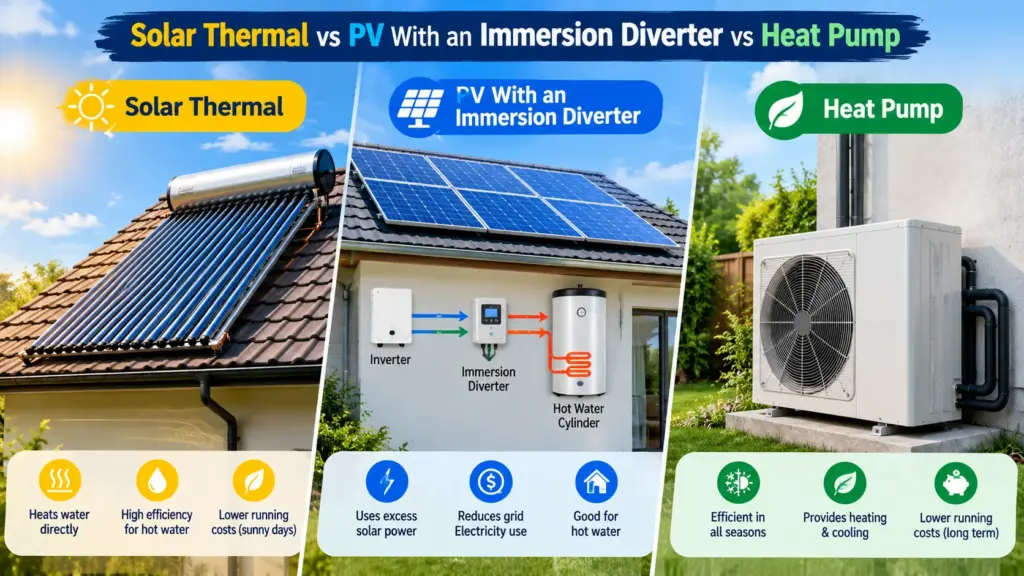
This is the comparison most competitor pages skip, and it is the one many homeowners now face. The same roof can serve three different hot water strategies.
| Option | Best fit | Watch out for |
|---|---|---|
| Solar thermal | Steady hot water demand, existing cylinder | Only makes hot water, never electricity |
| PV with immersion diverter | Homes wanting electricity for other uses too | Needs spare generation at the right time of day |
| Heat pump water heating | Homes without good roof access | Higher upfront cost, needs indoor space |
We have seen households choose PV simply because it serves more purposes. That is a fair reason. Solar thermal wins when you want the most hot water per square metre of roof, because collectors convert a larger share of sunlight into usable heat than PV panels do.
Cost and Payback: Read This Before You Sign
Energy Saving Trust puts a typical installed system at around £5,300. Screwfix, citing the same body, quotes £3,000 to £5,000 for parts and installation combined. Treat both as ballparks and check them against current quotes.
Savings are more modest than most brochures imply. Screwfix quotes EST figures of roughly £60 a year for a 4 m² system replacing gas, rising to about £115 when replacing LPG. At those rates, payback is long.
The picture changes with the fuel you displace:
- Electric resistance heating: Replacing it gives the strongest returns, because that is the costliest way to heat water.
- Mains gas: The weakest returns, because gas is cheap.
- LPG or oil: Mid to strong, depending on local prices.
Older guides still mention the Renewable Heat Incentive. As far as I know it stopped accepting new applicants in 2022, so check what support exists where you live today.
Installation and Upkeep: What the Visit Looks Like

A typical installation takes one to two days. The work covers roof mounts, pipework, the controller, pump and, if needed, a new solar cylinder.
A few checks save headaches later:
- Pressure gauge: A steady drop points to a leak. Screwfix cites around 2 bar as a typical fill pressure, but follow the manufacturer’s figure.
- Fluid change: Plan for an antifreeze flush roughly every five years, at about £100 according to Screwfix.
- Pump life: Budget for replacement at around ten years.
- Hard water scale: In hard water areas, scale can coat the heat exchanger coil and cut performance. Ask about a scale-reducing setup.
- Legionella control: Solar-heated tanks that never reach high temperatures can allow bacteria to grow. Most guidance suggests stored hot water should regularly reach 60°C, which your backup heater should handle through a scheduled heat-up. Confirm this with your installer.
Questions to Put to Every Installer
- Survey: Who carried it out, a surveyor or a salesperson?
- Winter yield: What output do you expect in January, not on an annual average?
- Stagnation plan: How does this system handle an empty house in summer?
- Certification: Are you accredited under a recognised scheme such as MCS where I live?
- Quotes: Can I see at least three, with the same specification?
FAQ
Can a solar hot water system work with a combi boiler?
Rarely. Most combi boilers are not designed to accept preheated water. You usually need a conventional boiler and a cylinder, so budget for those changes.
Will it heat my radiators?
Almost never. Most systems are designed for taps, showers and baths. Solar contributes only around 10% of space heating needs, according to Screwfix.
Does it still work on cloudy days?
It produces less. Diffuse light still warms the collectors, but output falls noticeably, which is why a backup heater is standard.
Do I need planning permission?
Often not, as these systems are commonly treated as permitted development in the UK. Exceptions include listed buildings, conservation areas and national parks, so check locally.
How long does one last?
Collectors commonly last 20 years or more with basic care, while pumps and fluid need earlier replacement.
Can I pair it with a heat pump?
Yes, in many homes. The solar loop preheats the cylinder and the heat pump covers the remainder, though design needs to account for cylinder coil layout.
Will my home insurance need updating?
Check before installation. Screwfix recommends confirming that your policy covers the new equipment and the roof work.
You May Also Like It:
Power Generation Companies: Top 10 Players and How to Compare
Power Generation Equipment: What It Is, How to Choose It, and What Actually Fails in the Field
Outages and Emergencies: The Complete Guide to NV Energy Power Outages in Nevada







[…] Solar Hot Water System: What It Really Delivers, Costs and Needs […]