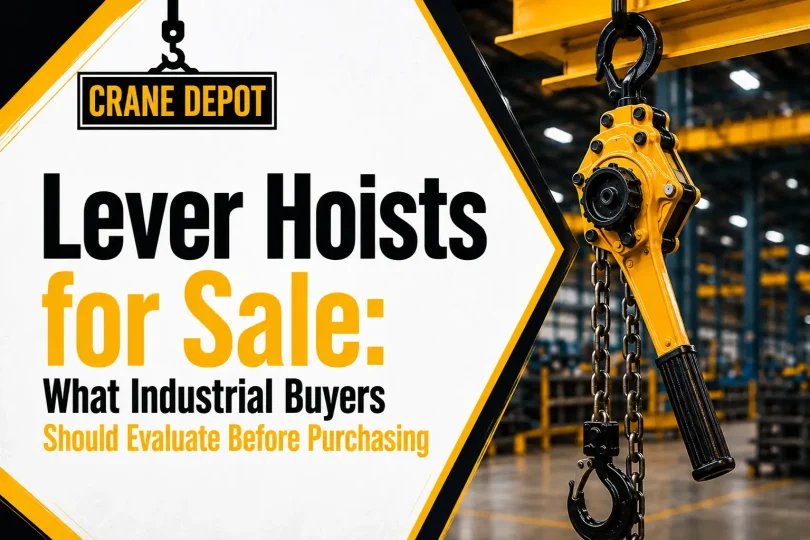

Purchasing lifting equipment for an industrial facility involves more than comparing product prices. The equipment must match the loads being handled, the frequency of use, the working environment, and the way materials move through the facility. For companies researching lever hoists, understanding these factors can make the difference between a practical long-term investment and equipment that does not adequately meet operational requirements.
Lever hoists remain valuable in manufacturing, construction, maintenance, fabrication, and field-service applications because they provide manual lifting and pulling without requiring an electrical power source. Their relatively compact design also makes them useful where equipment needs to be transported between work areas.
The challenge for buyers is identifying the right configuration for the job.
Why Lever Hoists Remain Relevant in Industrial Operations
Powered cranes and electric hoists have become standard equipment in many production facilities, but manual lifting equipment still has an important role.
A lever hoist can be particularly useful when a task is performed occasionally rather than continuously. Maintenance technicians, construction crews, and service teams may need to lift or position equipment in locations where installing powered equipment would be impractical.
The equipment can also be useful for pulling, tensioning, and aligning components, giving operators greater flexibility than a lifting device intended solely for vertical movement.
For these applications, portability and independence from electrical power can be major advantages.
What to Look for When Comparing Lever Hoists
A search for lever hoists for sale can produce many configurations. Buyers should establish the requirements of the application before comparing individual products.
1. Rated Capacity
Capacity should be one of the first specifications reviewed.
The hoist must be appropriately rated for the loads it will handle. Buyers should identify the maximum anticipated load rather than selecting equipment based on an average load.
The complete lifting arrangement also matters. The supporting structure, attachment points, rigging components, and lifting accessories must be suitable for the intended load.
2. Lift or Pull Requirements
Not every lever hoist application involves straightforward vertical lifting.
Some users need equipment primarily for positioning or pulling. Others may require a specific amount of chain travel to accommodate the working area.
Understanding the exact movement required helps buyers select equipment that fits the task rather than paying for characteristics that provide little practical benefit.
3. Frequency of Use
How often the hoist will operate should influence the purchasing decision.
A maintenance department that uses a hoist occasionally may have different requirements from a fabrication facility where lifting and positioning occur throughout the workday.
Buyers should consider expected operating frequency, workload, and environmental conditions when determining which equipment is appropriate.
4. Working Environment
Industrial environments vary considerably.
A hoist used indoors in a clean manufacturing area may experience very different conditions from equipment used outdoors, around fabrication processes, or in locations exposed to moisture and contaminants.
Environmental factors can influence inspection requirements, component selection, corrosion protection, and maintenance practices.
Understanding Lever Chain Hoists
A lever chain hoist uses a load chain and manually operated lever mechanism to provide mechanical advantage during lifting or pulling.
Its compact configuration makes it particularly useful in applications where access is limited or equipment must be carried to the load.
Typical applications include:
- Equipment installation
- Machinery maintenance
- Construction
- Fabrication
- Utility work
- Load positioning
- Component alignment
- Tensioning operations
When selecting a lever hoist, buyers should consider how the equipment will actually be used rather than focusing solely on its rated capacity.
Portability Can Influence Equipment Selection
One of the major reasons industrial teams choose manual lifting equipment is portability.
A maintenance crew may need to work on several machines across a facility. Transporting a permanent crane to each location is obviously impractical. A portable manual hoist can instead be taken directly to the work area when an appropriate support point is available.
This makes portability particularly valuable for field service teams, maintenance departments, and contractors.
However, portability should never override capacity or application requirements. The equipment still needs to be compatible with the supporting structure and the intended lifting method.
Manual Versus Powered Lifting Equipment
Lever hoists are not a replacement for every type of powered lifting system.
For repetitive production lifting, an electric hoist may provide greater speed and reduce physical effort. Facilities handling heavy loads continuously may also require a complete overhead crane system.
A manual lever hoist can make more sense when:
- Lifting is occasional.
- Electrical power is unavailable.
- Equipment must be transported between work areas.
- Loads need controlled positioning.
- Pulling or tensioning is part of the task.
- The installation is temporary or mobile.
The right choice depends on the application rather than whether powered or manual equipment is inherently better.
When Another Hoist Type May Be More Appropriate
Some industrial applications require capabilities beyond those normally associated with lever hoists.
For example, facilities handling very heavy loads or requiring substantial lifting heights may evaluate Wire Rope Hoists. These systems are commonly used in demanding overhead lifting applications where higher capacity, longer lifts, or frequent powered operation are required.
This comparison highlights an important purchasing principle: equipment should be selected according to operational requirements rather than product category alone.
Considering the Complete Material Handling System
The hoist is often only one component of a larger material handling setup.
Once a load is lifted, it may need to move horizontally along a beam. Depending on the application, a Push Trolley can provide manual travel for compatible suspended loads.
Other facilities may use workstation cranes, jib cranes, gantry cranes, or overhead bridge systems to provide broader lifting coverage.
Thinking about the complete workflow helps buyers determine whether a standalone lever hoist is sufficient or whether a more comprehensive material handling solution would provide greater productivity.
Safety Should Be Part of the Purchasing Decision
Price and specifications are important, but safe operation should remain a central consideration.
Before purchasing equipment, organizations should establish how the hoist will be inspected, operated, stored, and maintained.
Operators should be trained to:
- Verify rated capacity.
- Inspect the equipment before use.
- Secure loads correctly.
- Avoid shock loading.
- Avoid inappropriate side loading.
- Keep personnel away from suspended loads.
- Follow manufacturer instructions.
A well-designed maintenance and inspection program can also help identify wear before it develops into a more serious equipment issue.
Evaluating Total Cost Rather Than Purchase Price
The lowest initial price is not necessarily the lowest-cost option over the life of the equipment.
Industrial buyers should consider the broader cost of ownership, including:
- Initial purchase price
- Installation or setup
- Maintenance
- Replacement components
- Inspection requirements
- Expected service life
- Downtime
- Operator productivity
A reliable hoist that is properly matched to the application may provide greater value over time than an inexpensive product that requires frequent repairs or does not suit the working conditions.
Questions Buyers Should Ask Before Ordering
Before selecting from available lever hoists for sale, procurement teams can benefit from answering several practical questions:
What is the maximum load?
Establish the heaviest load that the equipment will be expected to handle.
How often will it operate?
Determine whether the equipment will be used occasionally or throughout the production day.
How high must the load travel?
Identify the required lifting distance and working clearance.
Where will the equipment be used?
Consider indoor, outdoor, clean, dusty, wet, or demanding industrial environments.
Will the equipment need to move between locations?
If so, portability and ease of handling become important selection factors.
Is vertical lifting the only requirement?
If pulling, tensioning, or positioning are also required, a lever-operated system may offer useful flexibility.
Answering these questions creates a clearer specification for procurement teams and reduces the risk of choosing equipment based only on price.
Working With a Qualified Supplier
Supplier selection can also influence the purchasing experience. Industrial buyers should look for a supplier capable of providing clear product specifications, application guidance, replacement components, and appropriate technical information.
Organizations researching lever hoists for industrial applications can compare available configurations and supporting equipment before determining which option best fits their operational requirements.
For broader material handling requirements, Crane Depot industrial crane equipment can also serve as a reference point when comparing lifting equipment categories and system configurations.
Final Thoughts
Selecting from available lever hoists for sale requires a clear understanding of the application. Capacity, lifting requirements, operating frequency, working environment, portability, and supporting equipment all influence whether a particular hoist will provide reliable long-term value.
Lever hoists remain a practical option for maintenance, fabrication, construction, field service, and other applications where portable manual lifting is useful. Their independence from electrical power and ability to support controlled pulling and positioning make them particularly versatile.
The best purchasing decision is therefore not necessarily the product with the lowest price or highest capacity. It is the equipment that matches the actual work requirements, integrates appropriately with the surrounding material handling system, and can be maintained and operated safely throughout its service life.