
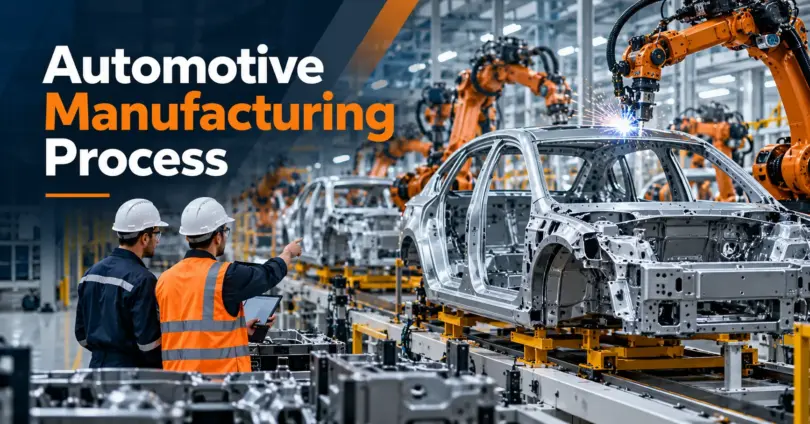

A modern car is not built in one place or in one step. It starts as a design file, becomes sheet steel and purchased components, and is gradually turned into a body shell, a painted body, a driving vehicle and finally a tested product ready for delivery. Each stage depends on the one before it, and a mistake in any of them shows up in the final vehicle.
This guide explains the automotive manufacturing process in plain language: the main stages from design to distribution, the equipment and automation used, how quality is controlled, which materials go into a car, and how electric vehicles change the picture.
Automotive manufacturing is the industrial process of turning raw materials and engineered components into finished vehicles. It involves vehicle design, metal stamping, body welding, painting, powertrain and component manufacturing, final assembly, and quality testing. Modern automotive factories use robotics, automated assembly lines, and quality control systems to manufacture vehicles efficiently, consistently, and safely.
How Does the Automotive Manufacturing Process Work?
At the highest level, a car plant works like a series of connected workshops. Steel coils arrive at one end and are pressed into panels. The panels are welded into a body structure. The body is cleaned, coated and painted. Separately, the engine or electric drive unit is built. All of these streams meet in final assembly, where the vehicle is completed and then tested.
The simplified flow looks like this:
Design & Engineering → Materials & Parts → Stamping → Body Welding → Painting → Final Assembly → Inspection & Testing → Distribution
The industry often groups the middle of this flow into four “major processes”: stamping, welding, painting and final assembly. Powertrain production runs alongside them and joins the vehicle during final assembly.
Main Stages of Vehicle Production
- Design & Engineering: Concepts, CAD models, prototypes and validation define what will be built.
- Materials & Parts: Steel, aluminum, plastics, electronics and thousands of supplied components are sourced and checked.
- Stamping: Sheet metal is cut and pressed into doors, hoods, roofs and structural panels.
- Body Welding: Panels are joined into the vehicle body structure, known as the body-in-white.
- Painting: The body is cleaned, protected against corrosion and given its color and gloss.
- Final Assembly: The powertrain, chassis, interior, glass, seats and wheels are installed.
- Inspection & Testing: The finished vehicle is checked mechanically, electrically and visually.
- Distribution: Approved vehicles are stored, loaded and shipped to dealers or customers.
Step-by-Step Car Manufacturing Process
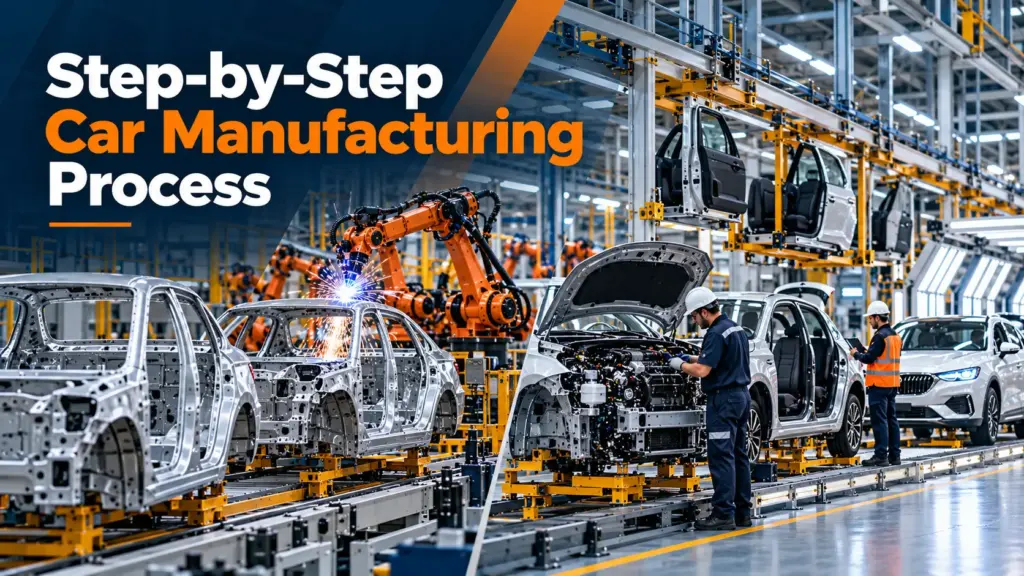
The sections below follow a vehicle through the plant in the order it actually happens. Details differ between manufacturers and models, but the logic is the same almost everywhere.
Step 1 – Vehicle Design and Engineering
Every vehicle begins as a concept: who it is for, what it must do, and what it should cost. Designers sketch the exterior and interior, while engineers define technical specifications such as dimensions, weight targets, safety requirements, emissions or battery range, and cost limits.
The design is then developed in computer-aided design (CAD) software. Engineers simulate crash behavior, aerodynamics, durability and thermal performance on the computer before anything is built. Physical prototypes follow, and they are tested on tracks, in climate chambers and in crash labs.
This phase is long. From first concept to market launch, a new vehicle program commonly takes several years, because the design must be approved for safety, manufacturability and cost before tooling is ordered.
- Vehicle concept and technical specifications: target market, size, powertrain type, safety and cost targets.
- Computer-aided design (CAD): 3D models of every part, plus simulation of crash, airflow and stress.
- Prototyping and engineering validation: test vehicles confirm the design works before mass production starts.
Step 2 – Raw Material Selection and Component Sourcing
A car combines materials with very different properties. Steel dominates the body, aluminum is used where weight matters, plastics and composites form interior and exterior parts, and rubber, glass and electronics complete the vehicle.
Most manufacturers (often called OEMs, or original equipment manufacturers) do not make every part themselves. Suppliers deliver seats, wiring harnesses, electronic control units, brakes, lighting and many other systems. Tier 1 suppliers deliver complete modules directly to the plant, and they in turn buy from Tier 2 and Tier 3 suppliers.
- Steel, aluminum, plastics and composites: chosen for strength, weight, cost and how easily they can be formed and joined.
- Automotive parts suppliers: deliver components in the right quantity and sequence, often just in time for assembly.
- Material quality requirements: incoming materials are checked against specifications before they enter production.
Step 3 – Metal Stamping and Body Panel Production
Stamping is where the physical car begins. Steel arrives in large coils, which are unrolled, straightened and cut into flat pieces called blanks. Presses then form each blank between a pair of dies into a three-dimensional panel.
Forming usually happens in several stages. Toyota describes a four-step press sequence in which the sheet is first drawn into shape, then trimmed, then bent and pierced, with each press stroke taking only a few seconds under very high force. Because the shape must match the designer’s intent exactly, die makers adjust and polish dies by hand to tolerances measured in thousandths of a millimeter.
The type of steel also varies by location. Harder grades are used around the passenger cabin to protect occupants in a collision, while softer, more easily deformed areas are designed to absorb impact energy. Offcuts are often reused for smaller parts or recycled.
- Sheet metal cutting and forming: coils are uncoiled, leveled, blanked and drawn into shape.
- Stamping presses and dies: precision tooling determines panel shape, thickness consistency and surface quality.
- Doors, hoods and body panels: finished panels are sorted and sent to the body shop in the order they are needed.
Step 4 – Body-in-White Assembly and Welding
In the body shop, stamped panels are joined into the vehicle’s bare structure, called the body-in-white (BIW). This is the car’s skeleton before paint, interior, engine or glass are added.
Resistance spot welding is the most widely used joining method for steel bodies. Two electrodes clamp overlapping sheets and pass a strong current through them, melting a small spot that forms the bond. A single body can contain several thousand welds. Modern bodies also use laser welding, structural adhesives and rivets, especially where aluminum or mixed materials are involved.
Robots do most of the repetitive welding, working inside fixtures that hold panels in exact positions. Because every later step depends on the body being square and consistent, dimensional accuracy is measured constantly with gauges, laser scanners and vision systems.
- Vehicle body structure: floor, side frames, roof and cross-members form the safety cage.
- Spot welding, robotic welding and joining: thousands of joints are made automatically and monitored for quality.
- Dimensional accuracy and inspection: measurement systems confirm the body matches design tolerances.
Step 5 – Surface Treatment and Automotive Painting
The paint shop does two jobs: it protects the body from corrosion and gives the vehicle its appearance. It is also one of the cleanest areas in the plant, because dust in the paint causes visible defects.
The typical sequence is:
- Cleaning and pretreatment: the body is degreased and treated so coatings bond properly.
- Corrosion protection: the body is dipped in an electrocoat (e-coat) bath, where an electrical charge deposits a uniform protective layer, even inside cavities.
- Sealing and primer: seams are sealed against water and noise, and a primer layer is applied.
- Basecoat and clearcoat: the color and the glossy protective layer are sprayed, mostly by robots.
- Curing: ovens bake each layer so it hardens fully.
Parts are inspected under bright light for defects, and small flaws are repaired before the body moves on.
Step 6 – Engine, Powertrain and Component Manufacturing
While bodies are being welded and painted, the powertrain is built in parallel.
For combustion vehicles, this means casting and machining engine blocks, cylinder heads, crankshafts and transmission housings, then assembling and testing engines and gearboxes. Engines are typically leak-tested and pressure-tested, and many are run on a test rig before installation.
For electric vehicles (EVs), the work shifts to electric motors, power electronics and battery packs. Battery cells are assembled into modules and then into a pack with a cooling system, protective housing and battery management electronics.
Both types rely heavily on precision machining. Parts such as gears, shafts, housings and bearings seats must hold very tight tolerances, which is why CNC machining is central to powertrain and component production.
- Engine and transmission manufacturing for combustion vehicles: casting, machining, assembly and test-rig validation.
- Electric motors and battery packs for EVs: winding, magnet assembly, cell-to-pack integration and electrical testing.
- Precision machining and component inspection: machined features are measured to confirm they meet specification.
Step 7 – Final Vehicle Assembly
Final assembly is where the vehicle becomes recognizable and then drivable. Painted bodies move along a continuous line, and the vehicle stays on the line while workstations add parts in a fixed sequence. This is the most labor-intensive stage of the plant, even in highly automated factories.
Doors are usually removed early so that workers can reach the interior, then reinstalled later. Typical activities include:
- Wiring, dashboard and interior installation: wiring harnesses, the instrument panel, headliner, carpets and trim.
- Powertrain and chassis integration: the engine or electric drive, suspension, axles and fuel or battery systems are raised from below and bolted to the body. This is commonly called the “marriage” point.
- Windows, seats, wheels and other components: glass is bonded in place, seats are fitted, and wheels and tires are mounted.
- Automotive assembly line operations: conveyors, overhead hangers and sequencing systems deliver the right part to the right station at the right time.
After the wheels are on, fluids are filled and the vehicle starts under its own power for the first time.
Step 8 – Quality Inspection and Vehicle Testing
Before it leaves the plant, every vehicle is checked. Inspectors review paint and panel fit, and technicians test electrical systems and software through diagnostic connections.
- Mechanical and electrical inspection: fasteners, fluid levels, lighting, electronics and driver-assistance systems.
- Brake, alignment and functional testing: wheel alignment, headlight aiming and brake performance on rollers or a short test drive.
- Water leak checks and end-of-line testing: a rain booth sprays the vehicle with heavy water to check for leaks, and a final diagnostic scan confirms every module is working.
Crash testing is a development activity, not a per-vehicle test. Manufacturers crash a limited number of sample vehicles during design and certification to verify structure, airbags and seat belts, and then control production so that every vehicle matches the tested design.
Step 9 – Finished Vehicle Logistics and Distribution
Approved vehicles are released in the plant’s system, stored in a holding yard and loaded onto car-carrier trucks, trains or ships. Because new cars can be damaged by poor handling, shipping includes protective measures and inspection at each handover. From there, vehicles go to dealerships or directly to customers.
- Final inspection and release: vehicles with open issues are held back for rework.
- Vehicle storage: cars are stored in a yard organized by destination and shipping date.
- Transportation to dealerships or customers: road, rail and sea transport are combined depending on distance.
What Equipment Is Used in Automotive Manufacturing?
A car plant is built around a handful of equipment families. Understanding them explains why plants are so expensive to build and why changing a model is a major project. These machines make up the core of automotive manufacturing equipment.
Stamping Presses and Forming Machines
Large mechanical or hydraulic presses, together with decoilers, levelers and blanking lines, shape sheet metal into body panels. The tooling (dies) matters as much as the press, because it defines the final geometry.
Industrial Welding Robots
Multi-axis robots carry spot-welding guns, laser heads or arc-welding torches. They repeat the same weld pattern thousands of times with consistent quality, working inside fixtures that hold the panels in place.
CNC Machines and Precision Machining Equipment
CNC machining centers, lathes and grinders produce engine blocks, transmission housings, shafts, gears and brake components. They are also used to make dies, jigs and fixtures. If you want to understand how tight tolerances are achieved, our machining and CNC articles cover the topic in detail.
Conveyor Systems and Assembly Line Equipment
Skid conveyors, overhead conveyors, automated guided vehicles (AGVs), lifting tables and torque-controlled tools move the vehicle through assembly and make sure every fastener is tightened to specification.
Automated Inspection and Testing Systems
Vision cameras, laser scanners, coordinate measuring machines, leak testers, roller test benches, wheel alignment stands and end-of-line diagnostic systems check quality at different points in the process.
| Equipment | Manufacturing Stage | Primary Function |
|---|---|---|
| Stamping presses and dies | Stamping | Form sheet steel into body panels |
| Welding robots | Body welding | Join panels into the body-in-white |
| Paint robots and curing ovens | Painting | Apply coatings and cure them |
| CNC machining centers | Powertrain and components | Machine engine, gearbox and chassis parts to tight tolerances |
| Conveyors and AGVs | Final assembly | Move vehicles and parts in sequence |
| Torque tools and fixtures | Final assembly | Fasten components to specification |
| Vision and measurement systems | Body, paint, assembly | Detect dimensional and surface defects |
| Roller test benches and diagnostics | Final testing | Verify brakes, drivetrain and electronics |
Automation and Robotics in Automotive Production
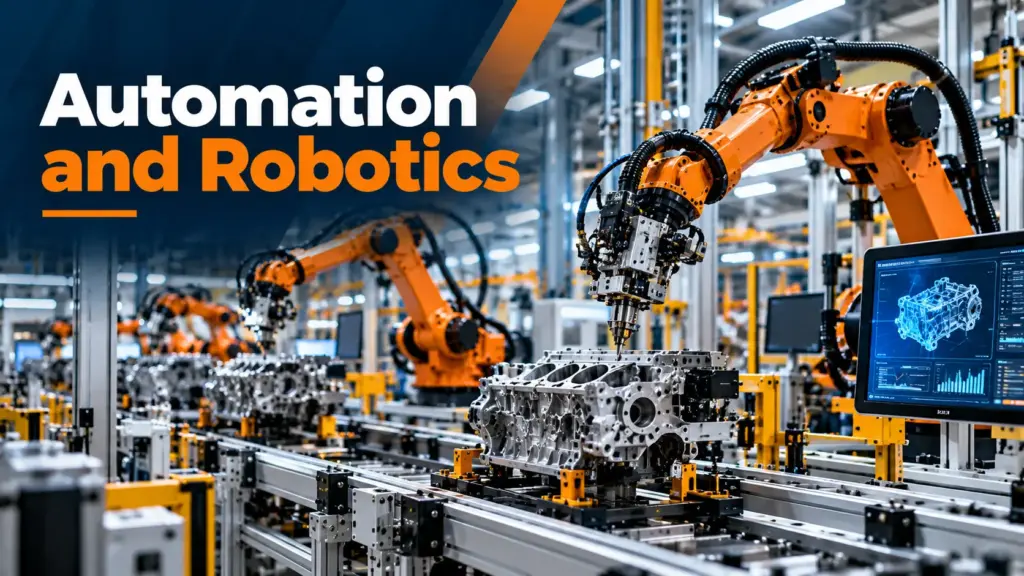
Automation is one of the main reasons modern plants can produce vehicles at high volume with consistent quality. The most common applications are in the body shop and paint shop, where work is repetitive, physically demanding or hazardous.
Industrial Robots on Automotive Assembly Lines
Robots weld, apply sealants and adhesives, spray paint, lift heavy panels and install windshields. Collaborative robots (cobots) increasingly work next to people on lighter tasks. Even so, many final assembly operations, such as routing wiring or fitting interior trim, still rely on human dexterity and judgment.
PLCs, Sensors and Automated Production Control
Programmable logic controllers (PLCs) coordinate machines, conveyors and robots, using sensors to detect position, torque, temperature and presence of parts. Production data is collected in manufacturing execution systems (MES), so supervisors can see output, downtime and quality in near real time.
Benefits and Limitations of Manufacturing Automation
| Factor | Benefits | Limitations |
|---|---|---|
| Repeatability | Identical welds, coating thickness and torque on every vehicle | Poor setup is repeated just as consistently |
| Throughput | Continuous operation at a steady cycle time | Line speed is limited by the slowest station |
| Worker safety | Robots handle heavy, hot and hazardous tasks | Robot cells introduce new safety risks that need guarding and training |
| Capital cost | Lower labor cost per vehicle at high volumes | High upfront investment in robots, tooling and software |
| Maintenance | Predictive maintenance can reduce unplanned stops | Skilled technicians are needed, and downtime is expensive |
| Production flexibility | Programmable cells can be reconfigured for new models | Heavily automated lines can be harder and slower to change than manual ones |
Quality Control in Automotive Manufacturing
Quality control in automotive manufacturing is not a single inspection at the end. It is a system that checks materials before production, monitors processes while parts are made and verifies the finished vehicle.
Incoming Material and Component Inspection
Steel coils, castings, electronics and bought-in modules are checked against specification before use. Checks can include material certificates, hardness and thickness measurements, dimensional checks and sample inspection. Suppliers are audited and rated, and problems are traced back to the source.
In-Process Quality Monitoring
Sensors and cameras monitor welds, torque values, paint thickness and part dimensions during production. Statistical process control (SPC) tracks measurements over time so that drift can be corrected before parts fall out of tolerance. Toyota’s well-known jidoka principle follows the same logic: stop the line when a problem is detected so defects do not move downstream.
Final Vehicle Inspection and Testing
Finished vehicles go through visual inspection, functional tests, wheel alignment, brake checks, a water test and an electronic diagnostic scan. Defects found at this stage are recorded and repaired, and the data is fed back to the process that caused them.
Automotive Quality Management Standards
Two standards are central to the industry:
- ISO 9001 is the general quality management standard used across many industries.
- IATF 16949 is the automotive-specific quality management standard, built on top of ISO 9001. It adds requirements for defect prevention, reduction of variation and waste, and supply chain control. Many OEMs expect their suppliers to be certified to it.
Common methods used under these systems include APQP (advanced product quality planning), PPAP (production part approval process), FMEA (failure mode and effects analysis) and measurement system analysis. Together with SPC, they aim to prevent defects instead of simply finding them. Traceability is another requirement: serial numbers, batch codes and the vehicle identification number (VIN) allow a faulty part to be traced to the supplier, the date and the vehicles affected, which is essential for recalls.
Materials Used in Automotive Manufacturing
Material choice is a balance of strength, weight, durability, cost and manufacturability. A material that is excellent in the lab is useless if it cannot be formed, joined, painted and recycled at plant volumes.
Steel and High-Strength Steel
Steel remains the main body material because it is strong, affordable, easy to form and easy to weld. Manufacturers use many different grades in the same car. High-strength and advanced high-strength steels allow thinner, lighter sections around the passenger cell, while softer steels are used where easy forming or energy absorption is needed.
Aluminum Alloys
Aluminum is roughly one third the density of steel, so it is used for hoods, doors, engine components, wheels and increasingly entire body structures and EV battery enclosures. It costs more and needs different joining and repair methods, which is why many vehicles combine it with steel.
Plastics and Composite Materials
Plastics form bumpers, dashboards, trim, fuel tanks and many under-hood parts. They are light, easy to mold into complex shapes and cheap at volume. Fiber-reinforced composites, including carbon fiber, offer very high strength for their weight but are mostly used in premium and performance vehicles because of cost and slower production.
Rubber, Glass and Electronic Components
Rubber is used for tires, seals, hoses and vibration mounts. Automotive glass is laminated or tempered for safety. Electronics, from sensors and control units to wiring harnesses and semiconductors, make up an ever larger share of vehicle value.
| Material | Typical Uses | Main Advantage | Main Trade-Off |
|---|---|---|---|
| Steel / high-strength steel | Body structure, closures, chassis | Strength and low cost | Heavier than alternatives |
| Aluminum alloys | Hoods, doors, wheels, battery housings | Low weight | Higher cost, different joining |
| Plastics | Bumpers, interior, tanks | Design freedom, low cost | Lower stiffness and heat resistance |
| Composites | Premium body and structural parts | High strength-to-weight | Cost and cycle time |
| Rubber and glass | Tires, seals, windows | Sealing, grip, visibility | Specialized processing |
| Electronics | Control units, sensors, wiring | Enable safety and features | Supply chain sensitivity |
Traditional vs. Modern Automotive Manufacturing
Automotive manufacturing has evolved from Henry Ford’s moving assembly line, introduced at Highland Park in 1913, to today’s data-driven plants. The core idea of flowing work through a sequence of stations has not changed, but the tools have.
| Factor | Traditional Manufacturing | Modern Manufacturing |
|---|---|---|
| Assembly | More manual operations | Human and automated operations |
| Welding | Manual and mechanized | Extensive robotic welding |
| Quality checks | Manual inspection | Manual and automated inspection |
| Production control | Conventional systems | Digital production monitoring |
| Flexibility | Depends on equipment | Flexible systems where implemented |
It would be inaccurate to say every modern factory is fully automated. Body shops and paint shops are highly automated, but final assembly still depends heavily on skilled people, and the level of automation differs from plant to plant.
Common Challenges in Automotive Production
Supply Chain Disruptions and Material Availability
A vehicle contains thousands of parts from hundreds of suppliers. Lean and just-in-time systems keep inventory low, but they also mean a single missing component, such as a semiconductor, can stop a whole line. Plants respond with supplier diversification, buffer stock for critical items and better supply chain visibility.
Production Costs and Equipment Downtime
When a line runs at a fixed cycle time, every minute of unplanned downtime means vehicles not built. Rising energy and material costs add further pressure. Preventive and predictive maintenance, quick tool-change methods and spare-part strategies are standard countermeasures.
Maintaining Quality and Consistency
Small variations in material, tooling wear or temperature can affect fit and finish. Higher model variety also raises the risk of assembly errors, since workers may build several variants on the same line. Error-proofing (poka-yoke), standard work and process monitoring help keep quality stable.
Worker Safety and Environmental Compliance
Presses, robots, welding, paint chemicals and heavy lifting create real hazards, so guarding, lockout procedures, training and ergonomics are essential. For more on workplace hazards, see our industrial safety section. Paint shops also have to manage solvent emissions and wastewater, while plants as a whole face rising pressure to reduce energy use and waste.
Future Trends in Automotive Manufacturing
Electric Vehicle and Battery Manufacturing
EVs have fewer moving parts in the drivetrain, so there is less machining of engine and gearbox components, but new processes appear: electrode coating, cell assembly, module and pack integration, and high-voltage testing. Many manufacturers are adding dedicated battery plants and retooling existing lines for mixed combustion and electric production.
Smart Factories and Industry 4.0
Connected sensors, machine data, digital twins and analytics are being used to predict failures, optimize schedules and trace quality problems faster. Value comes from using data to make decisions, not from collecting it.
Sustainable Manufacturing and Waste Reduction
Manufacturers are working to reduce energy use, recycle scrap steel and aluminum, cut paint-shop emissions and use more recycled materials. Reusing offcuts from the stamping process is a simple example of waste reduction that is already common.
Frequently Asked Questions
1. What is the automotive manufacturing process?
It is the series of stages that turns raw materials and purchased components into a finished vehicle: design and engineering, material and parts sourcing, stamping, body welding, painting, powertrain and component production, final assembly, testing and distribution.
2. What are the main stages of car manufacturing?
The four core production processes are stamping, welding, painting and final assembly. Design and engineering come before them, and inspection, testing and logistics follow. Powertrain production runs in parallel and joins the vehicle during assembly.
3. How does an automotive assembly line work?
Vehicles move continuously along a conveyor, and each workstation performs a defined set of tasks, such as installing the dashboard, seats or wheels. Parts are delivered to each station in the correct sequence, and robots, tools and workers share the tasks. Sensors and torque controls confirm each step is done correctly.
4. What materials are used to manufacture cars?
Steel and high-strength steel are the main body materials. Aluminum, plastics, composites, rubber, glass and electronic components are also used, with the mix depending on cost, weight and performance targets.
5. What machines are used in automotive factories?
Common machines include stamping presses, welding robots, paint robots and ovens, CNC machining centers, conveyors and AGVs, torque tools, vision systems, and end-of-line test equipment.
6. How is quality controlled during vehicle production?
Quality is checked at three levels: incoming materials and parts, in-process monitoring with sensors and statistical process control, and final vehicle inspection and testing. Quality management systems such as ISO 9001 and IATF 16949 provide the framework, and traceability allows problems to be tracked back to their source.
7. What is the difference between automotive manufacturing and assembly?
Assembly is one stage of manufacturing: putting finished components together to form a vehicle. Manufacturing is broader. It includes designing the vehicle, producing parts (such as stamped panels and machined components), welding, painting, assembling, testing and delivering it.
8. How does electric vehicle manufacturing differ from gasoline car manufacturing?
The body shop, paint shop and much of final assembly are similar. The main difference is the powertrain: EVs replace engine and transmission production with motors, power electronics and battery packs. EVs also add high-voltage safety procedures, battery handling and different end-of-line testing.
Conclusion
The automotive manufacturing process only works because many disciplines operate as one system. Engineering defines the vehicle, material processing and stamping create the parts, welding and painting build and protect the body, powertrain and components provide the drive, final assembly brings everything together, and automation and quality testing keep the results consistent.
No single stage determines vehicle quality; the result is only as good as the weakest link. That is why manufacturers continue to invest in efficiency, reliability and continuous improvement, from better tooling and smarter automation to stricter supplier control, because small gains repeated across thousands of vehicles add up to safer, better and more affordable cars.
