

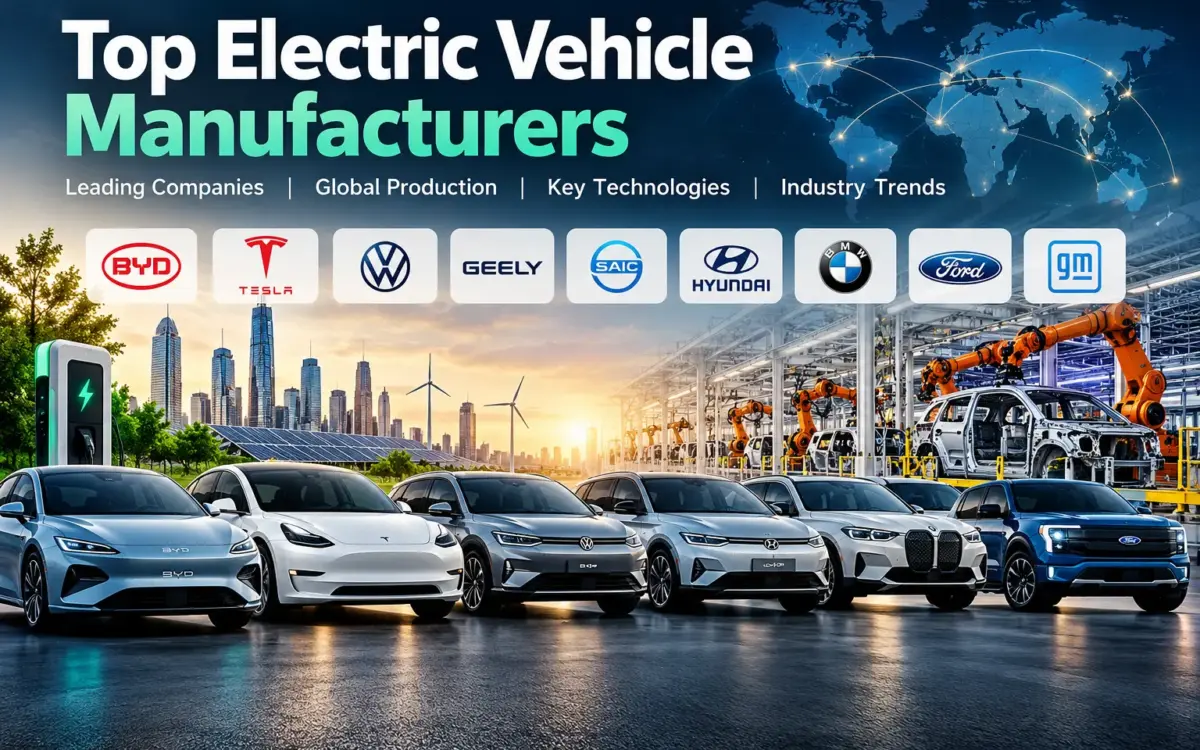
The world’s largest electric vehicle manufacturers are competing to lead a rapidly growing automotive industry. Companies such as BYD, Tesla, Volkswagen, and Geely are expanding electric vehicle production, investing in battery technology, and improving manufacturing efficiency.
However, identifying the biggest EV manufacturer depends on how the companies are compared. Some rankings include only battery electric vehicles (BEVs), while others also count plug-in hybrid electric vehicles (PHEVs). Sales figures, production volumes, and reporting years can also affect the rankings.
This guide explores the leading electric vehicle manufacturers, their global presence, production capabilities, manufacturing technologies, and the challenges shaping the future of electric vehicle production.
BYD is the world’s largest maker of battery-electric cars, with 2.26 million BEVs sold in 2025 against Tesla’s 1.64 million. Counting plug-in hybrids too, BYD sold about 4.6 million vehicles, and Geely Holding followed with 2.29 million new energy vehicles. Chinese automakers supplied 60% of global electric car sales in 2025, while European and North American brands each held about 15%, according to the IEA.
What Are Electric Vehicle Manufacturers? Four Business Models Worth Knowing
The label covers very different companies, and those differences shape everything from price to software quality.
- Dedicated EV makers: Tesla, Rivian, Lucid, NIO and XPeng build only electric models, so every plant, supplier contract and software team serves one powertrain.
- Vertically integrated giants: BYD makes its own battery cells, power semiconductors and motors, which gives it control over cost across the whole bill of materials.
- Legacy automakers in transition: Volkswagen, BMW, Hyundai, Ford and GM run electric lines beside combustion ones, often on shared or convertible platforms.
- Joint ventures: SAIC-GM-Wuling and the Volkswagen partnerships in China split design, sourcing and sales between a foreign brand and a local partner.
Responsibility does not stop at the factory gate. The manufacturer owns the battery warranty, over-the-air updates and recall handling, even when the cells come from a supplier such as CATL, LG Energy Solution or Panasonic.
I treat a maker’s supplier relationships as part of its profile for that reason. A brand with a weak cell supplier and a thin software team will show it within two or three years of ownership.
Top Electric Vehicle Manufacturers in the World
The IEA counts nearly 22 million electric cars manufactured worldwide in 2025, with China building close to three quarters of them. Global sales passed 20 million that year, and roughly one in four of all electric cars produced crossed a border before being sold.
This is a representative list of leaders, not an official league table. The first snapshot below uses battery-electric figures only.
| BEV rank, 2025 | Manufacturer | 2025 data point | What drove it |
|---|---|---|---|
| 1 | BYD | 2.26 million BEVs, up about 28% | Low-cost models and a jump in exports |
| 2 | Tesla | 1.64 million deliveries, down about 8% | Ageing lineup, US tax credit ended |
| 3 | SAIC-GM-Wuling | Third place per TrendForce | Very small, very cheap city EVs |
| 4 | Geely | BEV share rose from 3% to 6% | The Xingyuan, priced under 100,000 yuan |
| 8 | Xiaomi | BEV share rose from 1% to 3% | A single hit model line |
Rankings above come from BYD and Tesla reporting plus TrendForce’s 2025 BEV analysis. Volkswagen also grew its sales, but a weak China performance pushed it down the table.
1. BYD, China
BYD sells everything from the Seagull city car to the Seal sedan and the Han. Its Blade battery, an LFP design, is produced in-house, and the company employs around 120,000 engineers.
Its R&D spending reached 43.75 billion yuan in just the first three quarters of 2025. Exports passed one million vehicles for the first time that year, and the UK became its biggest market outside China.
2. Tesla, United States
Tesla builds the Model 3 and Model Y at factories in Fremont, Austin, Shanghai and Berlin. The Model Y is still among the best-selling electric models on earth.
The company posted 418,227 deliveries in Q4 2025, missing analyst consensus of around 449,000. Its second straight annual decline came as the US federal tax credit ended and European buyers looked elsewhere.
3. Geely, China
Geely is easy to underestimate because its volume is spread across many badges. Geely Holding sold 4.12 million vehicles in 2025, and 56% were new energy vehicles.
Galaxy delivered 1.24 million units, Lynk & Co topped 350,000 and Zeekr reached about 224,000. Volvo and Polestar sit in the same group, which gives Geely premium and mass-market reach under one roof.
4. Volkswagen Group, Germany
Volkswagen delivered 465,500 battery-electric vehicles in the first half of 2025, up about 47% on the year. Europe carried that growth.
China is the soft spot. VW answered with a China-specific sub-brand, ID.UNYX, and joint models developed with XPeng that were scheduled to reach showrooms in early 2026.
5. SAIC Motor, China
SAIC wholesaled 2.05 million vehicles in the first half of 2025, and its own brands made up 64% of that total. The company is steadily reducing its reliance on joint ventures with GM and Volkswagen.
The SAIC-GM-Wuling venture is the quiet powerhouse here. Its tiny, inexpensive EVs rank among the highest-volume battery cars in the world.
6. Hyundai Motor Group, South Korea
Hyundai builds the Ioniq line, the Kona Electric and Kia’s EV range. Its Ulsan complex, one of the largest integrated auto plants on the planet, added a dedicated EV facility targeting 200,000 units a year from 2026.
In the US, Hyundai is localising production to soften the impact of tariffs. Growth in the United States and Europe pushed it into the global BEV top ten in early 2025.
7. BMW Group, Germany
BMW placed seventh in global BEV sales in the first quarter of 2025. Its China sales lagged, which makes European demand critical to its electric plans.
The next-generation Neue Klasse platform is the company’s bet on lower costs and faster charging.
8. Ford Motor Company, United States
Ford’s Mustang Mach-E remains its most recognisable electric product. After the federal tax credit ended in 2025, Ford, like GM, trimmed some of its larger EV ambitions and leaned harder on hybrids.
That makes it a company to watch for affordable, smaller electric models rather than big trucks.
9. General Motors, United States
GM is the second-largest EV seller in the United States, behind Tesla. Its Ultium battery platform underpins most of its electric range, and its Chinese joint ventures supply small, low-cost models.
The US market is the test. Without the federal credit, GM must win on price and charging convenience alone.
10. NIO and XPeng, China
NIO runs three brands: NIO, Onvo and Firefly. It delivered 24,925 cars in June 2025, with battery swapping as its signature feature.
XPeng delivered 34,611 cars that same month, and nearly half its Q1 2025 volume came from the affordable Mona M03. Its software partnership with Volkswagen shows how a Chinese start-up can now supply a century-old automaker.
Electric Vehicle Manufacturers by Country
Electric Vehicle Manufacturers in the USA
The US market lost its federal EV subsidy, and TrendForce expects none in 2026. That reshuffles who succeeds.
- Tesla: Still the volume leader, with production in California, Texas and Nevada.
- General Motors: Number two by sales, balancing EVs with hybrid and combustion models.
- Ford: Reworking its electric strategy around cost.
- Rivian: Builds trucks and SUVs in Illinois and is adding a cheaper line.
- Lucid Motors: Targets the luxury sedan segment from its Arizona plant.
Leading EV Manufacturers in China
About 13 million electric cars were sold in China in 2025, close to 55% of all new cars there. The IEA found that 70% of the battery-electric cars sold were already cheaper than the average conventional car.
- BYD: Largest by volume across BEV and PHEV.
- Geely: Fastest-rising of the big groups.
- SAIC: Strong through its own brands and Wuling.
- NIO: Premium positioning with battery swapping.
- XPeng: Technology-led, with growing export ambitions.
Chinese EV exports doubled to more than 2.5 million units in 2025. Outside China, Europe and the United States, 55% of the electric cars sold were imported from China, up from under 5% five years earlier.
Major Electric Vehicle Manufacturers in Europe
BEV registrations across 16 major European markets reached 202,833 in August 2026, a 54.2% increase on the year and 30.5% of new-car registrations.
- Volkswagen Group: Europe’s largest volume producer of electric cars.
- BMW Group: Focused on its Neue Klasse generation.
- Mercedes-Benz: Positioned at the premium end.
- Renault Group: Strong in compact and affordable models.
- Stellantis: Spreads electrification across many brands.
Electric Vehicle Manufacturers in South Korea and Japan
- Hyundai and Kia: Fast chargers and a flexible platform give them a technical edge in both Europe and the US.
- Nissan: An early EV pioneer now rebuilding its lineup.
- Toyota: The world’s largest automaker by total sales volume, yet cautious on pure battery-electric models and heavily invested in hybrids.
How Electric Vehicles Are Manufactured
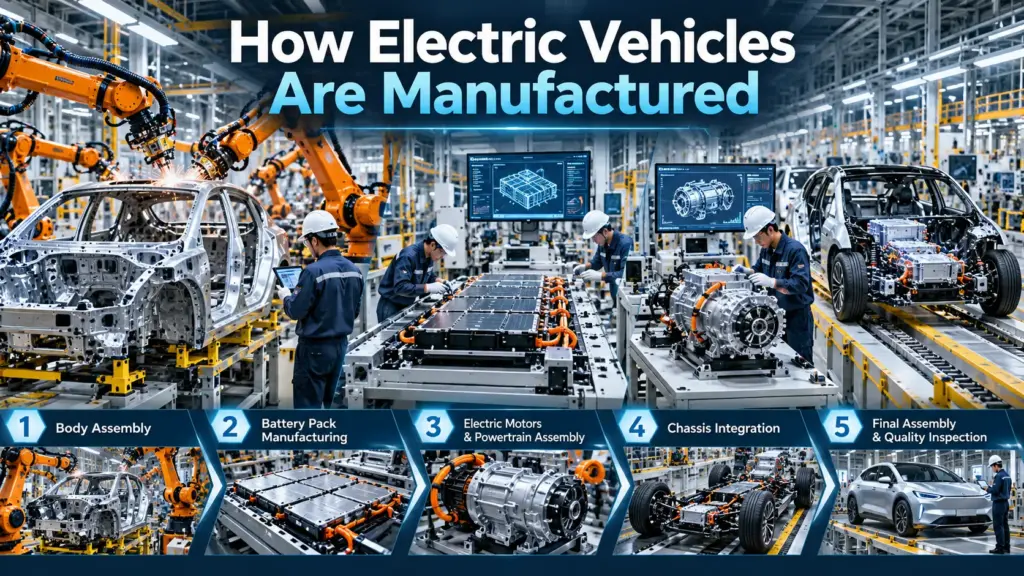
The sequence differs from a combustion plant in one major way: the battery pack is the most expensive part of the car and sets the pace of the whole line.
While EV production shares several stages with the traditional automotive manufacturing process, battery integration and electric powertrain assembly introduce different manufacturing requirements.
Electric Vehicle Design and Engineering
Most modern EVs start from a flat ‘skateboard’ platform that holds the battery in the floor. This frees up cabin space and lowers the centre of gravity.
Engineers fix the wheelbase, battery capacity and voltage architecture early, because changing them later means retooling.
Battery Pack Manufacturing and Integration
Cells go through formation and ageing, a charge-and-rest process that can take days. Only then are they grouped into modules or built straight into a pack.
Cell-to-pack designs remove the module stage entirely. That raises energy density and cuts parts count, but a single damaged cell becomes harder to repair.
Electric Motor and Powertrain Production
Most electric motors use permanent magnets or induction windings. Hairpin stator windings, which pack more copper into the same space, have become common in higher-efficiency units.
The inverter converts battery DC into the AC the motor needs. Silicon carbide chips are replacing silicon in many 800-volt systems.
Vehicle Body and Chassis Manufacturing
Large single-piece aluminium castings, often called giga castings, replace dozens of stamped parts. Fewer welds mean faster cycle times.
The trade-off shows up in collision repair, where a cracked casting can cost far more to fix than a bent panel.
1. Final Assembly and Quality Testing
The pack is raised into the body from below, in a step known as marriage. High-voltage insulation checks, thermal tests and end-of-line software flashing follow.
These inspections are part of broader automotive quality control procedures that help manufacturers identify defects and ensure consistent vehicle safety and performance.
I pay close attention to how a company handles software calibration at this stage, since many early quality complaints in new EVs turn out to be software, not hardware.
Key Technologies Used by Electric Vehicle Manufacturers
Lithium-Ion and LFP Battery Technology
Two chemistries dominate. LFP uses no nickel or cobalt, costs less and survives more charge cycles, while NMC packs more energy into the same weight.
BYD’s Blade battery is the best-known LFP design. Several makers now put LFP into standard-range models and keep NMC for long-range or performance trims.
Electric Motors and Power Electronics
Efficiency is decided as much by the inverter and thermal system as by the motor. A well-tuned heat pump and coolant loop can add noticeable range in cold weather.
When I compare spec sheets, I look at peak charging power and the time to go from 10% to 80%, not just the headline range.
Robotics and Automation in EV Manufacturing
Camera-based inspection checks weld seams and adhesive beads on the body. Autonomous carts move packs between stations without fixed conveyors.
The human work that remains clusters around wiring harnesses and high-voltage connectors, where fit is still hard to automate.
Battery Management Systems (BMS)
The BMS estimates state of charge, balances cell voltages and limits power when temperatures drift. A poor estimate can make a car show 15% remaining and then lose power early.
Software quality here varies far more than cell quality between brands.
Software Integration and Vehicle Connectivity
The IEA’s 2026 outlook added a section on automotive software and AI, a sign of how much value is moving into code. Over-the-air updates now change charging curves, range estimates and driver-assist features after delivery.
A car that improves after purchase is a different ownership proposition from one that is frozen the day it leaves the plant.
Electric Vehicle Manufacturers vs Traditional Automakers
The table below summarises the practical differences I see when evaluating both groups.
| Factor | EV-focused manufacturers | Traditional automakers |
|---|---|---|
| Vehicle portfolio | Primarily electric models | Combustion, hybrid and electric |
| Production | EV-specific platforms and plants | Mixed or dedicated lines |
| Cost control | Concentrated on battery and software | Spread across several powertrains |
| Risk | Heavy exposure to one technology | Exposure to policy swings in both directions |
The gap is narrowing. Chinese makers such as BYD and Geely sell both BEVs and plug-in hybrids at scale, so the old split between pure EV firms and legacy brands no longer describes them well.
How to Compare Electric Vehicle Manufacturers
Global EV Sales and Production Capacity
Check whether a figure is BEV-only or includes plug-in hybrids, and whether it counts deliveries, wholesale or retail registrations. SAIC’s retail numbers, for example, ran higher than its wholesale numbers in the first half of 2025.
If two sources disagree, that is usually the reason.
Battery Range and Charging Technology
Range depends on the test cycle. CLTC figures from China tend to be the most optimistic, WLTP is more moderate and the US EPA rating is typically the most conservative.
In North America, check for NACS port support, since several US automakers have moved to Tesla’s connector.
Vehicle Pricing and Affordability
The Geely Xingyuan starts at roughly 62,000 yuan in China, which is about 7,700 euros. That price point redefines what an entry-level EV means.
Look at total cost, including import tariffs, insurance and battery replacement quotes, rather than the sticker alone.
Manufacturing Quality and Safety Standards
Crash ratings from Euro NCAP or IIHS give a direct safety comparison. Recall history and the frequency of software updates tell you how a brand responds when something goes wrong.
Charging Network and After-Sales Support
A brand’s own network matters less than access to third-party fast chargers. Ask about parts availability and the nearest service centre before you commit, particularly with newer import brands.
Challenges Facing Electric Vehicle Manufacturers
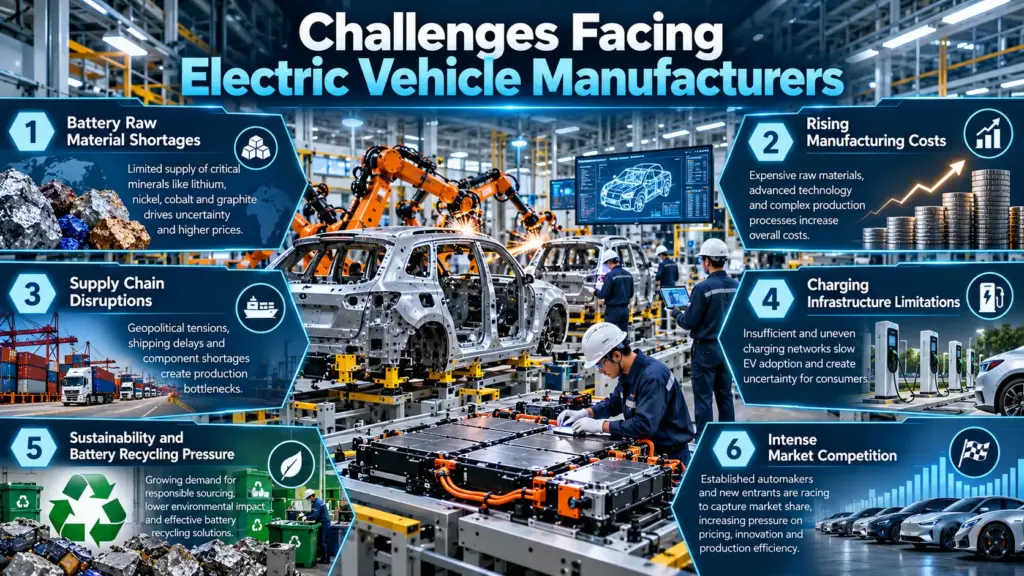
Battery Raw Material Supply and Costs
China produces more than 80% of the world’s battery cells and an even larger share of processed battery materials. Almost all cells used elsewhere come from China, South Korea or Japan.
That concentration is a supply-chain risk for every Western automaker.
Manufacturing Costs and Competitive Pricing
Price wars in China have squeezed margins. Leapmotor’s founder has argued publicly that automakers cannot keep selling at a loss and that the price war must return to rationality.
China is also shifting subsidies from fixed amounts to a percentage of price, which could disadvantage the cheapest models.
Charging Infrastructure Limitations
Home charging solves most daily needs, but apartment dwellers and long-distance drivers still depend on public fast chargers. Uneven reliability across networks remains a common complaint.
Supply Chain and Production Challenges
EV software and driver-assist systems demand large volumes of high-bandwidth memory. Memory is only 1% to 5% of vehicle material cost, yet shortages can still stall a production line.
Trade policy adds more friction. The USMCA renegotiation threatens cross-border logistics in North America, and Europe has opened anti-subsidy scrutiny of Chinese imports.
Battery Recycling and Environmental Sustainability
Recovered lithium, nickel and cobalt can shorten dependence on mining. Lithium-ion manufacturing capacity grew in both the EU and the US in 2025, though recycling volumes remain small compared with new demand.
Future of Electric Vehicle Manufacturing
The IEA expects global electric car sales to reach 23 million in 2026, about 28% of all new cars. First-quarter sales dipped 8% after policy changes in China and the US, yet nearly 90 countries posted year-on-year growth in March alone.
- Battery cost: Falling prices and the high oil prices tied to the current energy crisis are strengthening the case for EVs.
- Southeast Asia: Electric car sales more than doubled in 2025 to nearly 20% of the market.
- Electric trucks: They made up nearly one in ten trucks sold worldwide in 2025.
- Localised production: Expect more plants in Europe, the US and emerging markets as tariffs push companies to build near customers.
- Software and AI: Value is shifting toward driver assistance, energy management and update strategy.
If I had to pick one trend to track, it would be the contest between low-cost Chinese platforms and the Western push to localise production. Most other developments flow from that.
Frequently Asked Questions About Electric Vehicle Manufacturers
Which electric vehicle manufacturers produce their own batteries?
BYD makes its own cells in-house. Tesla produces some cells itself but also buys from Panasonic, LG and CATL, and most other makers rely on suppliers such as CATL, LG Energy Solution, SK On and Samsung SDI.
Which companies manufacture electric vehicles in the USA?
Tesla builds in California and Texas, Rivian in Illinois and Lucid in Arizona. GM, Ford, Hyundai in Georgia and several German brands also assemble electric models on US soil.
Who are the top Chinese EV manufacturers besides BYD?
Geely, SAIC-GM-Wuling, Chery, Leapmotor, Xiaomi, XPeng and NIO all sell at scale. Xiaomi doubled its BEV market share in 2025 with a single model line.
Does a bigger EV maker always mean a safer or better buy?
No. Size tells you about production scale, not crash performance or software support. Check independent crash scores, recall history and local service coverage.
Why are Chinese EVs cheaper than Western ones?
Vertical integration, enormous domestic volume and cheaper battery supply all lower costs. In 2025, 70% of battery-electric cars sold in China were already cheaper than the average conventional car.
Are Chinese EV brands sold in Europe?
Yes, and their share is rising. BYD’s UK sales grew roughly ninefold in 2025, even as the EU investigated Chinese imports and applied extra duties.
Is Toyota considered an electric vehicle manufacturer?
Toyota is the largest automaker by total sales, but its strategy leans on hybrids. It sells far fewer battery-electric cars than BYD, Tesla or Geely.
Final Thoughts
The leading electric vehicle manufacturers are no longer one group. BYD and Geely compete on scale and cost, Tesla on software and brand, and legacy companies such as Volkswagen and Hyundai on global reach.
When you read the next ranking, check the year, the powertrain definition and the metric before you trust the order. That one habit explains most of the confusion around this topic.
You May Also Like It:
Precision Machining Services: The Complete Expert Guide to CNC Manufacturing

1 Comment